






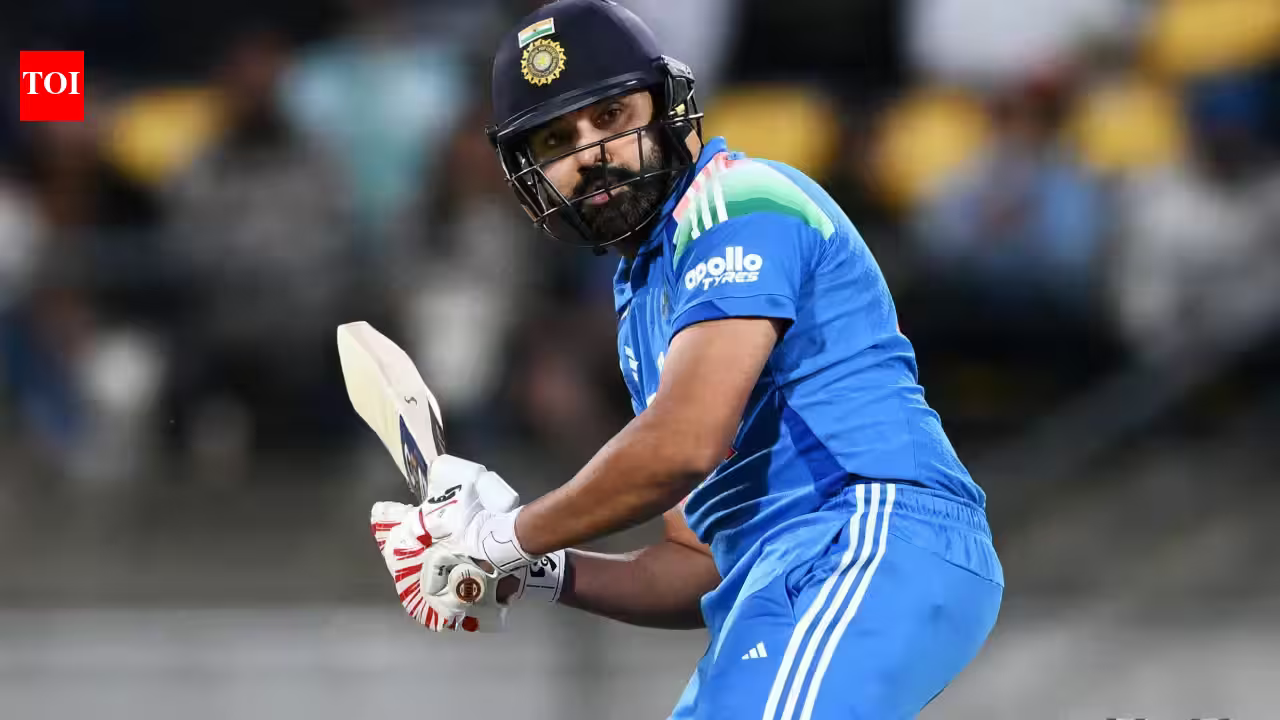
WELLINGTON — In a masterclass of controlled aggression and historical significance, Indian captain Rohit Sharma has once again etched his name into the annals of cricket lore. During a rain-shortened second ODI at the Hnry Stadium in Wellington, the prolific opener surpassed one of the most storied power-hitting records in the 50-over format, officially becoming the batter with the most sixes against New Zealand in ODI history.
Entering the contest needing just two maximums to eclipse the long-standing record held by Pakistan legend Shahid Afridi, Rohit approached his innings with his signature calm, clinical intent. While the conditions in Wellington were treacherous and the atmosphere tense, the “Hitman” delivered when it mattered most, launching two towering sixes off New Zealand pacer Kyle Jamieson in the seventh and ninth overs.
That second strike not only signaled his return to form following a frustrating six-ball duck in the series opener in Auckland but also vaulted him past Afridi’s tally of 50 sixes—a record that had stood firm since the Pakistani all-rounder’s retirement in 2015.
A Legacy of Power
Rohit’s feat is a testament to both his longevity and his unrivaled ability to clear the ropes against high-quality international bowling. Reaching the milestone in just his 34th innings against the Black Caps, Rohit now sits atop a prestigious list of global icons.
Shahid Afridi had set the previous standard by striking 50 sixes across 35 innings in 38 matches between 1996 and 2015. With the record now firmly in his possession, Rohit’s tally of 51 sixes against New Zealand highlights his dominance in a rivalry that has seen some of the world’s most fearsome fast bowlers.
Rounding out the top tier of this power-hitting hierarchy are West Indies icon Chris Gayle, who recorded 45 maximums, and Sri Lankan legend Sanath Jayasuriya with 41. India’s own Virat Kohli and England’s white-ball specialist Jos Buttler follow with 29 sixes each. For Rohit, who has thrived in the 50-over format throughout his career, this record serves as another feather in a cap already overflowing with accolades.
A Chaotic Win in the Capital
While the individual milestone was a cause for celebration, the match itself proved to be a nail-biting affair dictated as much by the elements as by the action on the pitch. Chasing a modest target of 135 in a match reduced to 47 overs per side, India found themselves in a precarious position.
New Zealand’s bowlers, led by a clinical Kyle Jamieson and Jacob Duffy, exploited the movement on offer, sharing six wickets between them. Both bowlers finished with identical figures of 3/35, tearing through the Indian top order. The early dismissal of Shubman Gill for a golden duck and the pressure exerted on Virat Kohli—who departed for just seven—left India teetering at 47/4.
Shreyas Iyer offered a vital anchor with his 30 off 46 balls, while Rohit’s own 23-run cameo proved foundational in keeping the scoreboard ticking. However, as wickets continued to tumble, including the quick losses of Naman Dhir and Anshul Kamboj, the pressure mounted on the middle and lower order. KL Rahul stood firm, remaining unbeaten on 26 as the rain clouds finally broke over Wellington.
DLS Math and Series Supremacy
At 113/7 after 26 overs, the match was finely balanced. New Zealand were sensing a historic comeback, believing that one or two more wickets would expose the Indian tail and hand them a series-leveling victory. However, nature had other plans.
As the heavens opened, the officials were forced to call a halt to play. At the time of the stoppage, India were four runs ahead of the required score under the Duckworth-Lewis-Stern (DLS) method. With no possibility of a restart, the umpires officially abandoned the match, awarding India a tense four-run victory.
The win gives India an unassailable 2-0 lead in the five-match series, building on their earlier five-wicket victory in Auckland. For the Indian side, it is a triumph of grit and adaptability; for Rohit Sharma, it is the continuation of a legacy. As he walked off the field under the heavy Wellington rain, he did so not just as a victorious captain, but as the undisputed king of sixes against the Black Caps—a record that underscores his status as one of the most destructive and consistent white-ball batters to ever play the game.
Disclaimer: This content is auto-generated for informational purposes only.
Source: Read Original News