









[
Teen Innovator Uses AI and Game Theory to Chart a Path for Arctic Ice Preservation
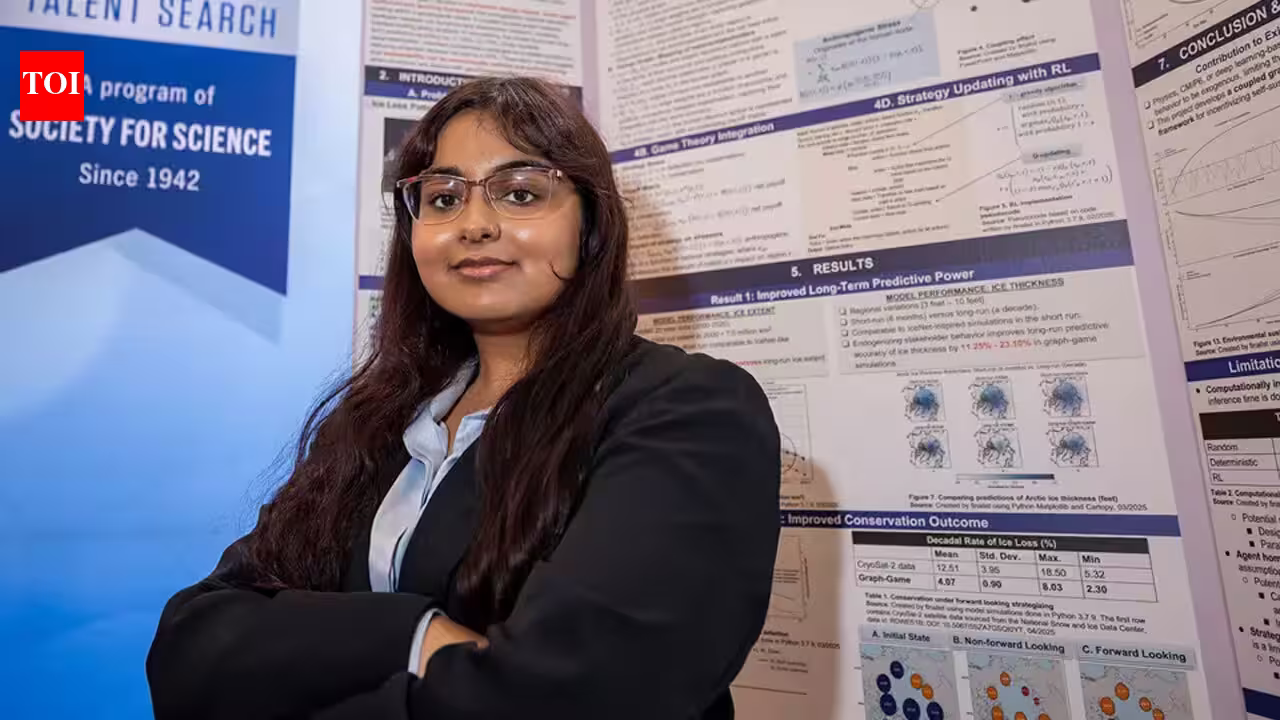
Fremont, California – As the Arctic faces an accelerating rate of ice loss, impacting global climate, a 17-year-old student from Fremont, California, has developed a groundbreaking mathematical framework that could revolutionize how nations approach conservation. Ryka Chopra, a student at Mission San Jose High School, has leveraged artificial intelligence, game theory, and mathematical modeling to explore how countries can cooperatively mitigate Arctic ice melt, earning her a coveted spot among the 40 finalists of the 2026 Regeneron Science Talent Search.
Chopra’s project, titled “A Dynamic Graph-Game-RL Framework for Incentive-Compatible Conservation in the Arctic Global Commons,” tackles a critical environmental challenge by directly integrating human decision-making into climate models – an angle often overlooked in traditional scientific approaches.
A Mathematical Lens on Arctic Melt
The Arctic, a crucial environmental indicator and global climate regulator, is experiencing rapid changes. CryoSat-2 satellite data cited in Chopra’s research reveal a concerning 12.5% decline in Arctic ice thickness per decade. While many models predict the rate of ice melt, Chopra’s work delves deeper, asking: What happens when the strategic decisions of nations are considered an intrinsic part of the environmental system they influence?
Her innovative two-graph framework establishes a powerful connection: one graph models the actions and interactions of countries and regions, while the other maps environmental impacts. This unique linkage allows her model to analyze how the decisions of one nation reverberate across both the international community and the fragile Arctic ecosystem.
Game Theory: Unlocking Cooperative Climate Action
The global stage is often characterized by competing national interests. Investing in environmental conservation, while globally beneficial, can entail immediate economic costs for individual countries. This presents a classic game theory dilemma: how can diverse players with conflicting priorities be incentivized towards collective action?
Chopra employed game theory to simulate potential conservation decisions among nations and regions connected to the Arctic. Rather than assuming altruistic choices, her model accounts for strategic self-interest. To further enhance its realism, she integrated reinforcement learning (RL). This AI technique allows "agents" (countries in this context) to learn through trial and error, adjusting their conservation strategies over time to seek favorable economic outcomes. The result is a dynamic model that can forecast how strategies might evolve over numerous periods, offering a more nuanced understanding of long-term cooperation.
Simulations Reveal Path to Cooperation
Chopra’s simulations, involving 25 Arctic-related nations and regions across multiple time periods, yielded promising results. The model indicated that cooperation to reduce Arctic ice loss is achievable, particularly when appropriate incentives are in place. This finding is crucial, as simply requesting environmental sacrifices from nations, each with its own economic priorities and resources, often falls short of fostering sustained collaboration.
By embedding these competing incentives into her mathematical framework, Chopra’s research aims to identify the specific conditions under which environmental cooperation aligns with the economic self-interest of participating countries. Her work shifts the focus from merely predicting ice loss to exploring how human behavior can be integrated into climate models to devise effective strategies for international cooperation.
Interdisciplinary Synergy: Math, Economics, and AI
Chopra’s project exemplifies the power of interdisciplinary research. Graph theory visualizes relationships, game theory models strategic decisions, and reinforcement learning enables adaptive strategies. Together, these tools create a comprehensive framework for tackling complex real-world problems where environmental and economic decisions are inextricably linked.
While not a definitive policy blueprint, her research offers a robust mathematical framework that can help researchers analyze various incentive structures and predict how nations might respond. This approach is particularly pertinent for global environmental challenges, where collective action is paramount.
A National Recognition for a Young Scientist
Ryka Chopra’s innovative work has positioned her as one of the 40 finalists in the 2026 Regeneron Science Talent Search, a prestigious Society for Science program recognizing outstanding high school research. Selected from over 2,600 entrants across 46 states and 16 countries, these finalists represent the vanguard of young scientific talent. They will compete for a total of $1.8 million in awards, underscoring the significance of their contributions to diverse fields.
Chopra’s project stands out for its unique synthesis of mathematical modeling and artificial intelligence to address a problem with profound global implications.
Beyond the Climate Model: A Multifaceted Talent
Ryka’s intellectual curiosity extends far beyond climate science and mathematics. She presides over her school’s history club, is a talented pianist and composer in the Pre-College division of the San Francisco Conservatory of Music, and serves as the conservatory’s student council secretary, organizing concerts. Her involvement also includes being part of her school’s yearbook editorial team and working as a photographer, capturing student life. This breadth of interests, spanning history, music, and rigorous scientific inquiry, highlights a truly exceptional individual.
Incentives: The Key to Arctic Conservation?
The Arctic’s future hinges on both natural processes and human decisions. Ryka Chopra’s research provides a compelling framework for understanding their interaction. Her model suggests that successful conservation doesn’t necessarily demand economic sacrifice; rather, thoughtfully designed incentives can encourage strategies that benefit both the environment and national economies.
While still a computational model, this 17-year-old’s integration of game theory, reinforcement learning, and environmental modeling offers a fresh and sophisticated lens through which to examine one of the world’s most complex climate challenges. From her high school in California, Ryka Chopra is asking a question with profound global resonance: can strategic incentives inspire nations to collaborate and safeguard the Arctic before more of its vital ice disappears?
Disclaimer: This article has been prepared using information and project details shared by Society for Science as part of the 2026 Regeneron Science Talent Search. The scientific findings and observations mentioned are based on the student’s research and information provided by Society for Science and have not been independently verified by The Times of India.