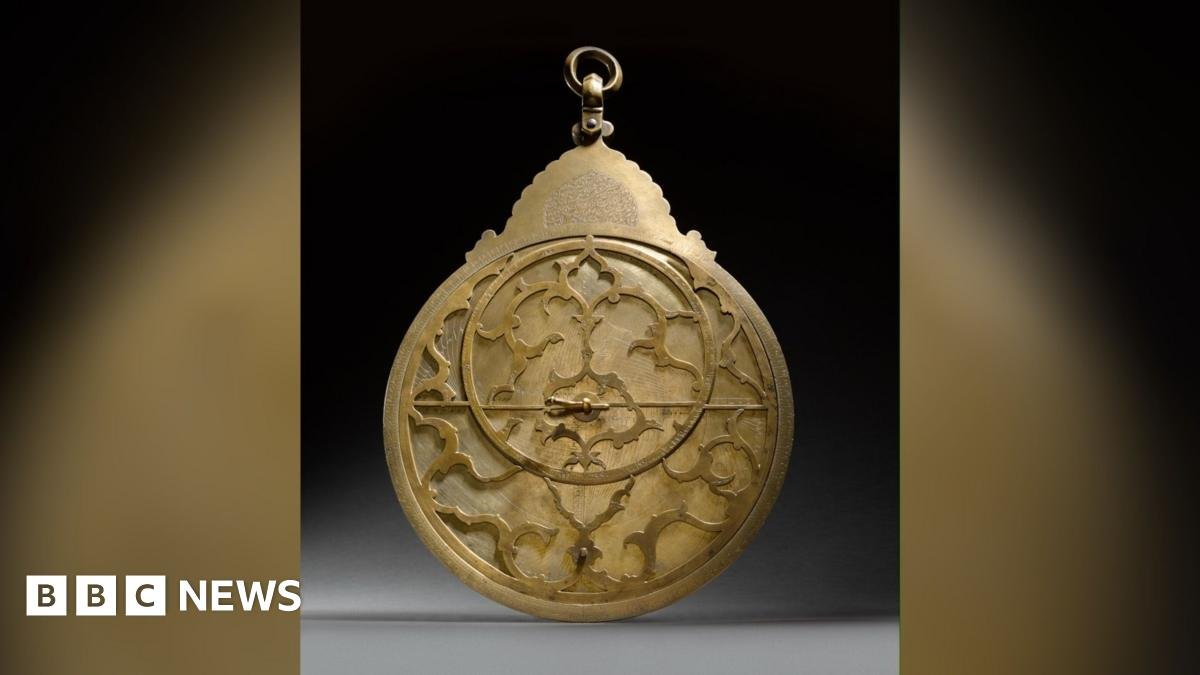
A spectacular brass astrolabe – or a hand-held astronomical computer – from the 17th Century, once part of the royal collection of Jaipur city in western India, will go under the hammer at Sotheby’s in London on 29 April.
The object is “perhaps the largest in existence” and has never been exhibited before, Benedict Carter, head of the department of Islamic and Indian Art at Sotheby’s, told the BBC.
Known to be part of the royal collection of Maharaja Sawai Man Singh II of Jaipur, it was passed on to his wife Maharani Gayatri Devi, one of the most glamorous women of her time, after his death. It then moved to a private collection during her lifetime.
Astrolabes are metallic disks with multi-layered, interlocking components that were historically used to tell the time, map the stars, the direction of Mecca and the motion of the sky.
“They are essentially a two-dimensional projection of a three-dimensional universe. I compare them to modern-day smartphones because you can do so many things with them,” says Dr Federica Gigante of the Oxford Centre for History of Science, Medicine and Technology.
“You can calculate the time of sunset, sunrise, the height of a building, the depth of a well, distance and even use them to predict the future. Along with an almanac they were once used to cast horoscopes.”