








Energy Independence Drives Renewables Surge Across Emerging Asia
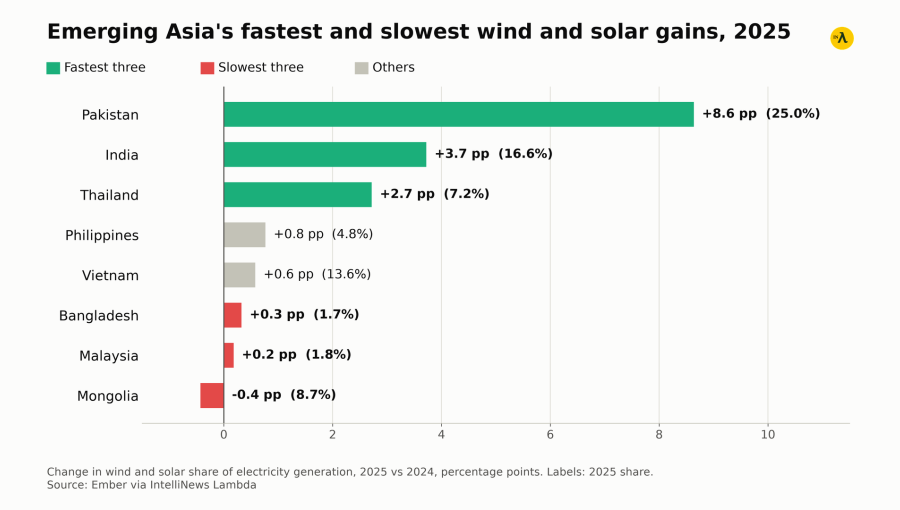
Emerging economies across Asia are accelerating the integration of wind and solar power at an unprecedented pace, driven not just by climate goals, but by a strategic push for energy security. As instability in the Strait of Hormuz makes reliance on imported fossil fuels increasingly precarious, nations like India and Pakistan are prioritizing self-generated, renewable energy to stabilize their power grids.
According to the International Energy Agency’s (IEA) Renewables 2026 report, developing economies outside of China are set to match the renewable capacity additions of advanced economies between 2026 and 2031. The Asia-Pacific region, excluding China, is expected to add more than 840 gigawatts (GW) of capacity—a two-fold increase compared to the 2020–2025 period. India stands at the forefront of this movement, contributing nearly half of this regional expansion, with solar power accounting for approximately 80% of the growth.
Shifting Energy Dynamics
The global center of gravity for green energy is visibly shifting. While China has long dominated the sector, its share of new global capacity is projected to decline from 61% in 2025 to roughly 53% over the coming years as it transitions to an auction-based model. Meanwhile, its neighbors are viewing renewables as a buffer against volatile energy markets. The volatility surrounding the Strait of Hormuz—a critical maritime chokepoint—has transformed imported fuel from a routine commodity into a high-risk liability. Consequently, many planned natural gas projects across Southeast Asia and Bangladesh have stalled, paving the way for investment to flow directly into solar and wind infrastructure.
India’s Ambitious 900 GW Roadmap
India has set its sights on a formidable target of 900 GW of non-fossil fuel capacity by 2035. This goal, reinforced by Prime Minister Narendra Modi, is supported by the third phase of the “Green Energy Corridor,” an infrastructure project valued at ₹1.86 trillion. This initiative aims to bolster grid connectivity and add significant battery storage capacity, nearly doubling the government’s previous 500 GW target for 2030.
However, grid infrastructure remains the primary hurdle for India’s transition. Recent data shows that significant portions of solar output are being curtailed due to inadequate transmission capacity. To mitigate this, authorities have approved high-voltage corridors designed to transport renewable energy from the surplus-producing western regions to the energy-hungry east. Experts emphasize that the success of these ambitious targets rests entirely on the government’s ability to modernize the grid at a speed matching generation capacity.
The Role of Carbon Finance
The surge in renewable infrastructure is now being reinforced by a nascent carbon market. Regional cooperation is growing, exemplified by recent carbon credit agreements between Singapore and various emerging economies, including Bangladesh. These pacts allow companies subject to carbon taxes to offset emissions by investing in high-integrity, sustainable projects abroad.
Furthermore, the ASEAN Common Carbon Framework, backed by industry leaders across Southeast Asia, is working to standardize carbon markets to encourage cross-border investment. As these regulatory frameworks mature, they are expected to unlock the capital necessary to overcome existing bottlenecks in transmission and storage. For the region, the combination of energy security and evolving carbon finance mechanisms marks a decisive pivot toward a cleaner, more independent energy future.
Disclaimer: This content is auto-generated for informational purposes only.
Source: Read Original News