






Remember Jonathan Banks’ famous Breaking Bad monologue that concluded with his character Mike Ehrmantraut turning the phrase, “No more half measures, Walter”? That was the handiwork of writer-producer Sam Catlin.
The two-time Emmy winner penned 10 episodes of Vince Gilligan’s landmark crime series before staying with Sony/AMC to shepherd four seasons of the genre-bending Preacher. A few years later, Catlin would be recruited by the now former Sony executives he’d worked with during his Breaking Bad tenure to help stick the landing of Apple TV’s Sugar season one. That same year, Apple TV’s co-heads of programming, Jamie Erlicht and Zack Van Amburg, reunited with even more talent from the Bad universe they helped launch including: Gilligan (Pluribus), Rhea Seehorn (Pluribus), director/EP Michelle MacLaren (Constellation) and Banks (Constellation).
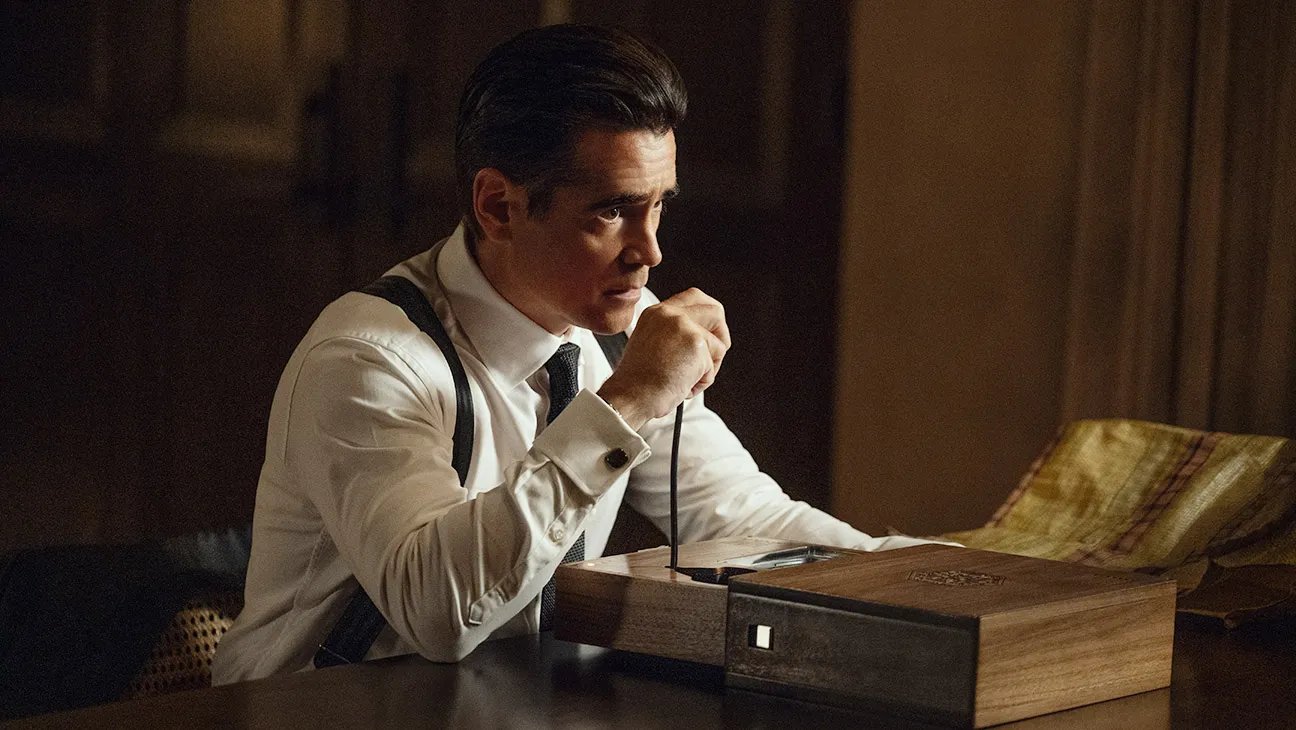
In season one of the Colin Farrell-led neo-noir series, Los Angeles PI/undercover alien, John Sugar, helps a legendary film producer (James Cromwell’s Jonathan Siegel) find his missing granddaughter. With Breaking Bad and Better Call Saul casting directors Sharon Bialy and Sherry Thomas in charge of Sugar’s casting, Emmy winner Anna Gunn marked yet another familiar face, as did Catlin’s wife, Julie Dretzin, who previously played the divorce attorney for Gunn’s embattled Bad character, Skyler White.
In season two, Sugar steps up to track down a Korean boxer’s missing older brother, all while unearthing a larger city-wide conspiracy in the process. With Catlin officially taking over as showrunner on this go-round, he doubled down on the Bad universe, adding Saul’s standout villain, Tony Dalton, as well as directors Adam Bernstein and Michael Morris, DP Marshall Adams and several other behind-the-scenes players. (Preacher, which actually employed Morris before Saul, shot a large chunk of its series in Walter White’s backyard of Albuquerque, New Mexico. So, on top of locational Easter eggs for Bad, Catlin enlisted several other Gilligan-verse alums for that show too.)
“Everything I know or hope to know about running a television show is from those five seasons working on Breaking Bad. So whenever someone from Vince’s world is available, I just try to emulate him,” Catlin tells The Hollywood Reporter in support of Sugar season two. “I steal and pillage from their cast and crew as much as I can.”
Dalton will elaborate to THR in the coming weeks, but when he received the offer to play Sugar season two’s corrupt sheriff character, Ray Vega, he called his Saul friend and castmate, Banks, for advice. As soon as the latter heard Catlin’s name, he extolled the virtues of his writing and the aforementioned speech from Breaking Bad season three’s “Half Measures.” Dalton immediately accepted the part after their call.
Below, during a conversation with THR, Catlin discusses how refreshing it is to be writing a genuine hero after a decade-plus of antiheroes, plus Sugar’s honest portrayal of Los Angeles.
***
Did [heads of worldwide video programming] Zack Van Amburg and Jamie Erlicht bring you over to Apple like they have almost every other person who’s associated with Breaking Bad?
(Laughs.) Pretty much, yeah. And [former Apple TV creative exec] Chris Parnell. An innumerable number of people who were at Sony back in the day came over to Apple. [Writer’s Note: During their tenures at Sony, Erlicht and Van Amburg were the first two executives to say yes to producing Breaking Bad.]

Colin Farrell as John Sugar in Sugar.
Apple TV+
I find it so interesting that you’re running a show about an alien who’s learned to be human by watching classic movies because you were known in the Breaking Bad room for not having a fondness for old movies, pre-The Godfather.
(Laughs.) It’s my punishment!
Has this job changed your previous perspective at all?
It has. It really has. I wouldn’t say I’m a cinephile now, but it’s definitely made me appreciate the context in which these movies came out. I’ve now watched at least 50 movies before The Godfather as research for this show.
Vince Gilligan has talked a lot about how he finds it important to write good guys right now, especially after devoting 15 years to antiheroes. You also followed up Breaking Bad with Preacher, which had plenty of its own dastardly characters. Thus, has the goodness of John Sugar been a welcomed left turn for you as well?
Absolutely. That’s one of the things that works about the show and is sort of surprising. He has skeletons in his closet and can slide into violence, but he is decent. He is a hero. He is a good guy, and his integrity is what sets him apart. So I think that’s what people like about the show. It makes the show feel old-fashioned and nostalgic in a way.
Sugar is an alien who’s more human than most humans, and he’s often so perplexed by how we treat each other. He’s not desensitized to the many daily horrors that barely register with most of us. Has it been interesting to put yourself in the headspace of an alien and remind yourself of everything we’ve turned a blind eye to over the years?
It’s interesting what you’re saying. I’ve never thought of it that way before. He fell in love with the 1940s human being from the movies he watched. It was a much simpler time, but not necessarily a less real depiction of what humanity could be. And here he is, in the 2020s, dealing with complexities, contradictions, distractions and insularity. In science fiction movies like Starman or E.T., the alien somehow teaches you to appreciate what you have in a way that you weren’t able to before. So I think this show does that in a very different way, but hopefully just as effectively.
As showrunner in season two, is more humor the main ingredient you added?
I hope so. My job was to continue everything that was working in season one and expand the show by giving it momentum and scope like you would in any season two. We definitely were on the lookout for more opportunities to add humor, not cynical humor or my typical humor, which is knowing humor. Sugar is not knowing in that same way. He’s not a rube, but there’s nothing sneering about Sugar. So it was about trying to find humor in a way that didn’t make him cynical.
I spoke to Anna Gunn for season one, and we talked a lot about the common threads between Sugar and the Breaking Bad universe: Bialy/Thomas casting, actor Dennis Boutsikaris and Skyler White’s divorce attorney, played by Julie Dretzin.
That’s my wife!
Indeed. Season two has even more folks in front of and behind the camera: Tony Dalton, directors Michael Morris and Adam Bernstein, DP Marshall Adams, camera operator Matt Credle, writer Jonny Gomez and editor Trevor Baker. How much of this extended family reunion was by design?
I’ve been lucky enough to have a long career, but I’ve had a narrow experience in the sense that I haven’t worked with a lot of different people. I pretty much started out on Breaking Bad, and I loved all of those people. They’re all such excellent artists.. Everything I know or hope to know about running a television show is from those five seasons working on Breaking Bad. So whenever someone from Vince’s world is available, I just try to emulate him as much as I can and take it from there.
Tony Dalton as Ray Vega in Sugar.
Apple TV+
Tony’s performance as Lalo on Better Call Saul clearly landed him his villain role on Sugar season two. You were in the Breaking Bad season two writers room when the name Lalo was designated for an off-screen character that Saul Goodman is deathly afraid of. Were you pretty amazed by what Tony and co. created out of a couple throwaway lines from a decade earlier?
That whole operation blew me away. I knew the Breaking Bad story very well, but [Better Call Saul] didn’t make sense to me on the page. I just didn’t understand the concept of it. But I also knew that Vince and Peter were meticulous. They weren’t going to cheat, and they didn’t cheat. They made another great show, so I steal and pillage from their cast and crew as much as I can.
So you knew Saul would be good, but you were surprised it turned out to be that good?
I knew it would be good because Vince and Peter were doing it, but I was surprised by it. I was surprised by the idea. I’m wrong about most everything. So I was a huge [fan]. That’s why I asked Tony Dalton and all those other people if they were available. [The Saul and Bad team] are the very best television producers in Hollywood as far as I’m concerned.
Sugar season one was recontextualized by the massive twist that John is actually an alien. There are a couple cool twists in season two as well, but I respect that you didn’t try to one-up the season one twist in another macro way. Did you realize early on that there’s no topping that level of bombshell?
Yeah, suspense is usually better than surprise. Give the information to the audience, and then let it percolate. After a short while, those types of surprises and turns kind of suck. You can very often feel that the narrative is constructed to make them land, and it’s very often at the expense of the organic evolution of the character, which is really what should always be the priority.
Colin Farrell as John Sugar in Sugar.
Apple TV+
Post-twist, the second season could’ve easily leaned more into sci-fi, but you kept the story grounded by actually dealing with real problems in L.A. such as homelessness and fentanyl. Did it just make sense to include those real-life issues since you’re already dealing with real-life pop culture?
After season one, I never looked at this show as Sugar globe-hopping and trying to find out what happened to his sister. To me, what resonated most in season one — other than the tone of the music and Colin’s performance — was the nostalgic noir detective show set in Los Angeles. My introduction to the detective genre was through the ’70s noir shows set in Los Angeles. How I first saw Los Angeles on TV was probably through those detective shows.
So in terms of season two, we still wanted him to be a private investigator who’s trying to help people that need his help. The mystery of his sister is still something that’s festering, but he’s tied to this idea of himself as a PI. It’s very important that he cling to that and help other people find the missing.
I guess what I’m asking is whether you wrote the show with a newspaper in front of you.
No, but there were certain things that came up about the wider conspiracy. There was some stuff not in L.A., but in outlying communities where this incredibly dire human calculation is certainly considered. There’s a schizophrenia about Los Angeles. It’s very progressive and very permissive. It’s the land of dreams and palm trees, but there’s also this part that people are scared of. There’s poverty and homelessness, and so it feels like those things could be in conflict in a way, creating political decisions that could be pretty cynical and terrifying. There’s an inherent hypocrisy about enjoying being a Los Angeleno. And that contradiction is the darkest part of human nature that Sugar is a witness to by the end of the season. It’s like, God, this is what society will do to the least seen just for aesthetic convenience.
Colin Farrell as John Sugar in Sugar
Apple TV+
Sugar is obviously one of the few shows that shoots in Los Angeles. Could you sense how much the local crews appreciated one of these all-too-rare opportunities to film in L.A.?
Yeah, we started production just a couple of months after the [2025] fires, and there was definitely an “L.A. strong” kind of feeling. There was a lot of camaraderie around that. It wasn’t just the fires. After the strikes and industry contraction, people were really happy, myself included, to have a place to work. We got to work in Hollywood and tell this Hollywood story. It felt like we were dancing between the raindrops.
***
Sugar is currently airing new episodes every Friday on Apple TV until Aug 7.