


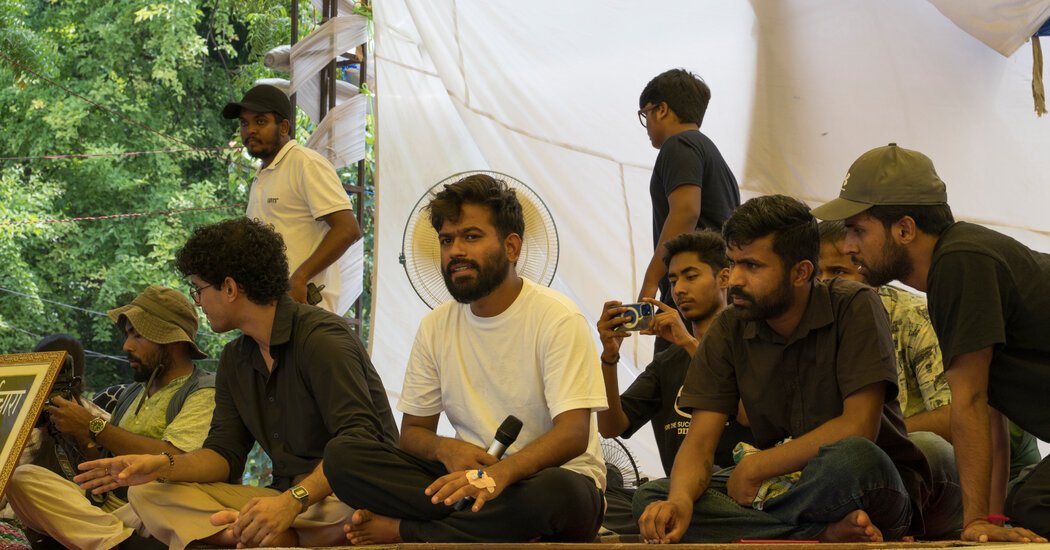
Abhijeet Dipke peered at the phone screen to see with his own eyes if what he’d just heard was true. For more than two months, Mr. Dipke had led a protest movement demanding the resignation of India’s education minister — and now, he had gotten his wish.
Mr. Dipke fell to his knees and repeatedly punched the makeshift stage at New Delhi’s main protest site in excitement. Then he rose up, grabbed a microphone and delivered the news to the sea of protesters around him.
“Long live student power,” Mr. Dipke shouted, pumping his fist repeatedly. “We have done it!”
The crowd erupted into deafening applause, cheering, pumping their fists into the air and sharing group hugs. Mr. Dipke, 30, who had already built a gigantic following after founding a movement through which India’s youth could channel their frustrations, had cemented his status as a folk hero.
He had taken on the government of Prime Minister Narendra Modi and scored a victory.
Barely two months before, Mr. Dipke was just another “international student from India,” with a master’s degree in public relations from Boston University, squeezing in workouts in between applying for jobs and playing FIFA soccer on his PlayStation, he said in an interview on Saturday from his perch onstage.
Hours before he heard that the government had acquiesced to the students’ demands, he described his journey from introverted student to leader of a mass movement.
Cockroaches, United
On May 16, Mr. Dipke woke up in Boston to a comment made by the Chief Justice of India, Surya Kant, comparing unemployed Indian youth to “parasites” and “cockroaches.”
Mr. Dipke said that he had been taken aback that the country’s top judge would refer to India’s youth in such a disparaging manner.
“I felt really hurt and humiliated,” he recalled.
And so he posted a simple question on the social media platform X: “What if all cockroaches came together?”
Mr. Dipke said that he hadn’t expected his musing to hold much power until he saw that millions of people — while embracing the humor — had also taken his post as a call to action. Within two days, he had built a website using A.I. tools, roping in some friends to help. Thus, the Cockroach Janta Party was born, the name a parody of the Bharatiya Janata Party of India’s prime minister, Narendra Modi. Membership was open to the “lazy,” the “unemployed” and anyone who “just rants.” Within two weeks, the Cockroach party’s Instagram account had picked up 22 million followers.
Mr. Dipke’s timing was impeccable. Barely two weeks earlier, India’s medical-college entrance exam, which 2.2 million aspiring doctors and dentists had taken, was canceled after the discovery that some questions had leaked beforehand. Such leaks are almost endemic to India’s education system and regularly prompt fury and frustration.
To bring lasting change, though, Mr. Dipke and others spearheading the Cockroach movement would have to figure out how to alchemize the energy of the nascent movement.
Peaceful Protests
Although India has a long history of democratic demonstrations, the space for any kind of agitation has eroded under the Modi administration. Mr. Dipke said that he decided to return to India in early June to start a protest, despite fearing that he might be jailed or attacked.
“I’m not a national security threat,” he said. “I’m a citizen of this country who loves this country.”
Less than two weeks after Mr. Dipke’s initial post, his Cockroach movement started protests in New Delhi in early June, next to an 18th-century observatory called Jantar Mantar.
“How long will we live in fear of this government?” he asked the hundreds of people who first gathered there.
For weeks, demonstrators camped out. Mr. Dipke and his team repeatedly urged protesters to keep their rallies peaceful as security forces maintained a heavy presence. Many protesters carried images of Gandhi and B.R. Ambedkar, another central figure in India’s independence movement who embraced nonviolent protest.
“Our movement is peaceful,” Mr. Dipke said on Saturday, blaming the authorities for clashes with security officers as protesters tried to march to Parliament on Monday. The police said in a statement that demonstrators that day had become “unruly, aggressive, and violent.”
Breakthrough
Mr. Dipke started his protest with a core demand: India’s education minister, Dharmendra Pradhan, must resign because the exam leak had happened under his watch.
Mr. Modi’s government largely ignored the demonstrations, even as they spread. Students made up the bulk of the protesters, but they were joined by people of all ages demanding accountability. Sonam Wangchuk, a prominent education activist, went on a hunger strike for 26 days in support of the movement.
The government first showed signs of listening as public outrage grew over the beating of protesters. They proposed talks at a senior minister’s residence. Mr. Dipke and his colleagues pushed back, insisting that government officials either came to Jantar Mantar or met with them at a neutral venue. They rejected some government proposals, such as a law against leaking exam papers, as inadequate.
Eventually, three rounds of talks were held at a neutral venue over five days between a Cockroach party delegation and two senior ministers, Jagat Prakash Nadda and Jitendra Singh.
Then came the phone call to Mr. Dipke late Saturday afternoon as he stood onstage. The government had agreed to nearly everything the party had demanded. It vowed to pay compensation to the families of students who died by suicide after the exam leak. It agreed to withdraw police cases against protesters. And it promised to discuss a five-point charter on broader exam and education overhauls.
After the agreement, Mr. Dipke’s colleagues announced that their protests was being called off “in good faith,” shaking hands with government officials in a scene that weeks earlier would have seemed unthinkable.
Although Mr. Dipke has an enormous following — every day, people stood in line for hours waiting to shake his hand — he said that he wasn’t sure whether he saw himself as a political leader. Calling himself a “big introvert” who enjoys history books and documentaries, he said he wanted to keep the limelight on the movement rather than on himself.
He added that he also worried about his parents, who live in the state of Maharashtra, in central India. His mother, who breaks down on every phone call, he said, “kind of weakens me as well.” Since returning to India, Mr. Dipke has spent only two days at his family home. He is also recovering from a bout of typhoid, he said, and therefore avoids video calls with his parents so as not to alarm them about his health.
By midmorning on Sunday, the street outside Jantar Mantar was quiet. Rows of yellow police barricades were stacked along the roadside. Workers picked up trash and painted over the graffiti that protesters had left on the brick walls.
Vijay Solanki, who recently completed an engineering degree, said that he admired Mr. Dipke for making people believe in the power of action. “Most of us were frustrated, but we didn’t know where to put that frustration,” Mr. Solanki, 26, said. “He brought students together for the first time, it felt like our voices were actually being heard.”