







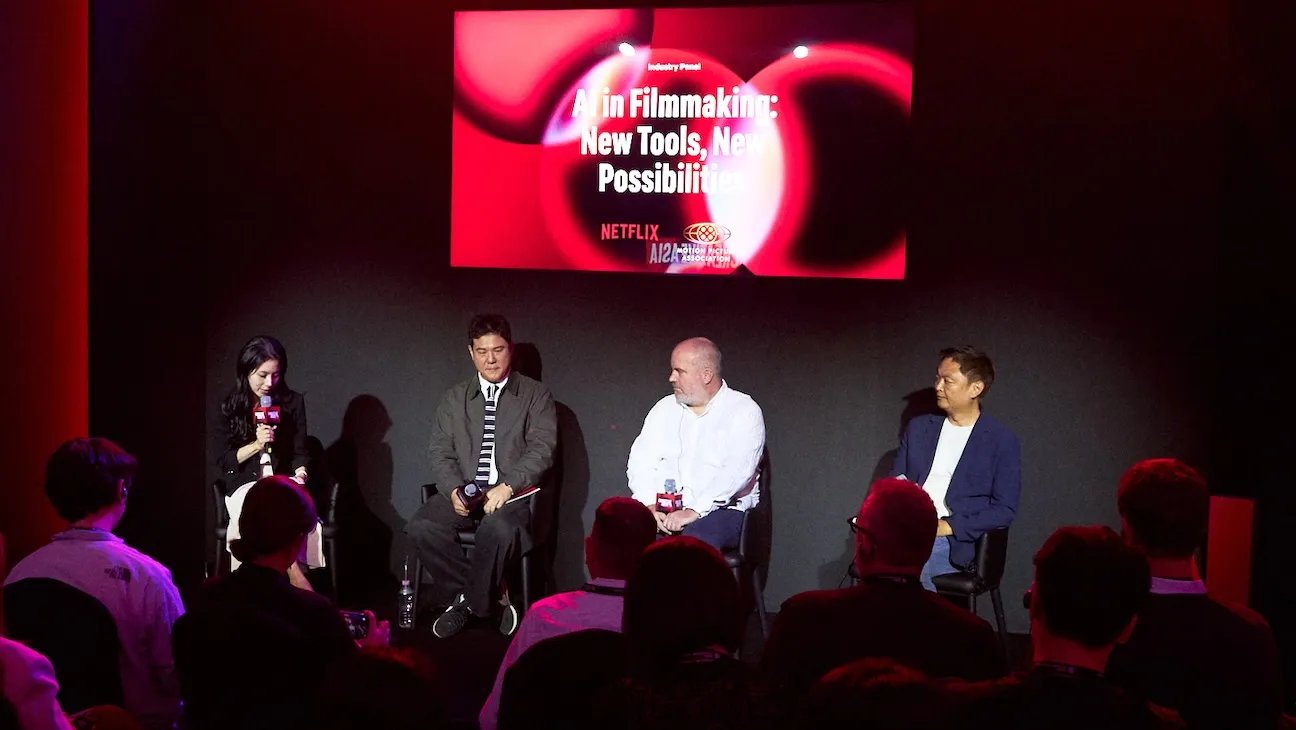
Netflix is aggressively integrating artificial intelligence into its global production pipeline, revealing that the technology has already been utilized in approximately 300 titles. This disclosure, made during a panel discussion at the Busan International Film Festival, underscores the streaming giant’s evolving relationship with generative tools and their role in modern cinema.
Sung Q Lee, Netflix’s senior director of production for Asia-Pacific, spoke at the company’s annual Creative Asia event, emphasizing that while AI is becoming a fixture in filmmaking, the core creative responsibility must remain with humans.
Integrating AI into the Filmmaking Workflow
Netflix is currently deploying AI across several critical stages of production, ranging from previsualization and set-dressing concepts to editing and complex visual effects (VFX). According to Lee, the company’s strategy is not focused on maximizing the sheer volume of AI usage, but rather on how these tools can meaningfully enhance a project’s potential.
“The question that matters to me isn’t, ‘How much AI can we put into this title?’ but, ‘What more can this title do with AI’s help?’” Lee explained during the panel, which also included contributions from Wētā FX chief technology officer Kimball Thurston.
For Wētā FX, the integration is categorized as “assistive AI.” Thurston noted that the primary objective is to eliminate monotonous, repetitive tasks. By providing rapid visual iterations, AI allows directors and cinematographers to spot errors and refine their creative vision much faster than traditional methods allowed.
A Potential Solution to Budgetary Constraints
While the Hollywood creative community has expressed significant concern regarding the ethical and labor-related implications of AI, the Asian film industry is increasingly viewing the technology as a vital opportunity to overcome financial barriers.
Korean filmmaker Kang Yun-sung, known for The Outlaws, highlighted the tangible economic benefits of adopting generative AI. His current project, The Gulf of Aden, utilizes AI tools from China’s Kling AI to realize ambitious scenes that would have been previously impossible due to budget limitations. Kang estimates that these technologies have slashed his production costs by roughly 40 percent.
“When we calculated how much we’d save… it came to a reduction of around 40 percent,” Kang said. “That’s not just from replacing CG and VFX. The shoot itself was streamlined, and that cut down our production time.” He argued that AI is effectively reviving ideas that were previously deemed too expensive to produce, allowing filmmakers to bring sidelined stories back to the screen.
Balancing Efficiency with Human Emotion
Despite the enthusiasm for cost-cutting and efficiency, the consensus among the panelists was that AI cannot—and should not—replace the human element. Sung compared the current AI wave to the historical technological revolutions that have shaped the film industry for over a century. He noted that while these advancements significantly improve the “how” of filmmaking, they cannot determine the “why.”
“When it comes to conveying emotion, ultimately, a human has to touch it,” Sung stated. “AI can get many jobs done, but does it touch human emotion? The human touch is critical and necessary.”
As the industry continues to experiment, the focus remains on using AI as a bridge between limited resources and artistic ambition. Whether these tools will eventually be accepted by audiences—who have shown mixed reactions to early AI-heavy releases—remains a hurdle. However, for executives at companies like Netflix and creators like Kang, the technology is rapidly becoming an indispensable part of the storyteller’s toolkit.
Disclaimer: This content is auto-generated for informational purposes only.
Source: Read Original News