









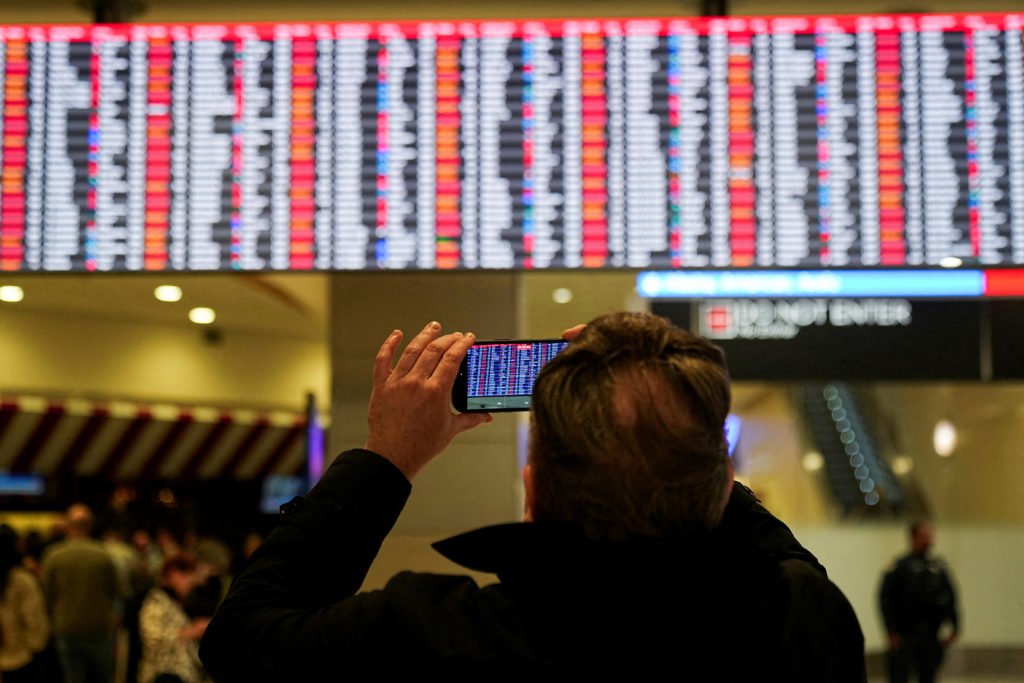
A chaotic week of digital disruptions has left the nation on edge, as a string of technical outages across banking, travel, and government sectors ignited a firestorm of speculation. From Microsoft and major financial institutions like JPMorgan Chase to a rare nationwide ground stop ordered by the Federal Aviation Administration (FAA), the rapid-fire succession of failures has led many to fear a coordinated, systemic attack on U.S. infrastructure.
The incidents, which began unfolding on November 16, quickly transcended mere IT headaches. Reports from 178 companies indicated widespread cyber-related issues, while critical agencies—including the National Security Agency and the National Weather Service—faced their own operational hurdles. For millions of Americans stuck in airports or unable to access banking services, the sheer volume of alerts created a palpable sense of instability.
Prominent voices quickly took to social media to voice their alarm. Nalin Haley, son of former presidential candidate Nikki Haley, declared on November 17, “We’re under attack in a way we’ve never seen before. This is an AI cyberattack.” Similarly, on the platform Bluesky, political strategists questioned whether the timing was truly coincidental, pointing to the concentration of outages as evidence of a deeper, darker plot.
However, cybersecurity experts and officials maintain that the reality is far more mundane. Despite the viral theories, investigators have found no evidence of a unified, systemic collapse. Instead, officials point to a combination of routine software maintenance, isolated technical glitches, and unrelated cyber incidents.
Psychologists suggest that the public’s inclination to view these events as a singular conspiracy is a classic manifestation of human cognitive patterns. “Detecting patterns is important for perceiving the world,” noted Javier Granados Samayoa, a psychology professor at Texas Christian University. “This tendency can sometimes lead people to see connections where none may exist.”
Research into conspiracy thinking suggests that when people feel a loss of control—such as when they are stranded at an airport or locked out of their work accounts—their brains are biologically primed to search for a “bigger” explanation to resolve uncertainty. This is compounded by “frequency bias,” where events that would typically be viewed as routine errors become magnified because they are happening in rapid succession.
Social media has only served to amplify these anxieties. Algorithms prioritize content that triggers strong negative emotions, and reports suggest that up to 30% of the viral discourse surrounding the outages was driven by bot activity and potential foreign influence.
While the disruptions have highlighted genuine vulnerabilities in America’s digital landscape, experts warn against the dangerous cycle of misinformation. As the situation stabilizes, the episode stands as a stark reminder of how quickly uncertainty and social media dynamics can turn a series of isolated technical bugs into a full-blown national panic.
Disclaimer: This content is auto-generated for informational purposes only.
Source: Read Original News