










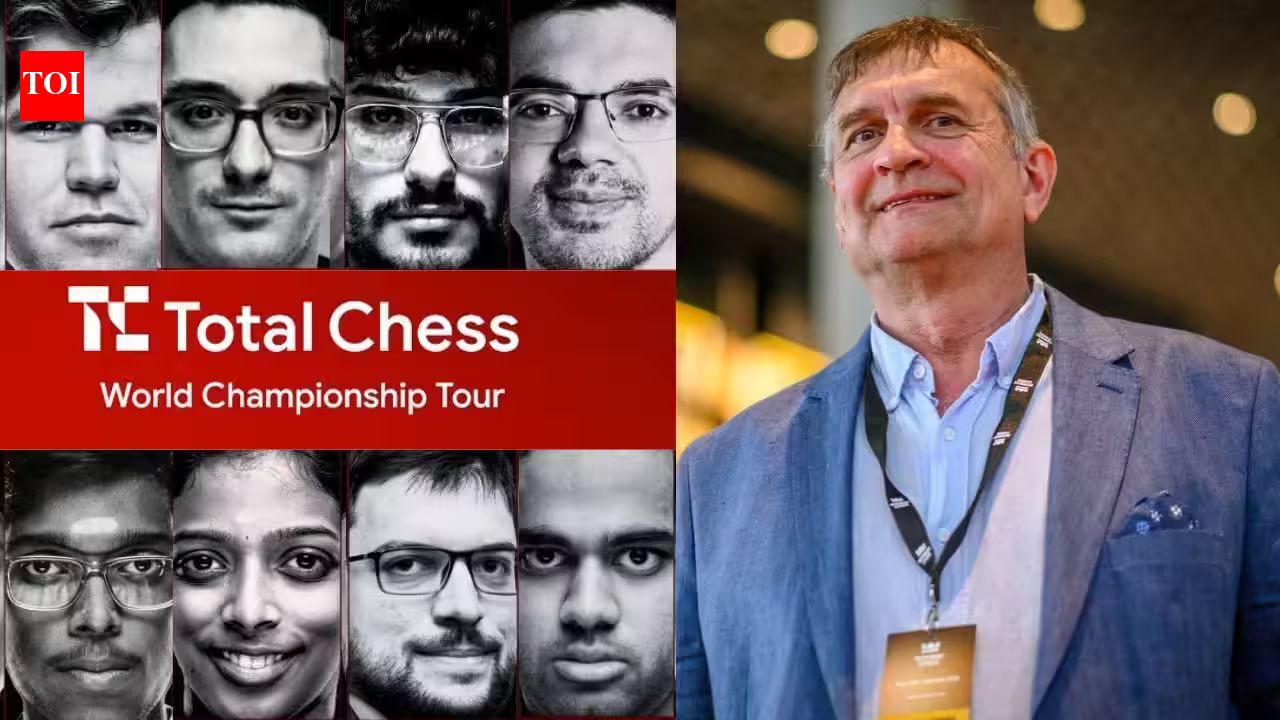
BUDAPEST — As the chess world converges on the opulent Anantara New York Palace in Hungary, the air is thick with anticipation and debate. With world No. 1 Magnus Carlsen leading a stellar field of 24 grandmasters, the Total Chess World Championship Tour pilot is set to redefine professional chess. However, as the clock ticks toward the November 10 start date, the tournament’s unique, multi-format structure has become the primary topic of conversation among experts and enthusiasts alike.
The pilot event, a cornerstone of the 2026–27 tour endorsed by FIDE, introduces a high-stakes group stage that relies exclusively on “fast classical” chess. Under this format, 24 players are divided into four groups of six, playing a double round-robin. Only the group winners advance to the semi-finals, where the format expands to include Rapid and Blitz. For the 20 players who do not clinch a group victory, the chance to compete for the championship title vanishes early, leaving many to question if the path to the trophy is unnecessarily restrictive.
Defending the “Fast Classical” Pivot
Kjell Madland, the visionary founder and CEO of Norway Chess and the Total Chess World Championship Tour, remains steadfast in his defense of the format. Speaking exclusively to TimesofIndia.com, Madland dismissed concerns that players are being sidelined or unfairly eliminated before they can showcase their prowess in faster time controls.
“They are not eliminated,” Madland asserted. “All the players will play all the games until the last day.”
According to Madland, the reliance on fast classical—defined by 45 minutes per player with a 30-second increment from the first move—serves a specific strategic purpose. With the time control having been recently introduced by FIDE, the pilot tournament provides the perfect, high-visibility stage to test its viability under competitive pressure.
“Since fast classical is a new format, it’s also good to have attention on this, so we think this is a good way to do it,” Madland explained. He also clarified the role of the opening day’s nine-round Blitz Swiss tournament. While it does not count toward qualification, it serves as a critical tie-breaker. If players end the group stage level on points, their performance in the Blitz tournament will determine their final standing.
A Modernized Blueprint for Professional Chess
The Total Chess World Championship Tour is not merely an experiment in time controls; it is a bid to modernize the game to meet the demands of modern media, OTT platforms, and global television audiences. Madland believes that the sport must evolve to capture a broader viewership, and that blending three distinct formats—Blitz, Rapid, and Classical—into one cohesive circuit is the key to identifying the “complete” chess player.
“I had a feeling for some years that we should build something that included everything, because we have talked with players, fans, media and everything,” Madland said. “I hope people find this very interesting, and also that they are open to seeing that chess needs to change a bit to meet the new audience.”
The knockout stage, which begins after the group rounds, will be a grueling test of versatility. The semi-finals, third-place match, and the grand final will each span two days. Each day, competitors will face four Blitz games, two Rapid games, and one fast classical game. To ensure a decisive outcome, scores will reset daily, and should a match remain tied after two days, a tense Armageddon encounter will be triggered, with Black enjoying the advantage of a draw to win the match.
A Star-Studded Lineup
The field of participants represents the global elite of the game. Joining Magnus Carlsen are U.S. titans Fabiano Caruana, Wesley So, and Levon Aronian, alongside young sensations like India’s Praggnanandhaa Rameshbabu and Arjun Erigaisi. The inclusion of top-tier women’s players, such as Bibisara Assaubayeva and Vaishali Rameshbabu, adds another layer of intrigue to the tournament, reflecting the tour’s ambition to create an inclusive and high-intensity spectacle.
While Madland acknowledges that any departure from tradition—particularly the exclusive reliance on fast classical in the opening stages—will naturally invite scrutiny, he is confident the pilot will succeed.
“Of course, we need to find a good way to do it. This is what we have done, and the players like it,” Madland noted. “Hopefully it will be good, but there will always be some questions about this and that. Hopefully this will work well.”
As the tournament begins, all eyes will be on how the grandmasters navigate the constraints of the fast classical format. For the organizers, this pilot is the ultimate testing ground. Madland noted that while they do not anticipate “big adjustments,” the flexible nature of a pilot project allows for rule refinements should the games prove that specific regulations require polishing.
For now, the stage is set in Budapest. With two coveted spots in the 2028 Candidates Tournament hanging in the balance, the pressure on the 24 competitors is immense. Whether the format is hailed as a revolution in broadcast chess or viewed as a controversial bottleneck, one thing is certain: the Total Chess World Championship Tour is forcing the chess world to rethink what it means to be the best in the game.
Disclaimer: This content is auto-generated for informational purposes only.
Source: Read Original News


