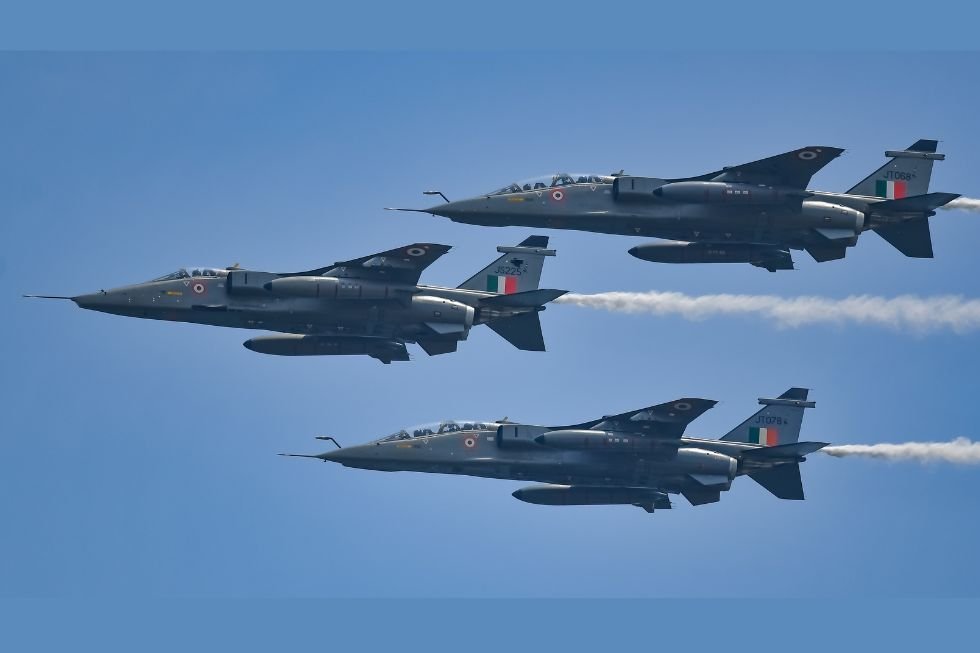
The Indian Air Force (IAF) serves as the sentinel of India’s airspace, responsible for securing a battlespace that is bordered by two nuclear-armed adversaries. Managing such a colossal battlespace demands the timely induction of assets, along with effective planning and coordination. In military terms, one can say it requires the uninterrupted functioning of the OODA loop, which stands for: Observe, Orient, Decide, and Act.
The OODA framework encompasses the full spectrum of capabilities, from foundational assets to the interface between military command and political leadership. In one line, it integrates tactical systems with strategic decision-making. Hence, when this loop functions smoothly, deterrence remains credible. When it slows, strategic vulnerability sets in.
Persistent delays in procuring critical airpower components have impaired the structural integrity of this cycle. In the absence of adequate platforms, advanced technology, and a vibrant industrial base capable of sustaining and regenerating combat capacity, the effectiveness and strategic weight of the IAF gradually erode. The ramifications of this decline are grave for the application of air power.
The story of India’s indigenous fighter program illustrates how this structural slowdown has unfolded over decades.
The case of LCA-Tejas: great expectations but little success
The concept of developing an indigenous supersonic fighter aircraft emerged in the 1960s. The initial effort, the HF-24 Marut, did not achieve its intended objectives. Subsequently, in 1983, the government launched the Light Combat Aircraft (LCA) program to address this shortcoming.
To improve coordination and management, the Aeronautical Development Agency (ADA) was established under the Defence Research and Development Organisation (DR&DO). The ADA was made the lead body of the LCA program. The primary aim of the LCA project was to replace the aging MiG-21 and Ajeet fighters of the IAF. Over time, the program’s scope expanded to adapt to evolving operational requirements and changes in the balance of power.
Despite nearly four decades of development, the LCA project is only a partial success. It has faced persistent technical and organizational challenges. The most debilitating of these challenges is propulsion.
The ADA, despite continuous government support, has failed to develop an indigenous jet engine. As a result, the most critical part of the aircraft depends on foreign suppliers. While elements such as aircraft design, composite materials and structural engineering are developed by the ADA, the engines are sourced from the US, the ELTA radar systems from Israel and the avionics from the UK.
This dependence on foreign suppliers constrains efforts to achieve self-reliance in defense manufacturing. Furthermore, the supply of General Electric (GE) F404-IN20 engines from the US is now uncertain. GE is failing to fulfill its earlier commitments. On top of this, the import of engines lacks significant technology transfer or licensed production, ensuring dependence on foreign suppliers forever. Yet technological dependence is only one side of the crisis; the production capacity forms the other.
Hindustan Aeronautical Limited (HAL) is the principal defense manufacturer in the Indian Defense Industry, but has continuously failed to deliver on time. For instance, of the first two IAF orders for LCA, placed in March 2006 and December 2010, HAL has delivered only 38 of 40 aircraft. Such production constraints put the IAF in a bind. As a result, the IAF only operates two squadrons of the LCA — one based in Tamil Nadu and one in Gujarat.
Moreover, the planned induction of 97 LCA Mk1A fighters has yet to enter the production phase. The Mk1A is expected to have more indigenous components than the Mk-1, such as the Uttam active electronically scanned array (AESA) radar. However, the bulk induction of the LCA is still pending.
If the LCA represents delayed maturation, the Advanced Medium Combat Aircraft (AMCA) reflects deferred ambition.
The ambiguity over the AMCA
The decision to build AMCA, featuring multi-role, fifth-generation, stealth, supersonic, twin-engine, AI and the most recent combat tactics, started in 2011. The ADA, under the DR&DO, started working on a prototype. However, it took the defense ministry more than a decade to finally get the ball rolling on the program.
The AMCA execution program started with a public-private partnership in May 2025, after a limited aerial battle with Pakistan. However, the HAL withdrew from the first phase of the AMCA execution program, citing previous commitments. This institutional hesitation reflects a deeper structural weakness in India’s defense innovation ecosystem.
Some scholars are hesitantly applauding this withdrawal, claiming that with the private sector now in control of the AMCA, the production might benefit. However, this assumption is difficult to support, especially given that the Indian private sector is deeply reticent in its research and development (R&D) spending. Of the 0.66% of GDP that the central government invests in R&D, the private sector contributes only 36%. In comparison, advanced economies such as the US and China spent 15 times as much on R&D as India, with the majority of spending coming from the private sector.
According to official estimates, the AMCA Mk1 is expected to make its first flight in 2029 and enter service in 2035. According to media reports, the IAF intends to buy 125 AMCA Mk1 aircraft. The next variant, the Mk2, powered by a 120 kN engine, is expected to enter service in 2038. Hence, despite all the management changes, the AMCA is still at least a decade away from actual deployment, even though it was conceived in 2011.
The Indian defense industry’s failure over the past four decades has left the IAF without the necessary combat power. As a result, the number of active fighter squadrons has decreased to 29, well below the sanctioned strength of 42.5. The Pakistan Air Force, on the other hand, has 25 squadrons, nearly equal to the IAF.
While the indigenous industry is failing to deliver on time, China has built a world-class Air Force. China’s rise as a significant airpower threatens Indian security.
Chinese sprint against Indian procurement sclerosis
In the last four decades, China has emerged as a great economic power, devoting significant resources to transforming its military, especially its air and maritime forces. In this effort, China inducted Soviet and Russian legacy systems and developed its own military assets on their lines.
The result is a dramatic change in the People’s Liberation Army-Air Force (PLA-AF). Today, the PLA-AF possesses more than 2,000 aircraft, of which 800 are fourth-generation-plus. The advantage vis-à-vis India becomes even sharper when qualitative depth and production velocity are considered. The Chinese fourth-generation or higher aircraft includes Russian models such as the Su-30 and Su-35, as well as domestically produced fighters like the J-10C, J-16 and J-20. Additionally, the Chinese Air Force also operates three squadrons of fifth-generation stealth fighters, the J-35.
India, in comparison, operates only 15 squadrons of Su-30 and two squadrons of Rafale fighters, totaling just 17 squadrons or 306 fighters of fourth-generation or higher aircraft. Furthermore, the IAF does not have any fifth-generation stealth fighters. On top of this, China, being India’s principal rival, is also looking to sell 40 J-35 stealth fighters to Pakistan, intensifying the qualitative and quantitative difference between the IAF and the PLA-AF.
Additionally, China is constructing airbases and airstrips on the Tibetan Plateau as part of a concerted effort to enhance military readiness. These airstrips serve two primary purposes: they allow the PLA to quickly mobilize troops and provide critical infrastructure in high-altitude, unpredictable weather conditions. Only a handful of these facilities can be effectively utilized during a conflict, so having more facilities with all-weather bunkers gives China a strategic edge over India.
This quantitative edge and access to numerous facilities in Tibet also allow China to absorb potential losses and sustain sortie regeneration, compressing India’s options for escalation. This advantage gives the PLA-AF greater flexibility to respond to the IAF.
Consequently, this forces the IAF to prepare for a two-front war with limited assets. It’s no wonder that in 2016, Air Marshal Birender Singh Dhanoa, later Chief of Air Staff (CAS), said, “Our numbers are not adequate to fully execute an air campaign in a two-front war scenario.” Similar sentiments were voiced by the current CAS Air Chief Marshal Amar Preet Singh in 2024: “We will fight with whatever we have.”
Faced with these indigenous delays and the PLA-AF’s rapid expansion, the IAF is increasingly turning outward to stabilize its capabilities.
Rafales: the backbone of the IAF
In 2001, India started discussions to induct 126 Medium Multi-Role Combat Aircraft (MMRCA). In 2007, the government accepted bids from six global contractors to procure 126 MMRCA aircraft for ₹42,000 crore (~$1,031). However, the MMRCA program was abruptly scrapped in 2015, and the government signed a deal to buy 36 Rafale fighters from France for ₹58,000 crore (~$870). What began as a stopgap measure in 2015 is now evolving into long-term force architecture.
The two squadrons of Rafale fighters currently available are insufficient, given India’s challenging security environment. Hence, the IAF issued a request for information in 2018 for 110 Multi-role Fighter Aircraft (MRFA). In February 2026, the Defense Acquisition Council (DAC) issued an Acceptance of Necessity (AoN) for 114 Rafale MRFA worth $35 billion or ₹3.25 lakh crore.
With the addition of these 114 Rafales, the French fighters are set to become the backbone of the Indian Air Force operations for the next 15 years. The Rafale aircraft, equipped with the latest F4 and F5 upgrades, will feature advanced weapons such as Scalps, Meteors, Highly Agile Modular Munition Extended Range (HAMMER) missiles, Spice-1000 glide bombs and the indigenous Astra Beyond Visual Range (BVR) missiles. This enhancement will alter the current balance of air power in the Indian subcontinent and the Indian Ocean, providing much-needed support to the IAF leadership and increasing the IAF’s warfighting capability multifold.
The cumulative effect of the fighter shortfall, the rapid expansion of the PLA-AF and the Pakistan Air Force’s enhancements — supported by China —has strategically compressed India’s airpower. This situation demands the single-minded attention of the political leadership.
Time for political leadership to embrace airpower
From the HF-24 Marut to the LCA Tejas, and from the Kaveri engine to the AMCA, there is a long history of development delays, propulsion failures and manufacturing defaults. These failures have led to continued strategic decline in airpower.
To restore airpower to a central role in strategic planning, political leadership must recognize that reducing IAF squadrons compromises the OODA loop. Leaders must understand that once the OODA loop weakens, the offensive capability of airpower lowers, and with it, the deterrence threshold falls.
This situation weakens the military leadership’s ability to sustain airspace dominance and constrains political leadership’s capacity to de-escalate at the right moment. This crisis must be dissected as it is, without embellishing it with decorative, high-sounding, hollow language.
Furthermore, political leaders must internalize the importance of airpower within India’s strategic landscape. In a two-front contingency, effective escalation control hinges on the ability to conduct rapid, sustained and technologically superior air operations. Airpower is essential, from deploying special forces for strategic missions to inserting mountain strike corps for sustained operations.
For instance, three fully operational squadrons of LCA Mk1A or AMCA Mk2 at Tejpur, Assam, would provide far greater escalation leverage against China than armored formations in Eastern Ladakh. The same logic applies to the Western theater. Airpower provides mobility, precision and the capacity to impose heavy cost — advantages that are indispensable in a compressed battlespace.
The logical conclusion for the political leadership is to develop a National Security Strategy followed by a National War Doctrine. This must place airpower at the core of long-term war planning.
Ultimately, if India aspires to emerge as a great power, it must develop a long-term political vision that aligns with its industrial capabilities, technological requirements and military readiness. The present crisis in the IAF is not the product of a single decade but the cumulative outcome of four decades of drift. Unless political leadership understands the centrality of airpower in India’s contested neighborhood, the crisis will continue to plague the IAF.
[Kaitlyn Diana edited this piece.]
The views expressed in this article are the author’s own and do not necessarily reflect Fair Observer’s editorial policy.