






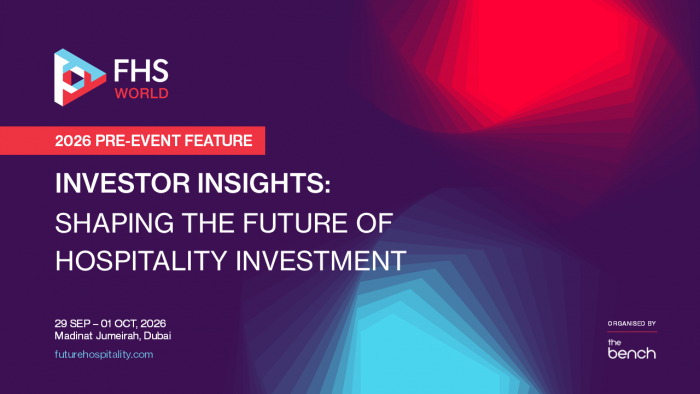
As global hospitality leaders descend upon Dubai’s Madinat Jumeirah for the Future Hospitality Summit (FHS) World 2026, a clear consensus has emerged among the industry’s top financiers: the era of “easy growth” has been replaced by a period of rigorous, disciplined selectivity.
Representing over USD $5 trillion in assets under management, more than 200 of the world’s most influential investors have gathered to navigate a shifting landscape defined by geopolitical uncertainty, construction cost inflation, and supply chain volatility. With 40 percent of attendees traveling from outside the GCC, the event highlights a global recalibration of how capital is deployed in the hospitality sector.
“Investor sentiment has become more disciplined and selective rather than less optimistic,” explains Mayra A. Mueller, President of CGK Partners Private Wealth. According to industry leaders, the focus has pivoted away from speculative expansion toward resilient assets with strong operating fundamentals and diversified revenue streams, such as mixed-use developments that integrate branded residences, wellness, and entertainment.
The past 12 months have been particularly challenging. Fahad M. Al-Alloush, CEO of Al Raya Real Estate, notes that the conversation has transitioned from growth to “risk-pricing,” driven by regional instability and the resulting surge in construction and logistics costs. This has led to a noticeable delay in project timelines, as investors are now underwriting delivery costs with far greater caution than in previous years.
However, the outlook is far from gloomy. Many investors pointed to “destination-level catalysts” as the primary drivers of renewed optimism. Projects like the highly anticipated Wynn Al Marjan Island in Ras Al Khaimah are being hailed as game-changers, signaling that investors are increasingly confident in emerging secondary destinations beyond the established hubs of Dubai and Abu Dhabi.
“The conversation has moved from simply asking ‘Is hospitality attractive?’ to asking ‘Where is the real value, and who can execute the business plan?'” says Devendra Asher, Director of Hospitality at Lordship Africa. Asher highlights that for markets like Africa, the potential lies in creating scalable, professionally operated platforms that respond to a growing, affluent, and internationally connected middle class.
The summit, themed “Reinvest in our Future,” provides a critical platform for these stakeholders to stress-test their strategies. From the FHS Dealroom to the exclusive Investors Lounge, the event aims to bridge the gap between capital availability and project execution.
As the industry looks toward 2027 and beyond, the message from the summit is clear: while geopolitical and economic headwinds persist, the long-term fundamentals of the hospitality sector remain robust. Success in this new climate will not be determined by market timing, but by operational efficiency, the quality of partnerships, and the ability to design assets that serve the evolving needs of the modern traveler. As Ali Shahid, CEO of The Bench, aptly summarized, the goal of FHS World is to put the right people in the same room to “test ideas, compare notes, and do business.”
Disclaimer: This content is auto-generated for informational purposes only.
Source: Read Original News