





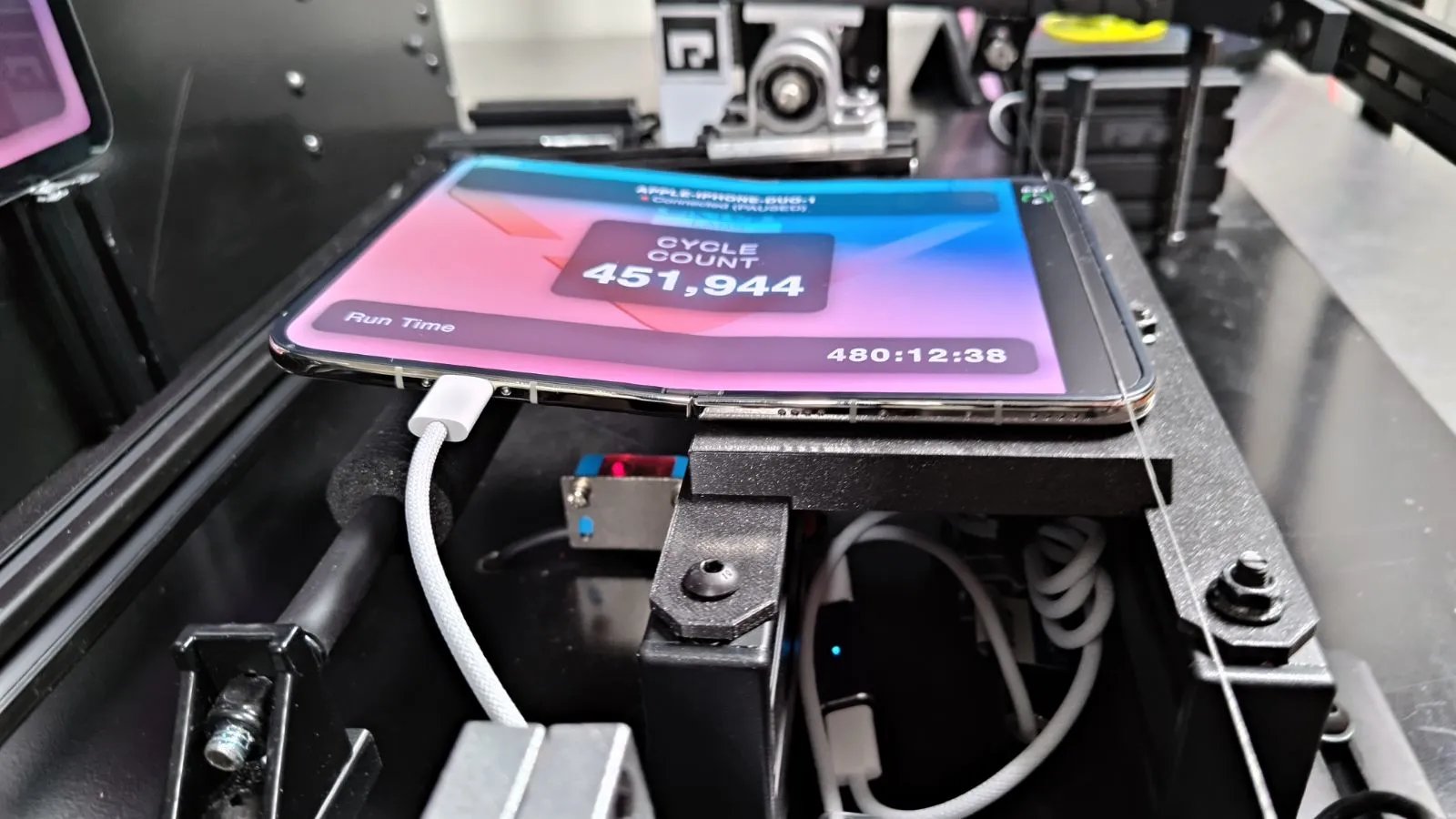
The Rigorous Testing of the iPhone Duo
The foldable smartphone market represents one of the most significant engineering challenges in modern consumer electronics. To understand the long-term durability of these devices, our laboratory utilizes a custom-built mechanical stress-testing rig known as the Fold-a-Phone. Our primary objective is to subject devices to extreme folding cycles that simulate years of intensive use. Three weeks ago, we introduced the new Apple iPhone Duo to this environment to establish its mechanical endurance thresholds. By placing the device under this constant, automated pressure, we aim to identify the exact point at which the hinge mechanism begins to lose its structural integrity and factory-calibrated resistance.
Identifying Signs of Mechanical Degradation
After approximately 390,000 cycles, our monitoring equipment began to capture deviations in the device’s performance. During a routine assessment on Tuesday afternoon, we detected a shift in the opening force required to move the display. Historically, the iPhone Duo exhibited a firm, precise action during each fold. However, the data revealed that the internal hinge mechanism was no longer performing with its original consistency.
By the following day, the change in the hardware was observable even without sensor data. The device ceased to open fully into a flat, 180-degree position. Instead, the screen would reach an angle, effectively failing to reach the horizontal plane. While the device was previously powered by an automated wire system that ensured a smooth, full extension, the mechanism began to falter at approximately 440,300 folds. The wire, which manages the mechanical opening force, began to withdraw prematurely, preventing the hinge from locking into its intended flat state before the testing cycle initiated the closing sequence once more.
Defining Failure in Foldable Hardware
It is crucial to distinguish between minor mechanical fatigue and catastrophic device failure. Currently, the iPhone Duo retains full functionality. The screen has not suffered from display pixel degradation, cracking, or blackout. The internal sensors remain operational, and the device maintains various intermediate folding positions without issue.
Our testing protocol defines failure as a complete loss of power, unresponsive sensors, or terminal damage to the display panel. The current state of the iPhone Duo—a minor deviation of roughly 5 to 10 degrees from a perfectly flat surface—does not yet meet these criteria. Because the phone remains capable of being fully opened manually, it is clear that the internal tension within the hinge has shifted rather than suffered a structural fracture. This distinction is vital for consumers; while the hinge action has lost its initial tactile snap, the device remains perfectly usable in daily scenarios.
Contextualizing Durability and Usage
To understand the significance of this test, one must consider the sheer volume of cycles the device has undergone. Assuming an average usage pattern of 100 folds per day, 450,000 cycles equate to approximately 12.5 years of continuous service. Most consumers will never reach this number of folds before upgrading their hardware. While manufacturers rarely publish specific cycle-life ratings, our testing provides a benchmark that places the iPhone Duo in a league with industry leaders.
Whether the device is rated for 500,000 folds or double that number, the current performance represents the initial phase of mechanical wear. The transition from a perfect state to one that requires manual assistance for full extension is the first tangible indicator of the inevitable aging process inherent in moving parts. By observing this transition, we gain valuable insights into the longevity of complex hinge architectures and the materials utilized in Apple’s design.
The Future of Hinge Engineering
The data gathered from our long-term testing provides a window into the evolution of foldable technology. As we continue the testing process, we expect to document further changes in the hinge resistance. Each cycle provides additional information on how these devices endure fatigue, helping to inform future iterations of foldable screen technology.
Our commitment to this rigorous testing process remains steadfast. We will continue to run the Fold-a-Phone until we observe clear evidence of terminal failure, ensuring that our assessment of the iPhone Duo’s durability is as comprehensive as possible. This ongoing investigation serves as a critical measure for both potential owners and the broader industry, highlighting how current engineering practices stand up to the rigors of multi-year, high-frequency usage. We invite our readers to follow our progress via our daily streams as we monitor the device until its final operational conclusion.
Disclaimer: This content is auto-generated for informational purposes only.
Source: Read Original News


