






The consumer wearable landscape recently shifted as Apple announced a significant expansion of its health monitoring capabilities. By revamping its Apple Watch Health Sensing System to include a Readiness score and increasing the frequency of heart rate variability (HRV) outputs 24-fold, Apple has aligned itself with competitors in the health-tech space. As over 100 million American adults turn to wearable devices for personal health tracking, the industry is increasingly positioning metrics like HRV and Readiness as essential markers for biological age, longevity, and autonomic nervous system health.
### The Science and Limitations of HRV
Heart rate variability (HRV) is defined as the variation in the timing between consecutive heartbeats. These millisecond-level fluctuations arise from the interplay between the sympathetic and parasympathetic nervous systems. While researchers have studied HRV for over three decades, most established medical literature relies on data derived from electrocardiograms (ECG).
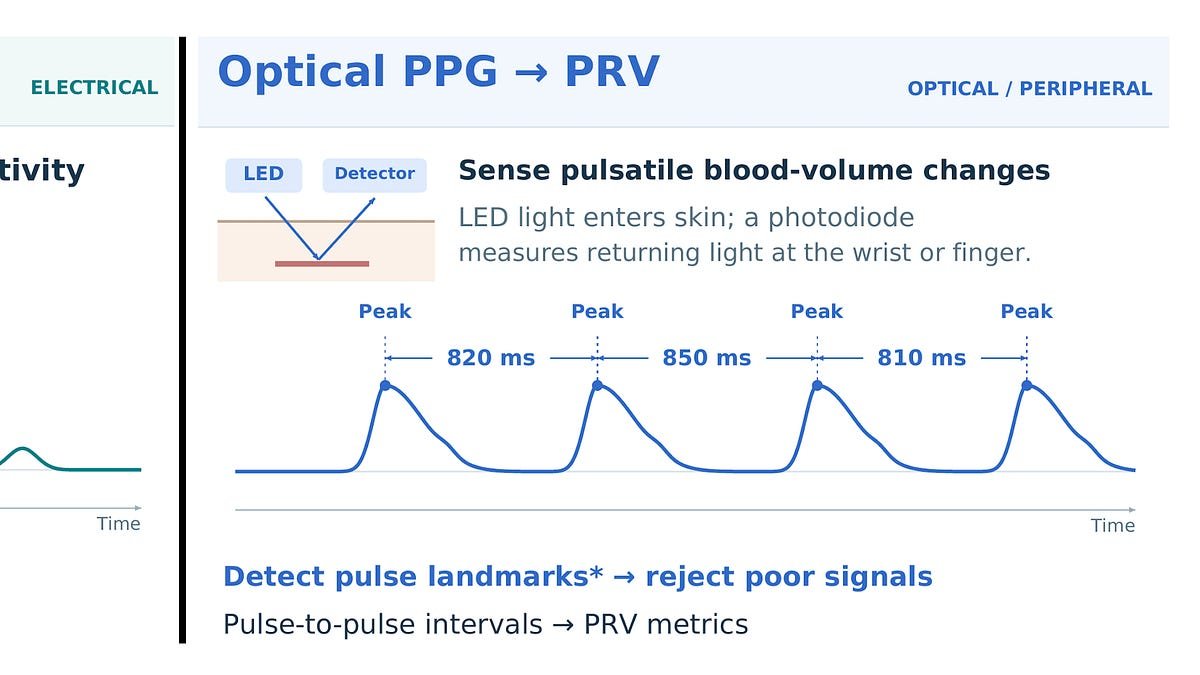
In contrast, most modern consumer wearables utilize photoplethysmography (PPG), which uses optical sensors to measure blood flow. This methodology produces pulse rate variability (PRV) rather than traditional HRV. While PRV and HRV can show correlation when a user is at rest, they are not interchangeable. Variations in sensor technology, placement, and the specific algorithm used to process data—such as RMSSD (root mean square of successive differences) or SDNN (standard deviation of NN intervals)—mean that measurements from different devices often lack consistency. Furthermore, the accuracy of these optical sensors can be influenced by external factors, including skin tone, body mass, and the presence of underlying chronic conditions.
### Decoding Readiness Scores
The recent introduction of “Readiness” scores represents a move toward synthesizing various physiological data points into a single, user-friendly metric. These composite scores typically aggregate HRV, resting heart rate, sleep duration, and physical activity levels to provide a snapshot of a user’s physiological recovery.
However, these algorithms are generally proprietary and have not undergone rigorous, peer-reviewed validation against established clinical health outcomes. Different manufacturers use distinct, unpublished weightings for their readiness calculations, rendering them non-standardized. A score of 90 on one brand of wearable device does not correlate to the same physiological state as a 90 on another. Because these algorithms can be updated by the manufacturer at any time without notification to the user, they lack the stability required for clinical diagnostic tools.
### The Gap Between Measurement and Causality
A critical distinction in health monitoring is the difference between a surrogate marker and a cause-and-effect relationship. While low HRV has been associated with various long-term clinical risks in studies using ECG equipment, there is currently no peer-reviewed evidence proving that actively attempting to increase one’s HRV through wearable-led behavioral changes results in improved long-term health outcomes.
Genetic studies suggest that HRV is likely a reflection of a person’s physiological state rather than a causal mechanism of health. Despite this, the marketing surrounding these metrics often implies that a higher score is a definitive goal for longevity. This has led to the emergence of concerns regarding “orthosomnia,” a condition where individuals experience increased anxiety or distress based on the data provided by their devices. When a user feels perfectly rested but is informed by a device that their recovery score is poor, the resulting psychological stress may ironically lead to a measurable decline in their next day’s metrics.
### Evaluating the Role of Wearables in Personal Health
The industry-wide move toward more frequent and granular data collection, such as Apple’s decision to output heart rate data every five seconds, reflects a competitive drive to capture more user attention. Yet, the utility of these metrics remains limited by a lack of standardization and large-scale, independent clinical trials.
For the average user, the most reliable approach is to observe long-term trends rather than reacting to individual daily fluctuations. Tracking consistent data over several weeks under similar conditions—such as measuring during sleep—may provide a clearer view of personal health baselines. However, it is essential to view these numbers with significant skepticism. Without transparent algorithms and validation against objective health outcomes, these metrics should be treated as supplemental information rather than definitive health indicators.
### Future Directions and Necessary Research
The potential for wearable sensors remains vast. Researchers, including those exploring the role of glymphatics in clearing metabolic waste from the brain, have posited that HRV could eventually serve as a non-invasive window into complex biological systems. To achieve this, however, the industry must transition from speculative marketing to rigorous, evidence-based science.
Manufacturers possess the resources to fund large-scale, randomized, or prospective studies that could bridge the gap between simple pulse variability and actionable health insights. Until such data is produced, the current reliance on “readiness” and HRV as health arbiters remains premature. While these devices can be useful tools for promoting general activity and awareness, they are currently built upon a foundation of proprietary metrics that have yet to prove their value in enhancing human longevity or disease prevention. As the sector grows, the responsibility lies with both the tech companies to provide transparency and the users to maintain a balanced perspective on what these digital markers actually signify.
Disclaimer: This content is auto-generated for informational purposes only.
Source: Read Original News