





Most political parties spend decades building a voter base before becoming a political force worth noting. The Nationalist Citizens Party of India (NCPI), a nondescript party, has been thrown into the limelight and the national power equation almost overnight. The NCPI is a party that could only secure a total of 822 votes in its sole electoral contest and raised just Rs 1.13 lakh in donations. But now its fortunes seem to have changed overnight. Steered by a husband-and-wife duo from West Bengal, it could become the fifth-largest party in the Lok Sabha and second-largest in the ruling NDA government if the Speaker approves of the merger of nearly 20 rebel Trinamool Congress (TMC) MPs with NCPI.
The NCPI, registered with the Election Commission of India (ECI) in January 2023, is emerging as the biggest beneficiary of the rebellion within the TMC. With nearly 20 TMC MPs announcing their decision to merge with the party, the NCPI will become the fifth-largest party in the Lok Sabha.
If the merger is approved, the NCPI’s strength would rise to 20 MPs from zero. It will become the fifth-biggest party in the Lok Sabha after the BJP (240 MPs), the Congress (99 MPs), the Samajwadi Party (37 MPs), and the DMK (22 MPs).
The TMC, which was the fourth-largest opposition party with 28 MPs in the Lok Sabha, would see its strength shrink dramatically to just nine.
A party with no electoral base suddenly becoming a major parliamentary force will be India’s most unusual political story. It takes a lot of hard work and investment to win a Lok Sabha seat. Getting to be a party with 20 MPs overnight is nothing short of a political miracle, which is the result of manoeuvring in which it most likely has had a minimal role.
Equally interesting is the story of the Kundu couple — Uttiya and Shewly — who steered the party founded by someone else, and allegedly “unilaterally decided on the merger”.
NCPI GOT A TOTAL 822 VOTES FROM 2 SEATS IN TRIPURA ELECTION
The NCPI’s sudden rise in national politics stands in stark contrast to its limited electoral record. The party was registered by the Election Commission of India (ECI) as a Registered Unrecognised Political Party (RUPP) on January 20, 2023, but has contested only one election since its formation.
Despite being registered in West Bengal, the NCPI chose to make its electoral debut in the 2023 Tripura Assembly elections, a decision that yielded little success and virtually no electoral footprint for the outfit.
The party’s first electoral battle was largely unsuccessful. Though the NCPI fielded candidates in seven constituencies, the nomination papers of four candidates were rejected, leaving only two candidates in the fray under the party symbol. In Tripura’s Chawmanu assembly constituency, the NCPI secured 536 votes, while in Kailashahar assembly fray, it managed just 286 votes.
Combined, the two candidates received only 822 votes, making the NCPI one of the smallest electoral players in the state election.
A third candidate associated with the broader NCPI network, Krishna Kumar Debbarma, contested from the Ambassa constituency as an Independent and polled 376 votes. Even after including his tally, the wider NCPI-backed effort garnered only 1,198 votes.
The results underscored the party’s negligible electoral relevance. It failed to win a single seat and did not emerge as a significant contender in any constituency.
The NCPI’s financial profile is also equally modest. Election Commission records show that the party reported total donations of only around Rs 1.13 lakh.
Unlike major political outfits that maintain expansive organisational networks, district units, and large membership bases, the NCPI operates with limited resources and little public visibility. Till the rebel TMC MPs decided to merge with the NCPI, the party remained largely unknown outside a few political circles in West Bengal and Tripura.
HUSBAND, WIFE LEADING TMC MERGER, NCPI FOUNDER KEPT IN THE DARK
At the centre of NCPI’s operations and the merger with TMC’s rebellion, MPs are Uttiya Kundu and Shewly Kundu. Party records and filings place the couple at the centre of the organisation’s functioning.
Uttiya Kundu serves as the party president and is associated with the Bengali publication Jago Biswa, where he has described himself as a publisher, editor, mathematician, social worker, and motivational speaker.
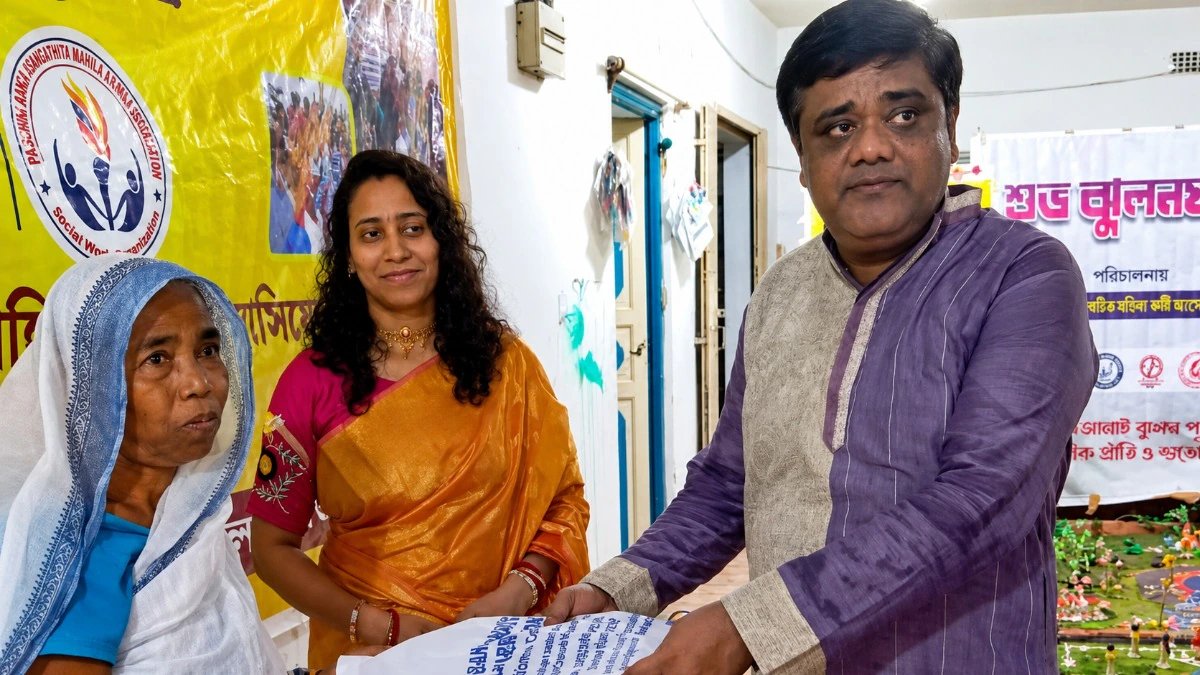
His wife, Shewly Kundu, serves as the party treasurer and has also been listed as a director in organisations operating from the same address as the political party, including Biswabazar Private Limited and Paschim Banga Asangathita Mahila Karmi Association.
Uttiya Kundu had posted an image of him with West Bengal Chief Minister Suvendu Adhikari after the newly sworn-in CM took oath in May.
“The days of dreaming are over. Now it is time to fulfil the dreams. As the Chief Minister of West Bengal, may Suvendu Adhikari’s journey of victory be successful,” Uttiya wrote on Facebook in the Bangla language.
“May your (Suvendu Adhikari’s) resolve give new life to every speck of dust in Bengal,” he added.
The power of the party that is all set to be a prominent faction in the Lok Sabha remains remarkably compact and centred around a single family, and has triggered apparent confusion within the NCPI.
Speaking to India Today TV on Monday, party founder Shantanu Dey claimed he had no prior knowledge of the move and suggested that several party members had also been kept in the dark.
“I am the founder. I made Shewly Kundu the president and appointed her husband to key responsibilities. They are making their own decisions. Nobody from the party has informed us about this merger,” Dey said.
According to Dey, the party’s groundwork began in 2022 before formal registration was completed in 2023. He also claimed that attempts to contact Shewly Kundu regarding the merger had been unsuccessful. Dey insisted that any expansion of the party should occur only after discussions within the organisation and in accordance with the party constitution.
IS BJP PLAYING A ROLE IN NCPI-TMC REBEL GROUP MERGING?
The rebel TMC MPs submitted a letter to the Lok Sabha Speaker announcing their decision to merge with the NCPI and extend support to the ruling National Democratic Alliance (NDA). They also requested a separate seating arrangement in Parliament, distancing themselves from members of the INDIA bloc.
This move will significantly strengthen the Prime Minister Narendra Modi-led NDA’s position in the Lok Sabha, particularly as the government seeks smoother passage of key legislation in both Houses of Parliament.
The dramatic turn of events has sparked intense political speculation over the BJP’s possible role in the split. The series of high-level meetings held at the residence of Union Minister Bhupender Yadav, where several of the rebel TMC MPs were reportedly present, is the point noted by political experts as a move by the BJP.
The presence of prominent BJP figures, including Nishikant Dubey, CM Ramesh, and CM Suvendu Adhikari, at some of these meetings has further fuelled suggestions that the BJP may have played a role in facilitating the rebellion within the TMC.
Adding to the speculation, senior TMC leader and Mamata Banerjee’s confidant, Sudip Bandyopadhyay, whose name appeared on the rebels’ list submitted on Saturday, was later seen meeting Union Home Minister Amit Shah the same day.
Congress leader Jairam Ramesh accused the BJP and Amit Shah of “illegally masterminding the TMC breakway”.
“A desperate Union Home Minister — who is an absolute disgrace to the position once held by Sardar Patel — has taken Indian democracy to new lows in a shameless manner. He has masterminded the illegal breakaway of 20 TMC MPs and their wholly questionable fusion with an unheard of and reportedly registered but unrecognised political outfit formed just three years back,” Jairam Ramesh wrote on X on Monday.
Jairam Ramesh further claimed that the NCPI could become the “second-largest party in the NDA”, but the party should actually be “agitating against the tactics”.
“The Nationalist Citizens Party of India (NCPI) could well end up becoming the second largest in the NDA, ahead of even the long-established and long-experienced TDP and JD(U), who should actually be protesting their downgrade through such underhand tactics and in such a disgusting manner,” he added.
However, BJP leaders have firmly denied any involvement in the developments, maintaining that the turmoil is purely an internal matter within the TMC.
HOW NCPI FOUND ITSELF AT THE CENTRE OF A TMC REBELLION
The stunning rise of the NCPI lies not in any electoral success but in parliamentary arithmetic.
The rebel TMC MPs required an existing political platform through which they could formalise their separation while seeking protection under merger provisions and avoiding immediate disqualification under the anti-defection law. The NCPI, despite its tiny electoral footprint, offered precisely that transit for the rebel TMC MPs.
The rebel TMC MPs are looking at saving their Lok Sabha membership first, before deciding if they would be staking claim to the TMC official party and symbol.
As a registered unrecognised political party listed with the ECI, the NCPI provided a ready-made organisational structure that could accommodate the rebels. This meant that a party with no MPs, no Assembly representation, no significant vote share, and minimal funding suddenly became politically valuable.
For the NCPI, the journey from 822 votes in Tripura to nearly 20 MPs in the Lok Sabha would represent one of the most extraordinary political elevations in India’s recent political history. What is interesting is that the outfit, which is similar to a shell company, is playing a unique role as Mamata Banerjee fights to keep control of a party she founded three decades ago.
– Ends