








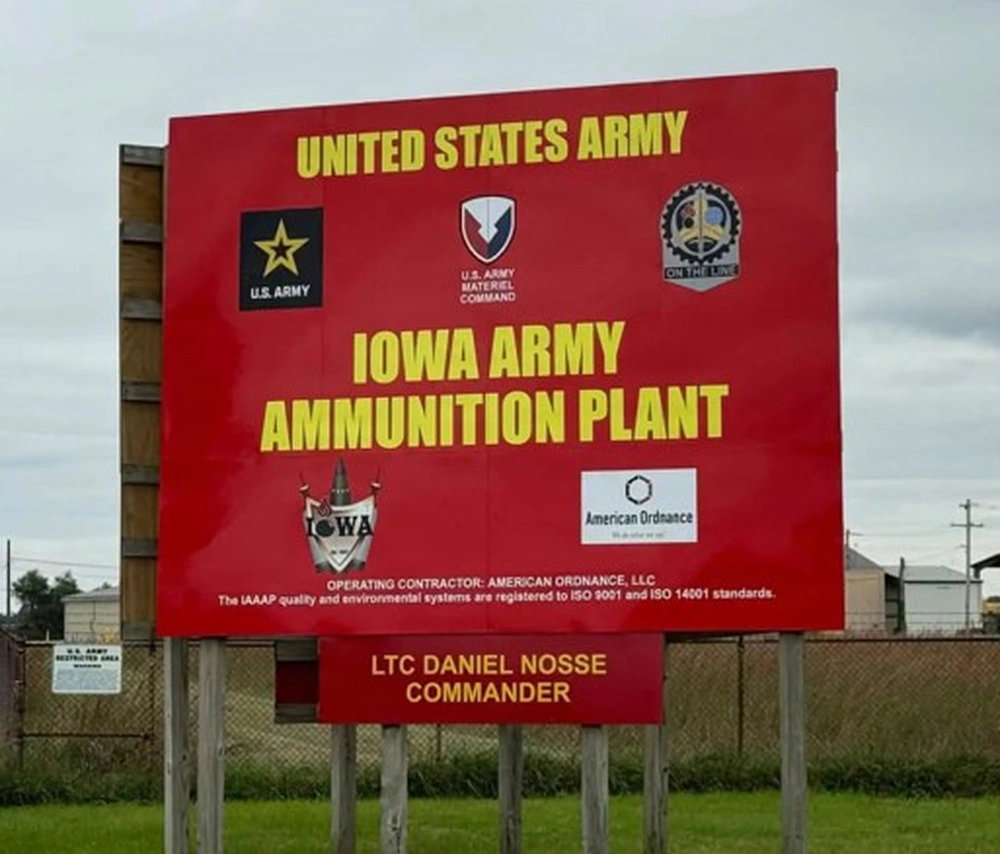
The U.S. Department of Justice (DOJ) has urged a federal appeals court to lift an administrative stay on a permit that would authorize the U.S. Army to detonate 9,700 pounds of degraded lead-based explosives in southeast Iowa. The DOJ insists that the action is critical to preventing an uncontrolled, and potentially catastrophic, explosion at the Iowa Army Ammunition Plant in Middletown.
The federal government’s latest filing on Sunday—the same day the Army intends to conduct the blast—followed the submission of new expert testimony from environmental groups challenging the necessity of the detonation. While the ongoing litigation before the U.S. Court of Appeals for the 8th Circuit concerns an emergency permit issued by the U.S. Environmental Protection Agency (EPA), the DOJ also signaled that the Army may bypass the permit entirely by invoking a specific exclusion in the law to proceed with the explosion on November 24.
The standoff stems from concerns regarding the stability of lead azide stored at the Middletown facility. The Army maintains that as temperatures drop, the chemical becomes increasingly unstable and prone to crystallization, elevating the risk of spontaneous, unplanned detonation. In contrast, environmental groups, including the Iowa Environmental Council and the Sierra Club Iowa Chapter, argue that the risks of a controlled detonation—which would release toxic lead particles into the air—have been insufficiently assessed and communicated to the public.
Scientific experts supporting the plaintiffs have cast doubt on the Army’s justification. Mark Thomas, a former EPA environmental health science researcher, argued in a court affidavit that the earthen structures surrounding the stored material provide significant insulation, protecting the explosives from the rapid temperature shifts cited by the Army as an imminent threat. Another expert, combustion specialist Ranajit Sahu, noted that the detonation process could release a wider array of toxic combustion byproducts than officials have acknowledged. He further argued that safer alternatives, such as chemical neutralization, were prematurely dismissed by the government.
The lack of transparency has caused significant alarm in surrounding communities. Iowa City, located approximately 62 miles from the detonation site, has expressed deep frustration over a lack of information. City Manager Geoff Fruin noted in a declaration that the municipality has received almost no formal notification or data regarding potential impacts on air quality or the Iowa River, which serves as the city’s primary water source. With thousands of children and elderly residents in the region, the city is calling for more comprehensive testing, mitigation, and public notice.
Conversely, some local residents in Middletown have expressed a desire for the Army to proceed with the detonation as soon as possible, fearing that the presence of the unstable material poses a greater immediate threat than the fallout from a controlled blast.
The DOJ continues to maintain that the environmental groups’ concerns, while noted, fail to acknowledge that there is no risk-free option. In its filing, the government emphasized that the “only choice is between a release the Army can manage and one it cannot.” They argued that the EPA’s permit is both reasonable and necessary, characterizing the plaintiffs’ legal challenge as an attempt to “second-guess” the technical judgment of government agencies.
As of Sunday afternoon, the Army had not released updated models or a finalized schedule for the operation. Environmental advocates continue to demand a full review of the situation, while the court weighs whether to maintain the stay or allow the Army to move forward with the disposal of the high-risk material.
Disclaimer: This content is auto-generated for informational purposes only.
Source: Read Original News