



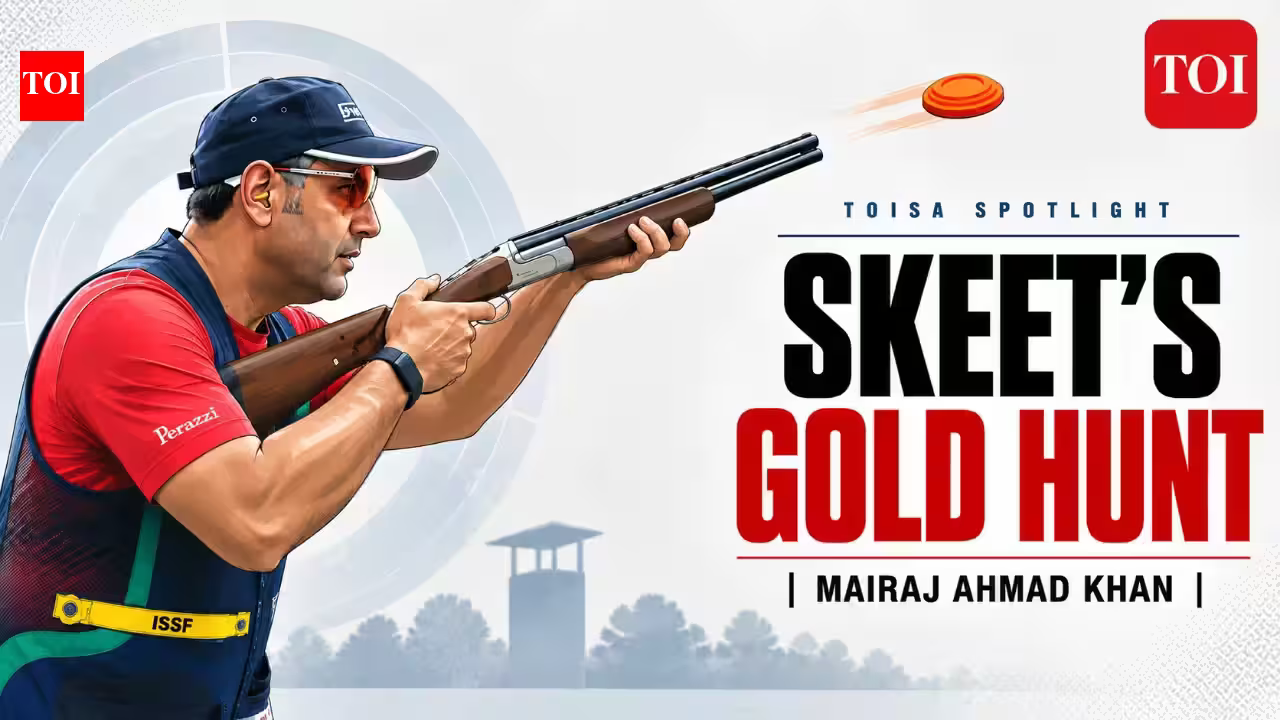
Persistence is a currency that Mairaj Ahmad Khan has spent liberally over the last two decades. As the veteran marksman prepares to step onto the range for his fourth Asian Games, the medal that currently occupies his headspace isn’t the one on the line in Japan. It is the elusive Olympic gold—the singular achievement that has remained just beyond his grasp for twenty years.
“Olympic gold, which I haven’t got yet. The fight is for that,” Khan says with the quiet intensity of a man who has made peace with his journey but refuses to concede his ambition. “I won’t leave it until I win. My first dream was to become an Olympian. That dream came true. Now the dream is to become an Olympic champion.”
At 50, Khan is more than just a competitor; he is an institution in Indian shooting. He holds the distinction of being the first Indian skeet shooter to qualify for the Olympic Games and the first to capture a men’s skeet World Cup gold. Yet, as he readies himself for his return to the Asian Games fold—nearly two decades after his debut in Doha 2006—he remains refreshingly grounded. “Mairaj Ahmed Khan is a very normal person,” he insists. “If I don’t shoot, I don’t think about shooting. I’m still working to tell everyone that Mairaj Ahmed Khan is alive and rocking.”
From the Cricket Pitch to the Shooting Range
The trajectory of his life could have easily taken a different turn. Before the rhythmic crack of a shotgun became his soundtrack, Khan was a devoted cricketer. “Mera pehla pyaar cricket tha,” he admits, recalling a time when his heart was set on the pitch rather than the podium. While his father, the late Ilyas Ahmed Khan, was a trap shooter who introduced him to the world of firearms, young Mairaj’s passion was strictly willow and leather.
He once famously spent 30 rupees in prize money from a local shooting competition to buy a cricket bat. He even played alongside a young Virender Sehwag, firmly believing that his future lay on the cricket field. However, in the late 1990s, professional sport in India looked very different. “Back then, nobody really looked at shooting as a career,” he notes. “Only rich people used to shoot—Maharajas and businessmen.”
With the backing of industrialist Naveen Jindal, Khan eventually committed to the sport, though his international debut in 2003 came later than that of his contemporaries. It was a late start, but one that Khan never viewed as a disadvantage.
The Philosophy of ‘Emptying the Cup’
The turning point in Khan’s technical and mental evolution arrived in 2013, when Atlanta Olympic champion Ennio Falco took the helm as India’s skeet coach. At the time, Khan describes the Indian contingent’s mindset as little more than “tourists” travelling at the government’s expense, lacking a true winning pedigree.
Falco’s philosophy was simple yet transformative: “You have to empty your cup.” It took time for Khan to grasp the depth of that advice—that to achieve greatness, he had to discard his old habits and biases and embrace a new, ruthless focus. Two years later, he secured India’s first Olympic quota in men’s skeet.
Looking back at his 2016 Rio experience, where he narrowly missed the final after a shoot-off, Khan remains haunted but enlightened. “Whenever I close my eyes, I can see myself on that range,” he says. The lesson he carried away was that the Olympic rings should not change the nature of the sport. “It’s the same competition of 125 targets. If you want to see that competition like a normal competition, like a selection trial or a World Cup, it must be that way.”
Surviving the Pandemic and Finding the Peak
The years leading up to Tokyo were a turbulent ordeal. After peaking in 2019 and early 2020—shooting a perfect 125/125 at the nationals—the COVID-19 pandemic halted everything. The year-long postponement and the personal tragedy of losing his father shortly before the Games left him struggling to regain his rhythm.
“I was in very supreme form… and then the pandemic came. You cannot carry your peak for two years,” Khan reflects. The solitude of training in Italy during the height of the crisis felt like “zombie land.” It took years for him to find his footing again, but a 2022 World Cup gold in Cairo served as the necessary catalyst. “If I didn’t win that World Cup, it would be a different Mairaj. That gold medal gave me another push.”
One Target at a Time
As he prepares for the rigors of the Asian Games, Khan’s approach remains stripped of unnecessary drama. He views his sport as a complex equation of environmental variables, equipment precision, and psychological endurance. He knows that at 50, he is competing against time, but his focus is entirely on the next station.
“Vincent Hancock also misses targets. But the difference between a loser and a winner is that the winner misses fewer targets,” Khan observes. “Never give up. In my diary, there is no word like this. I’m 50 years old and still working the same. I don’t have the feeling of giving up.”
As he looks toward the horizon—beyond Nagoya and toward the potential for another Olympic cycle—his motivation is singular. He references Abhinav Bindra, India’s only individual Olympic gold medalist in shooting, with a glint in his eye. “We have one Olympic champion in shooting,” he says. “What’s wrong if there are two?”
Disclaimer: This content is auto-generated for informational purposes only.
Source: Read Original News