








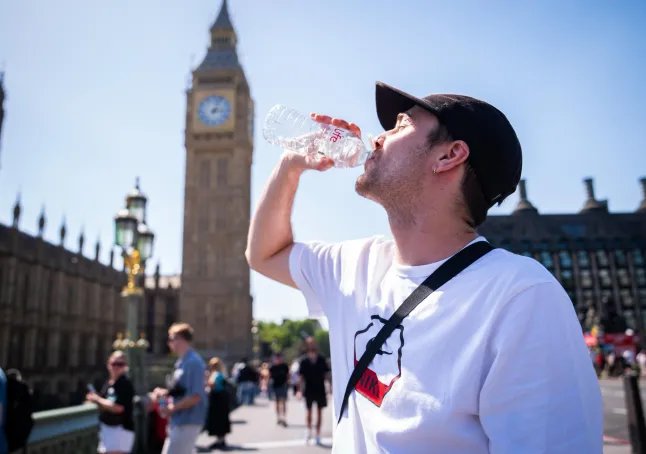

People in the UK woke up today – if they even managed to sleep – to yet more sweltering temperatures on the final day of a heatwave.
A record for the highest daily minimum temperature for May was set overnight as the temperature did not fall below 21.3°C at Kenley Airfield, south London, making it a ‘tropical night’.
The Met Office said on X that this makes last night a ‘tropical night’.
‘We have provisionally broken the UK record for highest daily minimum temperature in May… again,’ the weather service said.
It added: ‘Remarkably, the record was also broken yesterday.’
Sign up for all of the latest stories
Start your day informed with Metro’s News Updates newsletter or get Breaking News alerts the moment it happens.
The mercury is expected to climb to as high as 34°C in London today after the hottest day of May was recorded yesterday at 34.8°C.
The previous record was set in 1944, when Britain was baked by 32.8°C.
Forecasters described the heat as ‘unprecedented for the time of year,’ stressing that temperature records are typically broken by only fractions of a degree.
Wildfires have even erupted in some parts of the UK, including one that sparked in Holyrood Park, Edinburgh, yesterday evening.
Experts worry that blazes may break out in grassy, tourist hotspots like Buckingham Palace.


Multiple amber and yellow heat health warnings remain in place today, warning that there could be a ‘rise in deaths’.
Ambert alerts – the second-highest warning level in the UK Health Security Agency (UKHSA) three-tier system – are active in:
- London
- East of England
- South East
- West Midlands
- East Midlands
While yellow warnings cover the rest of England. These warnings, while not as severe, still warn that the heat poses a risk to vulnerable, older people.
Temperatures have been firmly in the high 20s or 30s for many parts of the UK since Saturday and well into the bank holiday weekend.
If anyone abroad is wondering why Britons are especially moaning about the heat, it’s because heat in the UK ‘hits differently’.
Unlike the US, where extreme heat is expected, the UK is not built for heat.
Fewer than 5% of homes have air-conditioning units, according to a report from the Department for Business, Energy and Industrial Strategy.
Most homes have Britain’s long, dark winters in mind, so are designed to keep heat.
Met Office spokesperson Stephen Dixon told Metro: ‘Meteorologically, the UK air tends to be more humid compared to that in continental Europe.
‘High humidity can make it harder for sweat to evaporate, which is how we naturally cool ourselves down.’
Get in touch with our news team by emailing us at webnews@metro.co.uk.
For more stories like this, check our news page.
MORE: London trains cancelled after smoke spotted on the track during heatwave
MORE: Two teenagers die in separate incidents on hottest day of the year so far
MORE: Edinburgh Marathon runners in hospital for heat stroke after bank holiday temperatures soar