







The UK is in the grip of a “firewave”, with this summer’s extreme heat producing the ideal conditions for wildfires, scientists and environmentalists have warned.
A particular danger was that more blazes seem to be taking place closer to urban areas rather than in remote countryside, causing hazards to homes and health, they said.
Wildfires have burned in places including North Yorkshire, County Durham, Greater Manchester, East Sussex, West Sussex, Devon, Somerset and London over the last few days.
Claire Belcher, director of the wildFIRE Lab at the University of Exeter, said: “This ongoing ‘firewave’ is the most widespread that the UK has seen. We’ve had lots of fires in certain regions before, but we’ve never seen fires burning right across the country like this.
“Climate change is making wildfires more likely – with wet winters causing more vegetation growth, and prolonged heatwaves drying that vegetation – and we must manage our land better to reduce risks and stop fires spreading. The impact of wildfires on wildlife can be devastating, and restoring landscapes afterwards is really challenging.”
As of Monday afternoon, the National Fire Chiefs Council said emergency services were dealing with 19 wildfires.
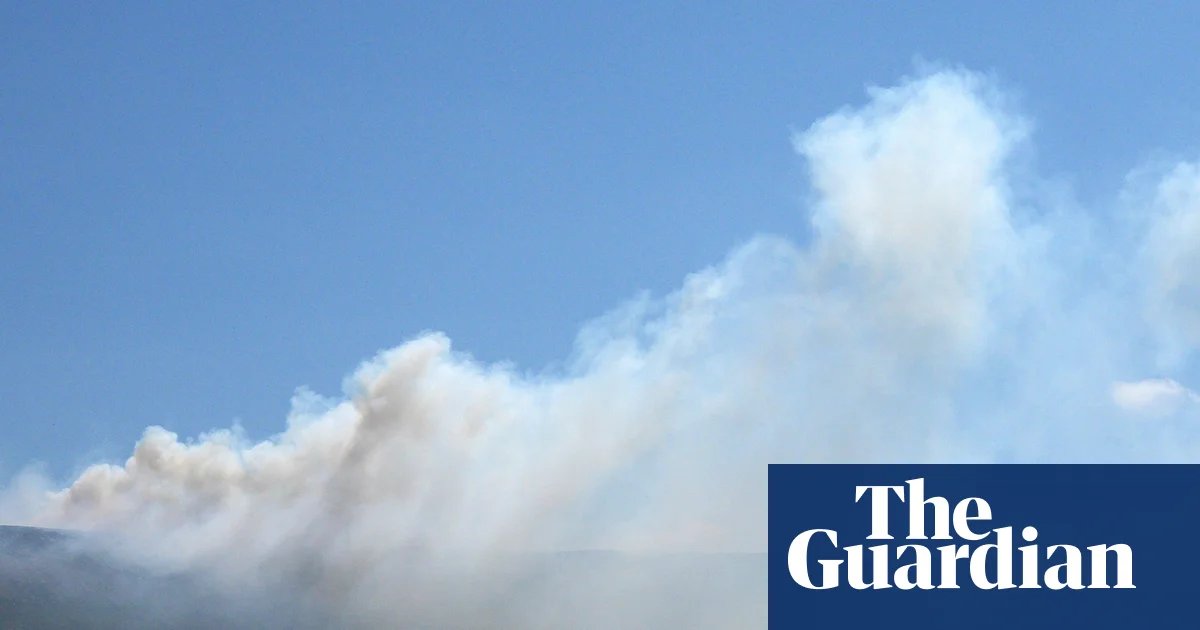
Two fire services have declared major incidents and people were evacuated from near a mountainside in north Wales, where residents described hearing crackling fire advancing towards homes as ash fell from a sky turned dark by thick smoke.
At 5pm on Monday North Wales fire and rescue service said it had stood down the major incident and it was safe for evacuated residents to return but warned people to keep windows shut.
Maria Barbosa, wildfire scientist at the UK Centre for Ecology & Hydrology, said: “What we are witnessing is climate change actively rewriting the vulnerability of the British landscape.
“When landscapes experience several consecutive days with temperatures above 30°C and little or no rain, plants and soils lose moisture faster than they can recover. Vegetation becomes a more available fuel source, making it much easier for fires to spread.
“The impacts extend well beyond the fires themselves. High temperatures are already affecting public health, especially among vulnerable populations. When wildfire smoke is added to a heatwave, air quality can deteriorate significantly, increasing respiratory and cardiovascular risks. Smoke can travel long distances, exposing communities far from the fire front to harmful pollutants and compounding the health burden of extreme heat.”
Vikki Thompson, postdoctoral researcher in impact attribution from extreme weather events at the University of Edinburgh, said: “This week parts of the UK will experience the perfect weather conditions for wildfires: hot, dry, and windy. This leads to the exceptional fire danger.”
A local councillor, Cathy Augustine, said: “It’s incredibly sad that the fire is in the very special Carneddau landscape – a beautiful part of north Wales but also really difficult terrain for firefighters to work in. It’s also home to important wildlife.”
She said some residents who had to flee were initially been taken in by a local pub, the Gladstone, and one school had closed for the day. Local volunteers were helping care for wild ponies.
Natural England said there remained an “exceptional fire risk” in pockets of southern Britain and a “very high” risk for much of England and Wales.
A second major incident was declared in Derbyshire, where fire chiefs said they were working to protect homes, infrastructure and wildlife.
Derbyshire fire and rescue service (DFRS) said there was a “large-scale wildfire” at Tintwistle Moor caused by “tinder dry” ground. The operation to douse the flames included dropping water from helicopters.
Extra firefighters from neighbouring services were called in to help, along with mountain rescue teams and the police.
The Greater Manchester fire and rescue service was called to a moorland fire near Dovestone Reservoir. A spokesperson said: “Due to strong winds, smoke from the fire travelled significant distances, with people reporting haze and the smell of smoke as far as Manchester city centre.”
In Walthamstow, east London, 125 firefighters tackled a blaze that affected a house, gardens and sheds and a railway embankment. Some residents were evacuated and two rest centres were set up. The cause of the fire is under investigation.
About 50 firefighters from London fire brigade also fought a wildfire in Orpington in the south-east of the capital. The fire service said several acres of grass were alight across two fields.
Thomas Smith, associate professor in environmental geography at the London School of Economics and Political Science, said: “The UK has traditionally experienced many of its larger heathland and moorland fires in spring, when dead vegetation remains from winter and live plants have not yet fully greened up.
“In an ordinary summer, that new green growth contains enough moisture to make much of the landscape more resistant to fire. What we are seeing during repeated and exceptional heatwaves is that this natural seasonal protection can break down.
“The other important feature of this weekend was the number of fires occurring at the rural–urban interface, where flammable vegetation meets homes and infrastructure.
“The fires around York and Walthamstow may be small compared with the large moorland fires that dominate annual burned-area statistics for the UK, but their consequences can be disproportionately large – a relatively small vegetation fire in a densely populated area can become a major emergency.”