








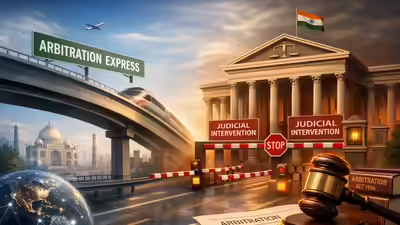
In a global economy defined by speed, certainty and cross-border commerce, dispute resolution can no longer afford to move at the pace of traditional litigation. Arbitration has, therefore, emerged not merely as an alternative but as the preferred mechanism for resolving complex commercial disputes. Its appeal lies in efficiency, flexibility and finality. Yet, the success of arbitration rests on a principle so fundamental that without it, the entire edifice begins to falter, and that is – minimum judicial interference. India’s arbitration framework, governed by the Arbitration and Conciliation Act, 1996, is built on this very premise. Section 5 of the Act explicitly limits judicial intervention, aligning India with the UNCITRAL Model Law and global best practices. The legislative intent is unambiguous: courts are to support arbitration, not supplant it.And yet, the journey of arbitration in India has often resembled an express highway interrupted by frequent toll gates. While the destination promises efficiency, the route is so many times slowed by judicial intervention, therefore raising a critical question, “Is arbitration truly autonomous, or is it still tethered to the courts it seeks to bypass?Legislative Design and Judicial DoctrineThe architecture of India’s arbitration regime reflects a deliberate shift towards autonomy. The doctrine of Kompetenz-Kompetenz, enshrined in Section 16, empowers arbitral tribunals to determine their own jurisdiction. This principle is not merely procedural, it is foundational. It ensures that arbitral proceedings are not derailed at the threshold by prolonged judicial scrutiny.The arbitration jurisprudence reaffirms this approach, limiting judicial intervention at the referral stage under Sections 8 and 11 to a prima facie examination. This marks a significant step towards aligning India’s arbitration law with international standards, where courts exercise restraint and defer to arbitral tribunals. The underlying philosophy is clear – when parties choose arbitration, they choose autonomy.As experience has shown across jurisdictions, where courts step in too readily, arbitration begins to resemble litigation in disguise. And when that happens, the very purpose of arbitration stands diluted.Judicial Restraint Not a Courtesy, but a NecessityThe call for judicial restraint has gained renewed urgency in recent discourse. The Hon’ble Mr. Chief Justice of India Surya Kant, addressing the ICA International Conference, aptly described arbitration as an “express highway” for dispute resolution, one that must remain free from unnecessary obstructions. The metaphor is instructive.An express highway delivers value only when it remains uninterrupted. If every few kilometres require a halt, inspection or reconsideration, the advantage of speed is lost. Similarly, arbitration can only function effectively when courts resist the temptation to intervene beyond the limited scope envisaged by the statute.This is not to suggest that judicial oversight is redundant. On the contrary, it remains essential in ensuring fairness, legality, and procedural integrity. But oversight must not transform into overreach. There is no prize for guessing – when intervention becomes routine, autonomy becomes illusory.Anti-Arbitration Injunctions and Post-Award Review The Corridor of Intervention is narrow. One of the most contentious areas of judicial intervention lies in anti-arbitration injunctions. These orders, which restrain parties from initiating or continuing arbitration, have the potential to derail proceedings entirely. Recognising this, courts have increasingly emphasised that such injunctions must remain exceptional, not routine. This approach aligns with global jurisprudence, where respect for party autonomy and contractual commitments forms the bedrock of arbitration.Equally significant is the scope of judicial review at the post-award stage. Sections 34 and 37 of the Arbitration Act provide limited grounds for setting aside or appealing arbitral awards. These include jurisdictional errors, procedural irregularities, and violations of public policy. However, the interpretation of “public policy” has historically been a point of contention. At times, courts have expanded this ground to undertake a deeper examination of arbitral awards, thereby blurring the line between review and re-adjudication. While recent jurisprudence has sought to narrow this scope, the need for consistency remains critical. Because the strength of arbitration lies in finality. If awards are routinely reopened, the process loses its credibility. A journey that is endlessly revisited never truly reaches its destination.Technology, AI and the New Arbitration LandscapeArbitration today is not merely evolving in legal terms, it is being reshaped by technology. Virtual hearings, digital filings and online case management systems have transformed accessibility and efficiency. What once required physical presence and logistical coordination can now be conducted seamlessly across jurisdictions.However, the integration of Artificial Intelligence (AI) in arbitration introduces both opportunity and risk. AI-driven tools can assist in document review, case analysis and predictive outcomes. They reduce time, cost and human error. But they also raise fundamental questions about decision-making.Arbitration derives its legitimacy not merely from efficiency, but from the confidence that decisions are grounded in human judgment – reasoned, contextual and accountable. Technology can assist, but it cannot replace this human element. If arbitration becomes overly reliant on automated processes, it risks losing the very quality that distinguishes it and that is, the trust of the parties.Arbitration as an Economic ImperativeBeyond legal doctrine, arbitration plays a critical role in economic development.For investors, both domestic and international, the availability of a reliable dispute resolution mechanism is a key consideration. Predictability, enforceability and efficiency are not abstract ideals; they are practical necessities.A robust arbitration framework enhances investor confidence, facilitates cross-border transactions and strengthens India’s position as a global economic hub.Conversely, uncertainty and excessive judicial interference can have a chilling effect. If parties perceive that arbitration in India is susceptible to prolonged litigation, they may opt for alternative jurisdictions. In a competitive global landscape, perception often shapes reality.The Way Forward: From Intervention to ConfidenceThe path ahead requires a calibrated and consistent approach. First, judicial discipline must remain paramount. Courts must adhere to the statutory mandate of minimal interference, ensuring that arbitration retains its autonomy.Second, capacity building is essential. Judges, arbitrators and practitioners must be equipped with the knowledge and skills required to handle complex arbitration matters, particularly those involving cross-border elements.Third, institutional arbitration must be strengthened. Well-functioning arbitral institutions can enhance efficiency, reduce delays and bring India closer to global standards.Fourth, technology must be embraced thoughtfully. While digital tools can enhance efficiency, they must operate under frameworks that ensure accountability and fairness.Finally, legislative clarity must continue to evolve, addressing ambiguities and reinforcing India’s pro-arbitration stance.Conclusion: When Less is MoreThe principle of minimum judicial interference is not merely a procedural guideline; it is the cornerstone of a credible arbitration ecosystem. When courts exercise restraint, arbitration thrives. When they intervene excessively, its purpose is diminished. The balance, therefore, is delicate but essential.In the end, arbitration is a promise, a promise of efficiency, autonomy and finality. For that promise to be realised, courts must recognise that sometimes, the most powerful role they can play is not to step in, but to step back. In arbitration, as in many aspects of law, less is often more, and when restraint guides intervention, justice not only moves faster, it moves with greater certainty.