








US Politicians Launch Campaign to Reject RSS-Linked Campaign Donations
New York: A coalition of 90 American politicians, including high-profile U.S. Representatives Pramila Jayapal and Ro Khanna, has formally pledged to reject all financial contributions from individuals or entities linked to the Rashtriya Swayamsevak Sangh (RSS). The move, which has sparked a sharp backlash from Hindu advocacy groups, follows a high-profile visit to the United States by the organization’s chief, Mohan Bhagwat.
The pledge was unveiled on August 31 by two advocacy groups, Hindus for Human Rights Action and the South Asian American Coalition to Renew Democracy Acts (SACRED Acts). The campaign targets elected officials and candidates at the federal, state, and local levels across eight U.S. states, urging them to sever financial ties with affiliates of the RSS.
Catalyst for the Pledge
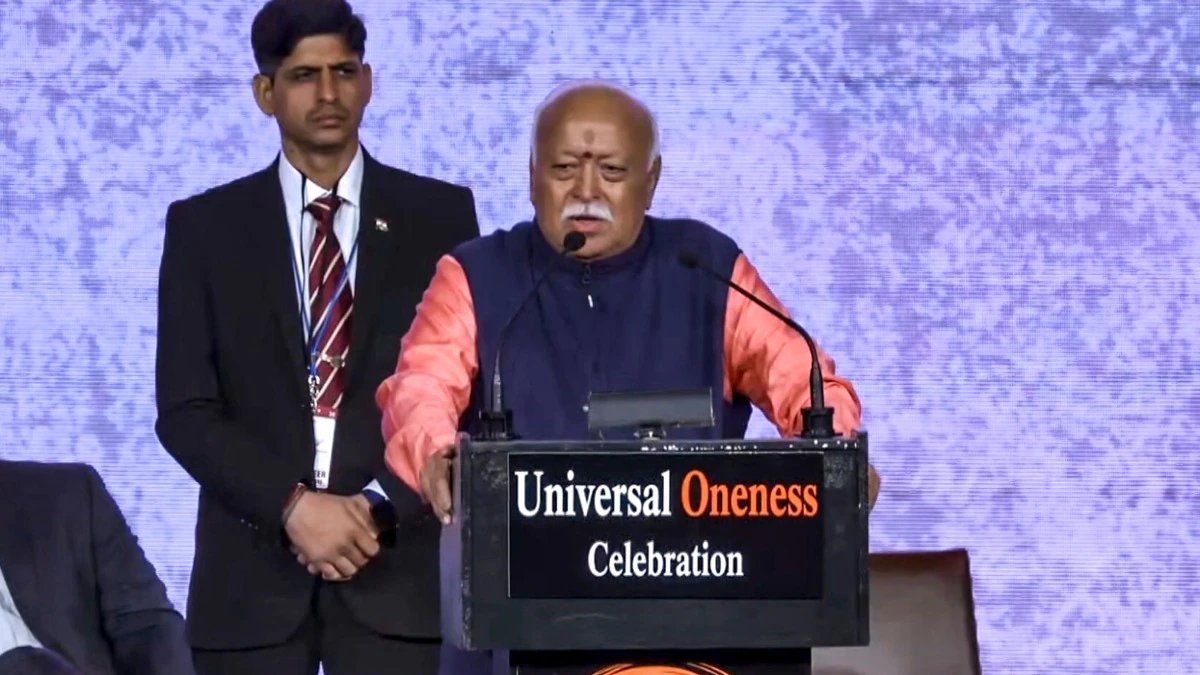
The initiative emerged in direct response to Bhagwat’s August 29 appearance at Madison Square Garden in New York City. While the event was billed as a “Universal Oneness Celebration” aimed at promoting interfaith dialogue, it drew significant protest. Prior to the event, the U.S. Commission on International Religious Freedom (USCIRF) had called for sanctions against the organization, citing allegations of “perpetuating attacks on religious minorities.”
Local opposition also mounted, with New York City official Zohran Mamdani publicly criticizing the organization as “exclusionary,” though no legal measures were taken to block the gathering.
Political Fallout
The pledge has garnered support from a diverse group of Democrats and Republicans. Representative Pramila Jayapal justified her participation in the initiative by describing the RSS as a “right-wing organization” that actively seeks to “destabilize and undermine democracy in India.”
Representative Ro Khanna, another key signatory, expressed his intent to prevent the group from influencing the American political landscape. “I am proud to announce that I am taking SACRED Acts’ and Hindus for Human Rights Action’s Nonviolence Pledge to ensure that the RSS, the group behind Gandhi’s assassination, cannot create a PAC or influence elections in the US,” Khanna stated. He further confirmed he is donating away a $6,600 contribution he discovered was linked to a pro-MAGA billionaire with ties to the RSS.
Despite the firm stance taken by these lawmakers, the effort has been met with skepticism. Critics have pointed to reports suggesting that some signatories, including Khanna, have previously accepted substantial funds from prominent Hindu nationalist figures, suggesting that fulfilling the pledge fully may prove complex.
Accusations of Discrimination
The initiative has been met with fierce condemnation from organizations such as the Hindu American Political Action Committee (HAPAC) and the Hindu American Foundation (HAF).
HAPAC characterized the campaign as the work of “radical far-left outfits,” labeling the move as “anti-Hindu” and “anti-American.” The organization claimed that many signatories were either misled or pressured into signing, arguing that the pledge imposes a discriminatory “loyalty test” on Hindu American donors.
Suhag A. Shukla, executive director of the Hindu American Foundation, echoed these concerns on social media, asserting that the pledge singles out a specific community based on “presumed dual loyalty” to a foreign entity. “No other American citizens’ contributions will be scrutinized,” Shukla noted, adding that the effort to investigate only Hindu American donors is “un-American to the core.”
As the political discourse intensifies, the RSS-linked donation controversy highlights growing tensions over the influence of foreign political ideologies within the American democratic process, setting the stage for a protracted debate on the boundaries of political advocacy and civic participation.