








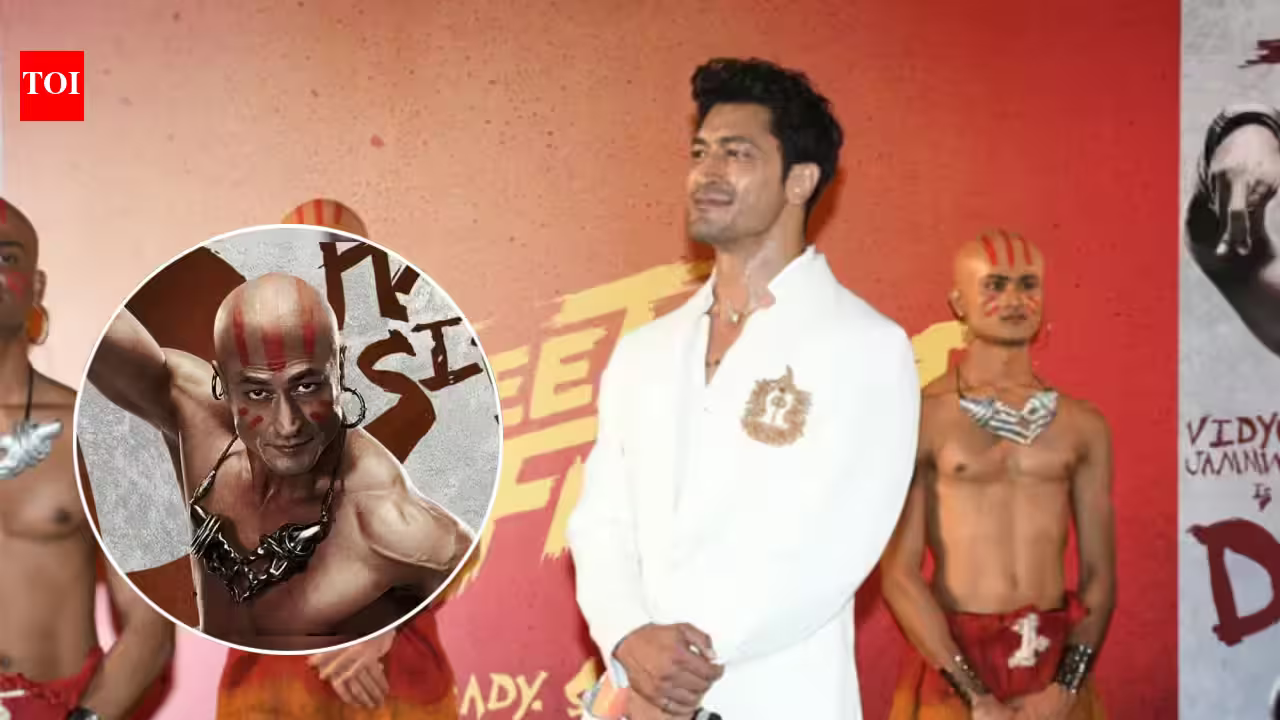
Vidyut Jammwal has never been an actor who plays by the rules of Bollywood’s traditional stardom. While his contemporaries spent years perfecting the art of the choreographed dance number, Jammwal was busy in the shadows, mastering the lethal, rhythmic grace of kalaripayattu. Now, that lifelong dedication to India’s ancient martial art is about to take him to the biggest stage on the planet: Hollywood.
As he prepares for the October 16 release of Street Fighter, the adaptation of Capcom’s legendary video game franchise, Jammwal isn’t just stepping into a role—he is fulfilling a destiny that feels almost tailor-made for his skill set. Cast as Dhalsim, the stretchy-limbed, fire-breathing yogi who stands as one of gaming’s most iconic figures, Jammwal isn’t playing a caricature; he’s playing a version of himself.
The Perfect Alignment of Actor and Icon
For those who have followed Jammwal’s career—from the breathless intensity of Commando to the visceral combat of Khuda Haafiz—the casting of Dhalsim feels like a cosmic alignment. Speaking recently about the transition, Jammwal noted that the character’s foundation is built on the exact pillars he has cultivated since age three.
“He is a martial artist, a kalaripayattu practitioner. He does yoga. Of course, he does that yoga flame and the supernatural things that I can’t,” Jammwal joked, maintaining his characteristic poise. “But it was very close to me.”
The project has been a long time coming, not just for the audience, but for an actor who has been waiting for the right international vessel to carry his specific brand of athleticism. Street Fighter is a beast of a franchise—a cultural touchstone that has languished in live-action purgatory for years. Jammwal’s involvement signals a shift in tone: this isn’t just a popcorn flick; it’s a high-stakes arena where global action legends are set to collide.
An Unexpected Assembly of Titans
The Street Fighter call sheet reads like a fever dream for action junkies. We aren’t talking about standard casting; we are talking about a roster that includes the raw power of Roman Reigns, the charisma of Cody Rhodes, the imposing presence of Jason Momoa, and the cultural weight of 50 Cent. Rounding out the ensemble are Noah Centineo, Andrew Koji, and Callina Liang.
For Jammwal, the draw wasn’t just the screen time; it was the proximity to greatness. “For me, I was looking forward to working with legends I have always known,” he reflected. “I was excited I would get to be with these people rather than just meeting them for a party.”
In an industry often marred by ego and territorialism, Jammwal found a different frequency on the Street Fighter set. He describes a brotherhood among these stars that defied the typical Hollywood hierarchy. Watching these men operate—successful, wealthy, yet grounded—has left a mark on him. “These are men you can really hang around with,” he added. “They are successful, yet secure. There is no pretence.”
The Cultural Paradox: Hollywood’s Appreciation of Indian Roots
Perhaps the most stinging, albeit insightful, takeaway from Jammwal’s experience is his realization regarding the global reception of Indian heritage. While Indian cinema has frequently commodified martial arts as a spectacle, Jammwal found that his Hollywood co-stars were deeply invested in the history and technical mastery of kalaripayattu.
“These 9-10 global legends know more about kalaripayattu than many Indians,” he admitted with a note of melancholy. He describes moments on set where the sheer discipline of the art form—including the traditional use of the shankh—was met with genuine reverence by stars like 50 Cent and Noah Centineo. It is a striking irony: an Indian martial artist having to explain the depth of his nation’s heritage to the West, only to find the West already waiting with open arms and inquisitive minds.
This experience has reinforced Jammwal’s mission. He isn’t just looking to be an actor in a foreign market; he is acting as an ambassador for a discipline that predates modern sports by centuries.
The “Bruce Lee” Moment for Kalaripayattu
The question of whether Street Fighter will serve as the watershed moment for kalaripayattu—similar to what Enter the Dragon did for Kung Fu in the 1970s—is one that Jammwal doesn’t take lightly. He is a realist, but he is also an optimist.
“If I could do what Bruce Lee did for Kung Fu? Kung Fu had its good fortune,” he muses. “Kalaripayattu will have its time too.”
For years, Jammwal has been a lone wolf in the Indian industry, championing the art form in music videos, documentaries, and social media clips, often pushing his body to the absolute limit. Seeing that dedication potentially translated into a global franchise release is, by his own account, life-changing. He isn’t asking for the recognition to be centered on him; he is asking for the world to look at the craft.
What to Expect on October 16
As the release date nears, the anticipation surrounding Street Fighter is reaching a fever pitch. Fans of the game are bracing for a live-action experience that finally respects the source material, and Indian fans are eager to see if their homegrown action hero can truly stand toe-to-toe with the biggest names in Hollywood.
Vidyut Jammwal has spent his life training for moments exactly like this. He brings an authenticity to the screen that money can’t buy and CGI can’t replicate. Whether he’s embodying the enigmatic spirit of Dhalsim or simply representing the discipline of his ancestors on a global stage, one thing is certain: when the first trailers drop and the theater lights dim, the world will see that the fire of kalaripayattu is well and truly burning.
October 16 isn’t just a release date for a film; it is a coronation of sorts for one of India’s most singular talents. And if the rumors from the set are to be believed, the world is about to realize exactly what we’ve known all along: Vidyut Jammwal doesn’t just play the part—he is the art.
Disclaimer: This content is auto-generated for informational purposes only.
Source: Read Original News