








Andrew here. I’m in Los Angeles, where the finance world has gathered for the Milken Institute Global Conference.
We have a packed briefing for you on Monday: a scoop on Google and the White House; more on GameStop’s roughly $55 billion takeover bid for eBay; and a look at Berkshire Hathaway’s annual meeting — the first without Warren Buffett on the stage.
One note from here in L.A.: The mood is shockingly bullish. I was at a dinner where, by a show of hands, virtually no one polled said they believed that we were in an A.I. bubble. Think about that. Is it a positive sign of the boom’s staying power? The ultimate crowded trade?
The Trump administration’s compute fears
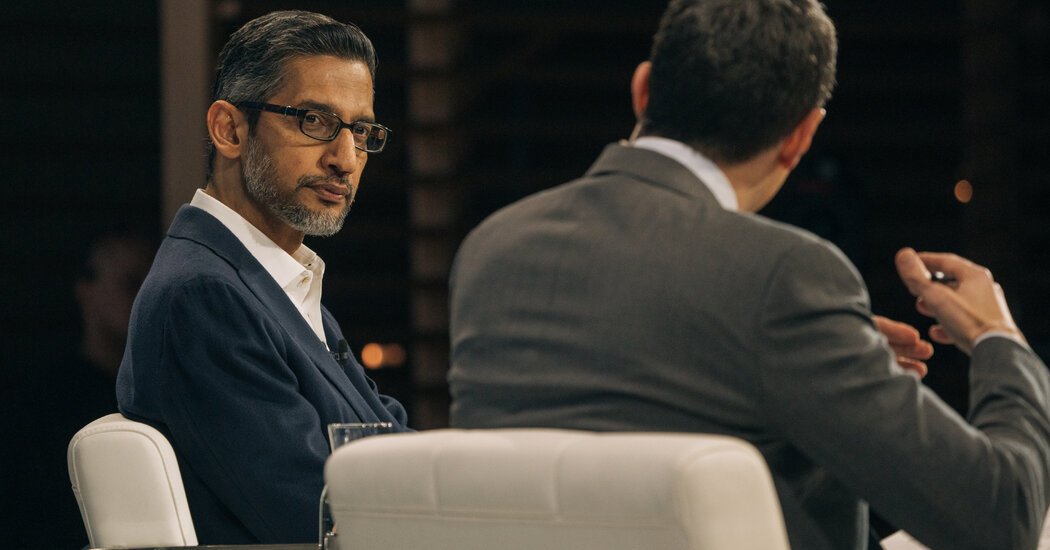
The C.E.O. of Alphabet, Sundar Pichai, was at the White House on Thursday for a series of high-stakes meetings with senior Trump administration officials.
The official agenda was cybersecurity threats. But DealBook has learned that the subtext was more specific: worries about artificial intelligence “capacity” — and the government’s struggle to secure enough A.I. processing power to maintain its own defenses.
It’s the latest fallout from Anthropic’s Claude Mythos Preview model, access to which is restricted to several dozen corporate and government users. Anthropic has described the limited release as a safety-first measure, but it has also spooked the Beltway.
Recent tests suggest that Mythos can identify and exploit vulnerabilities in critical software infrastructure at a speed traditional cybersecurity teams can’t match.
But the administration is worried that Anthropic doesn’t have enough “compute,” industry lingo for computing power, and that the company might have to throttle the use of Mythos even for high-priority users. In a crisis, some officials fear, the government could be locked out of the tools it needs to patch its software systems.
That’s where Google (and OpenAI and others) come in. Even as the administration appears to be easing tensions with Anthropic, it’s hoping to use Google’s Gemini, OpenAI’s GPT models and other bleeding-edge tools to decrease its reliance on Claude.
Separately, the Pentagon last week said that it had reached deals to use several more models beyond Claude on classified work.
Google does face a big challenge, DealBook understands: Some of its A.I. processing chips, known as TPUs, can’t be used in some classified contexts. Anthropic became an easy option for the government because its models largely run on Amazon Web Services, Amazon’s cloud computing platform, which has spent billions to achieve so-called Impact Level 6 security certifications.
The government is seeking ways to help accelerate similar clearance for Google TPUs.
-
In related news, Anthropic is nearing a $1.5 billion joint venture with Wall Street giants, including Goldman Sachs and Blackstone, to sell A.I. tools to private-equity-backed companies, according to The Wall Street Journal, which cited unnamed sources.
HERE’S WHAT’S HAPPENING
Oil prices rise despite President Trump’s pledge to unclog the Strait of Hormuz. Brent crude, the global benchmark for oil, climbed above $111 a barrel, while the average price of U.S. gasoline hit $4.46 on Monday, according to AAA. Markets appear unconvinced by Trump’s latest effort to help guide ships stranded in the critical waterway since the war with Iran began; the initiative was short on detail and does not appear to involve escorting vessels.
A Trump ally suggests the criminal investigation into Jay Powell could be revived. Jeanine Pirro, the U.S. attorney in Washington and a Trump loyalist, told CNN’s “State of the Union” on Sunday that she wouldn’t rule out reopening the inquiry into the renovation of the central bank’s headquarters. Powell, the departing Fed chair, has cited the matter — widely perceived as an attack on the institution’s political independence — as a reason for staying on as a governor.
Rudy Giuliani is in “critical but stable” condition. The 81-year-old former mayor of New York City is in a Florida hospital, a spokesman said on Sunday, declining to say when or where he was hospitalized. Giuliani, who has been troubled by financial and legal woes, suffered a fractured vertebra in a car crash last year and has been seen only sporadically in public since.
Betting on a meme-stock M.&A. boost?
Ryan Cohen has made money from audacious investments before, including when he bought into GameStop and turned it into the archetypal meme stock.
Now, he’s making a more ambitious bet, overseeing GameStop’s proposed $55 billion takeover of the much larger eBay. The question is whether he can successfully lead his vast retail investor following to help him in his long-shot quest.
Here’s what the GameStop bid looks like:
-
$125 a share, split evenly between cash and stock. That’s about 20 percent above where eBay was trading on Friday, before The Wall Street Journal reported details of the potential bid.
-
Cohen’s company said it had already built up a 5 percent stake in eBay.
Analysts and investors have asked how Cohen would pay for the deal. GameStop’s market value is about $11 billion, while eBay’s is roughly $46 billion.
Cohen disclosed that he had a $20 billion financing commitment from TD Bank. (GameStop already has $9 billion in cash.) And he has pledged to find $2 billion in annualized cost savings within 12 months of the deal closing.
While Cohen told The Journal on Sunday that he would be willing to wage a proxy fight if eBay resists, he may have to increase his offer to win over other shareholders.
Could rallying meme-stock investors be a key to victory? Cohen has built a following among denizens of internet investing forums who have helped buoy GameStop’s share price. They’ve also helped Cohen with other investment bets, including buying up stakes at Bed Bath & Beyond and Nordstrom.
A flood of supporters purchasing GameStop’s stock could make it a more valuable currency for a deal. That said, its shares are down in premarket trading on Monday.
Cohen has already outlined some ambitious goals for eBay should he win it, telling The Journal that he could integrate eBay with GameStop’s bricks-and-mortar stores and have eBay do more with live shopping.
But he faces several challenges:
-
Shares in GameStop are down nearly 39 percent over the past five years, as the retailer has sought to cut costs and pivot toward selling collectibles.
-
Cohen’s track record has been mixed: He quickly exited Bed Bath & Beyond’s stock after just five months, with the retailer subsequently filing for bankruptcy. And he withdrew a proxy challenge at Nordstrom.
-
The deadline to select eBay board candidates in time for the company’s annual meeting in June has already passed.
Abel’s first shareholder exam
For years, Berkshire Hathaway’s annual shareholder meeting in Omaha, Neb., has been a must-attend event for investors, as people gathered from around the world to hear what Warren Buffett had to say.
But the conglomerate’s gathering on Saturday, the first since Greg Abel took over as C.E.O., appeared to draw fewer people. And it raised big questions about what Berkshire would be like without Buffett as its leader.
The highlights:
-
Berkshire now sits on more than $380 billion in cash and equivalents, an astounding amount of financial firepower for what Buffett frequently called his “elephant gun.”
-
Abel largely projected an aura of steadiness and pledged that he wouldn’t seek to break up Berkshire.
-
Some shareholders said that Abel, known for his operational expertise, demonstrated greater granular knowledge of Berkshire’s businesses than Buffett did.
A bigger test for Abel looms. Even Buffett acknowledged in an interview with CNBC that now isn’t a great time for Berkshire to buy things. Buffett added: “We’ve never had people in a more gambling mood than now. That means prices for an awful lot of things will look pretty silly.”
Abel also argued, that like Buffett, he would be disciplined in investing Berkshire’s cash. “It doesn’t mean you need to deploy all your capital or spend all your money right now,” he said of the company’s resources.
But $380 billion is a lot of money to spend. And with Berkshire’s stock price stagnant — it has lost 12 percent over the past 12 months, compared with a roughly 28 percent gain in the S&P 500 — Abel will be under pressure to show solid returns, quickly.
Is the Buffett magic wearing off? Following one of the most influential capitalists in modern history was always going to be difficult.
Reuters reported that several thousand seats at the meeting appeared to be empty, a rarity for the event. And Berkshire-owned brands like See’s Candies that set up shops for shareholders at the meeting had lots of unsold merchandise at the end of the day.
That could be a problem for Berkshire-owned local businesses like the Nebraska Furniture Mart and the jeweler Borsheims that earn significant revenue during the annual meeting weekend.
Karp defends Paul Weiss’s deal with Trump
Two months after Brad Karp resigned as chairman of Paul Weiss over revelations of his interactions with Jeffrey Epstein, he appeared virtually before a Harvard Law School class to discuss a range of issues, according to The Harvard Crimson, citing students who attended the lecture.
And Karp faced backlash from some over his ties to Epstein, which he has said he regrets.
During the session, Karp, a veteran lawyer, defended Paul Weiss’s settlement with the Trump administration, a move that has continued to draw criticism.
It reflects how the fallout from President Trump’s battles with law firms continues to reverberate more than a year later.
What Karp told the students, according to The Crimson:
-
Paul Weiss’s partners unanimously agreed to seek a settlement with the administration, amid fears that others would try to poach their lawyers. (Karp claimed to have inadvertently received an email from a rival firm signaling its plans to do just that.)
-
Before settling, Karp said, he discussed with other firms putting up a united front against the administration. It didn’t work; several other major firms reached their own deals with the White House.
-
Karp briefly considered resigning, but his wife persuaded him to stay.
As part of the deal, Paul Weiss agreed to provide about $40 million worth of free legal work on matters championed by Trump.
Not everyone agreed with Karp’s claims. George Conway III, the former conservative lawyer turned Trump critic and Democratic congressional candidate, dismissed Karp’s statement that the settlement was needed for Paul Weiss’s survival. (In March, the administration signaled that it would abandon efforts to punish four firms that didn’t reach settlement pacts, though it quickly reversed course.)
“The law firms that fought Trump not only won, but prospered,” Conway wrote on social media. “Karp should hang his head in shame.”
Karp also took heat over his Epstein connections. Annette Gordon-Reed, the Harvard professor who teaches the class, told students that questions related to the matter weren’t allowed.
Still, one student displayed a picture of Epstein on a laptop that was visible on a Zoom call of the class, The Crimson reported.
THE SPEED READ
Deals
-
Banks including JPMorgan Chase, Morgan Stanley and Japan’s MUFG are reportedly looking to sell on their exposure to the ballooning debt tied to the construction of new data centers. (FT)
-
Cerebras Systems, a maker of chips for artificial intelligence applications, is seeking to raise $3.5 billion in an I.P.O., its second attempt to go public since October. (Reuters)
Politics, policy and regulation
Best of the rest
We’d like your feedback! Please email thoughts and suggestions to dealbook@nytimes.com.