










Gretchen A. Peck | E&P Magazine
Every news outlet today — no matter their platform or profit model — wants to be considered the most trusted source of news for the communities they serve. That’s especially true for breaking news events, when questions and speculations swirl.
As part of a larger Pew-Knight Initiative study, “Americans’ Complicated Relationship With News,” published last December, Washington, D.C.-based Pew Research Center asked the question: “Where do Americans turn first for information about breaking news?”
Michael Lipka is associate director of research at Pew Research Center. He set up the scenario the study explored: “You’ve heard that something has happened, something breaking. What’s your instinct after that? Where are you going to go to find out more?”
The survey queried 4,065 randomly selected U.S. adults; 88% responded, creating a panel of 3,560 participants.
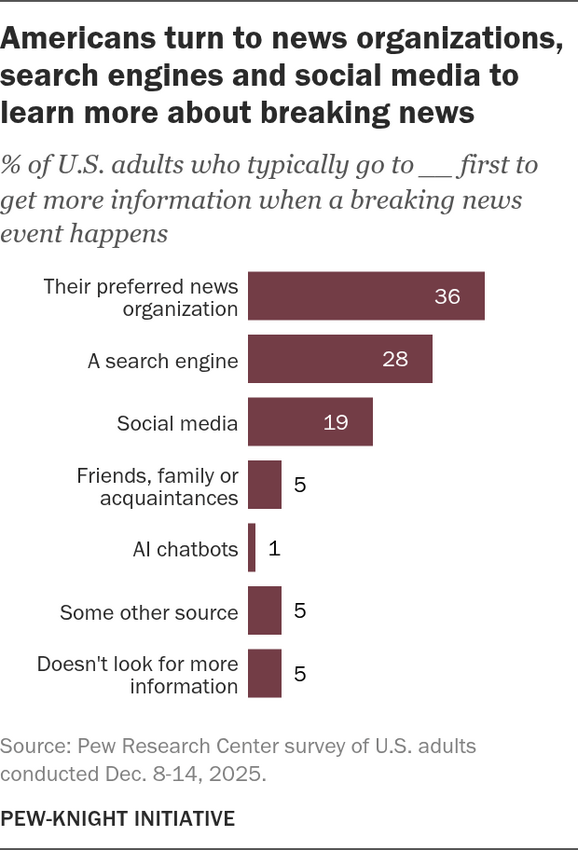
Thirty-six percent of the adults surveyed reported they turn to “their preferred news organization.”
“That number was higher a few years ago, [54%]” said Lipka. “We’d asked a similar question — not a perfect apples-to-apples comparison, like we do with a lot of our questions, where we trend things over time.”
The study lacks some insight into what the respondents mean by “their preferred news organization.” Lipka explained that they crafted the question to allow for broad interpretation of the term. It might be a major-market or a local community newspaper, a nonprofit digital outlet, even a news-discussion podcast.
“We know the news environment has become more fractured, and we know that there’s many different options for people to get news from, including on the local level,” he said. “So, we wanted to have a catch-all category that speaks to that.”
What we can glean is that these trusted, go-to sources are distinguishable from the other survey options. For example, 28% said they rely on search engines, such as Google and Bing; 19% said social media is where they go.
Younger news consumers prefer digital sources for breaking news.
Seventy-six percent of adults between the ages of 18 and 29 were among those who relied on social media sources, versus 28% of adults over the age of 65.
“Younger people are more digitally inclined and certainly more into social media,” said Lipka. “You can see, 31% of the youngest adults said, once breaking news happens, they’re going to social media first.”
Perhaps the most surprising data point is about artificial intelligence (AI). Just 1% of the respondents said they go first to AI chatbots for information about breaking news — despite “everyone talking about AI these days,” Lipka said. “It’s not huge yet.”
“That’s not to say AI isn’t having a big impact on the way people get news more broadly. … We know that a lot of people get news from search engines in general,” he said. “We know that search engines are implementing AI into their results all the time. Certainly, AI is having more of a role than those numbers than the chatbot responses would indicate.”
Pew Research will continue to study breaking-news behaviors.
“For us, there’s a recognition of how much the news environment is changing, from the perspective of the news consumer,” Lipka said. “It’s always helpful for people who are producing news, who are working for news organizations, to understand audiences and their habits. … Then, you can consider making changes to your strategies.”
 Gretchen A. Peck is E&P’s editor-in-chief. She has reported for E&P since 2010, previously served as a contributing editor, and welcomes your emails at editor@editorandpublisher.com.