






It was a cascading flow of emotions built around cherished memories, both sweet-n-sour – spanning decades.
Memories were coming in swarms as a towering persona in the realm of broadcasting, literature and cultural activism across the country and even abroad, Dr Rafeeq Masoodi was delineating “self” and his illustrious “literary journey.”
Sopore, known for its vibrant political history, dominated the discourses, yet pleasantly only for its literary connection as Dr Masoodi traced his (literary) journey from his native place, i.e., serene Dangiwacha of Rafiabad, to his prestigious alma mater JNU and then across the length and breadth of the country.
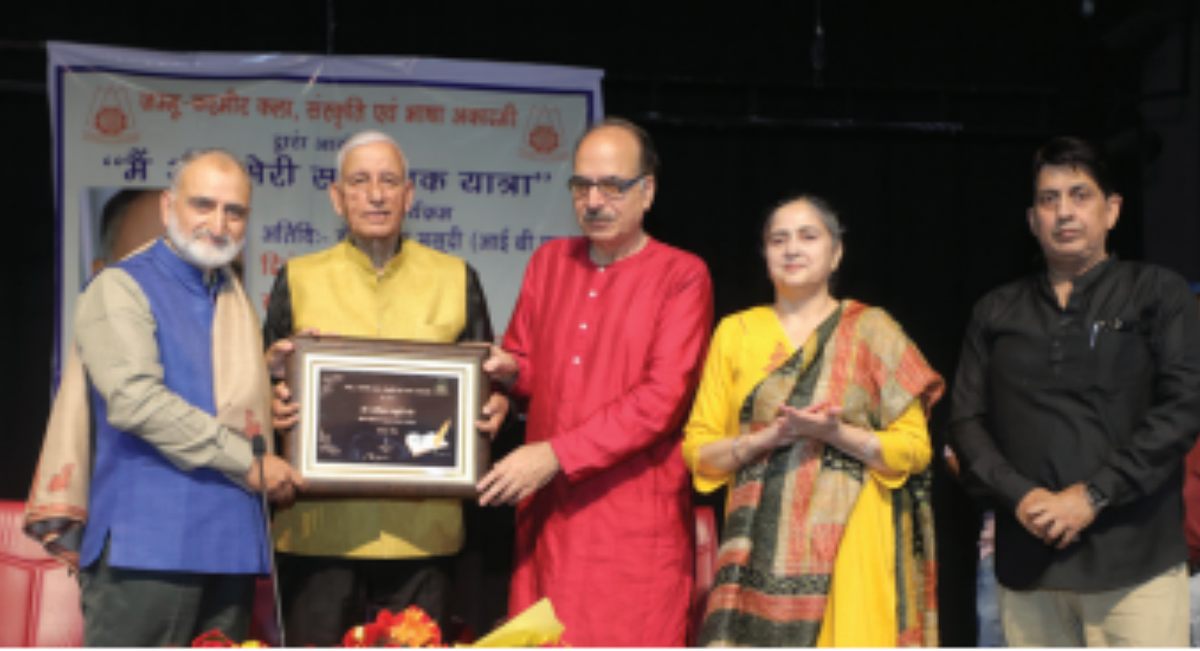
Friendly banters among old pals, colleagues amused the gathering bound by delicate literary thread in the programme organised by Jammu and Kashmir Academy of Art, Culture and Languages (JKAACL) on its former Secretary Dr Rafeeq Masoodi under the series “Meet the Eminent” at Abhinav Theatre on Saturday.
The event, focused on Dr Masoodi, a retired officer of the Indian Broadcasting Service (IBS), titled “Main Aur Meri Sahityik Yatra” (Me and My Literary Journey) witnessed the participation of eminent literary personalities, scholars and enthusiasts.
For the illustrious audience also, it was an interesting sojourn to explore different facets of former Additional Director General of Doordarshan (Dr Masoodi) as a poet, writer, administrator, philanthropist and above all a witty human being.
Earlier, at the outset, Secretary JKAACL, Harvinder Kaur, formally welcomed the distinguished guests and participants. In her address, she elaborated on the Academy’s sustained efforts to nurture literary culture, promote meaningful dialogue and provide a vibrant platform for writers and scholars. She particularly underscored the importance of documenting and celebrating the literary journeys of distinguished personalities like Dr Masoodi, whose contributions enriched the cultural and intellectual landscape of Jammu and Kashmir.
The recorded messages of Principal Secretary Culture Brij Mohan Sharma and the former Principal Secretary Suresh Gupta eulogising the contribution of Dr Masoodi towards the expansion of JKAACL and growth of culture and literature in J&K during his (Dr Masoodi’s) tenure (in various capacities) too were played during the event. Notably, Dr Masoodi is the patron of Adbi Markaz Kamraz, the literary and linguistic organisation in J&K, also.
In his keynote address, Dr Agnishekhar presented a deeply engaging and reflective discourse about his pal (Dr Masoodi). He fondly recalled his early association with Dr Masoodi, sharing personal anecdotes that highlighted his intellectual depth, literary sensibilities and administrative acumen.
“Our association dates back to the days in Government Degree College (GDC) Sopore in 1971 or 72 when Rafeeq (Dr Masoodi) joined Hindi classes in PUC at the insistence of Prof Ghulam Rasool Bacha. Prof Bacha had entrusted the responsibility of teaching him Hindi to me and our other friend Vinod Chadha. To everyone’s bewilderment, he (Rafeeq) cleared Hindi exams too while a Pandit student failed. It was Rafiq’s perseverance which worked in his favour,” Dr Agnishekhar reminisced.
For many among the audience, the transition of Kuldeep Sumbli to the litterateur Dr Agnishekhar (pen-name) was also a revelation amid the cascading flow of memories.
Another interesting nugget in the literary discourse was how Rafeeq was given the pen-name of “Rafeeq Das” following the analogy of Surdas, Kabir Das etc.
“Most significant aspect of Rafeeq, who has carved his niche as a multi-dimensional personality, is genial nature – devoid of any ego,” Dr Agnishekhar asserted, while recalling many cherished moments.
His speech eloquently portrayed Dr Masoodi as a creative writer and a dedicated public servant, whose works reflected both sensitivity and social commitment.
On the occasion, Nisar Azam presented a comprehensive and well-researched paper on Dr Masoodi’s literary oeuvre, with specific focus on his poetry in Kashmiri. He critically examined the thematic richness, stylistic nuances and socio-cultural relevance of his poetry, drawing appreciation from the audience for his scholarly insight and analytical depth.
“Dr Masoodi with his simplicity weaved in poetry compels the readers to pause and reflect upon the deep sensibilities. The most significant aspect of his poetry is that he introduces “Maun” (silence) evocatively and in the most eloquent manner,” Nisar Azam stated.
In his address, Dr Rafeeq Masoodi shared an illuminating account of his literary journey, interwoven with experiences from his public service.
He fondly recalled his childhood friends Prem Nath Prem and Chaman Lal and Sopore college days where he was literally dragged out of his class by Prof Bacha to make him study Hindi, though against his (Rafeeq’s) wish. “Prof Bacha’s assertion was – he wanted to repay what my father invested in him,” Dr Masoodi reminisced.
He profusely quoted incidents, cherished moments related to Dr Agnishekhar (then Kuldeep Sumbli), Vinod Chadha, Vijay Mohini Kaul – who taught them, eminent broadcaster Shanta Kaul, Shehnaz Rashid, Aziz Hajini among others.
“Prof Bacha, renowned linguist Dr Namvar Singh and geographer of international repute Prof Moonis Raza shaped me into what I’m today. They chiselled my persona,” Dr Masoodi poignantly remembered, while sharing a treasure of memories. While reciting nuggets of poetry, he also remembered his father, mother and wife.
Dr Masoodi spoke about the evolving literary environment, the challenges faced by contemporary writers, and the pressing need to preserve linguistic and cultural diversity. He emphasised that institutions like the Academy could play a pivotal role in fostering creativity, encouraging young writers and safeguarding the region’s literary heritage.
Dr Masoodi did not show any inhibition in mentioning the vigilance case filed against him as he disclosed that facts would find a glimpse in his upcoming book “Tainted Me.”
The programme was presided over by prominent (bureaucrat-turned) Punjabi and Urdu litterateur Khalid Hussain, who, in his presidential remarks, highlighted the transformative power of literature in shaping societal values and fostering critical thinking. He remarked that such programmes served as vital forums for intellectual exchange and cultural continuity.
A significant observation in Khalid Hussain’s engaging discourse was that while post-partition literature depicted shared pain, agony with humanistic approach and satire, post-90 literature bordered on divisive narrative.
“Politics of hatred never serves any purpose,” he said, while sharing poignant moments from his personal life related to his son.
The occasion also marked the release of Dogri translation of Dr Masoodi’s book “My Pain, My Affliction.”
Among the distinguished attendees were prominent litterateurs Dr Jitendra Udhampuri, Prof (Dr) Lalit Magotra, Professor Rajkumar, Dr Naseeb Singh Manhas, Baljeet Singh Raina, Sonali Arun Gupta, Additional Secretary, JKAACL and Dr Javaid Rahi, Chief Editor, Gojri whose presence added to the significance of the occasion.
Dr Jitendra Udhampuri, Prof Lalit Magotra, Dr Nasib Singh Manhas and Dr Javaid Rahi in their brief addresses acknowledged the significant contribution of Dr Masoodi as a litterateur and an administrator.
The proceedings were efficiently conducted by Dr Chanchal Sharma, ensuring smooth flow and engagement throughout the event.
The programme concluded with a formal vote of thanks presented by Lal Chand, who expressed gratitude to all participants, speakers and the audience for making the event a meaningful and memorable literary gathering.