







India’s growing preference for healthy eating has been making headlines for a while now. Olive oil, long regarded as the healthiest oil variant, is now enjoying the benefits of this trend.
Before healthy eating became a buzzword, Figaro introduced India to the famed “Zaitoon ka Tel”. Now, both Figaro and its parent company, Deoleo, aim to make the brand more relevant to modern India by capitalising on this trend.
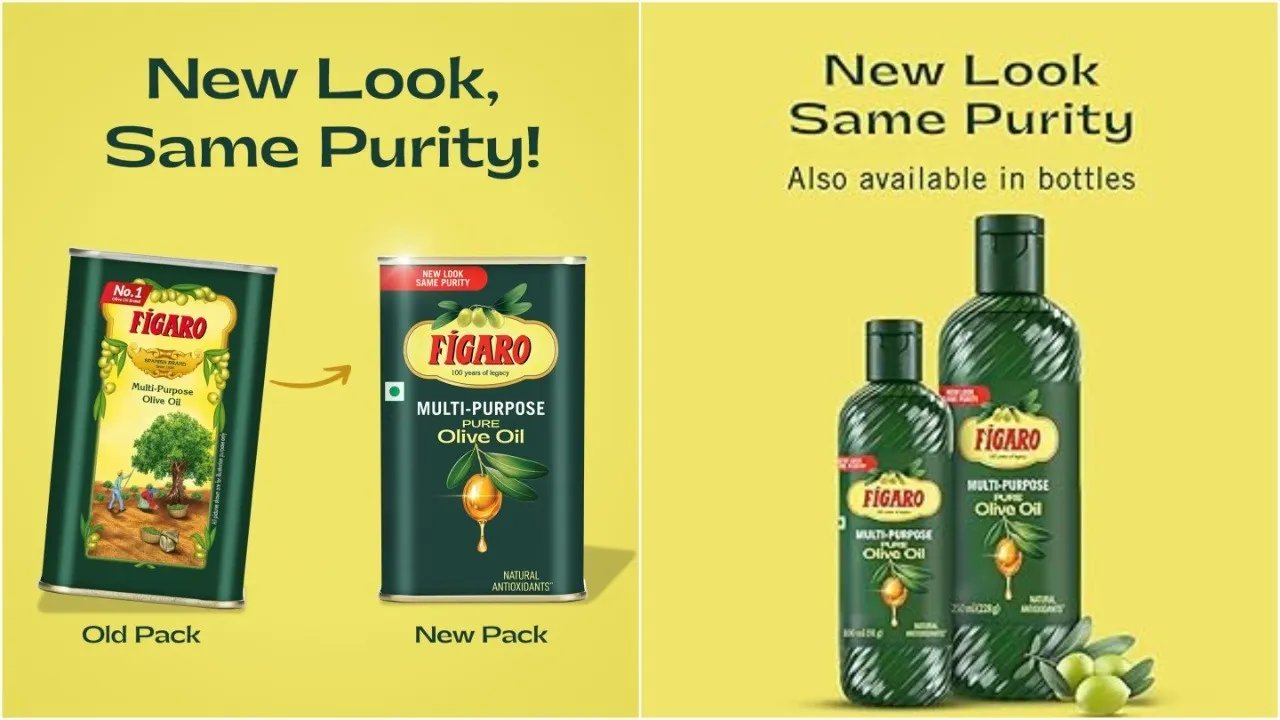
The 107-year-old Spanish olive oil company, Figaro, has undergone a brand revamp for the first time in its history by making its iconic packaging more minimalist and practical for Indian consumers.
Figaro surveyed over 1,000 participants across India and found out what stood out the most in its packaging to consumers.
“The green tin, the brand name written in red inside a yellow halo, and its multi-purpose utility” was the answer, noted Satarupa Majumdar, marketing director, India, Deoleo, the world’s largest olive oil company headquartered in Madrid, Spain, that manages brands including Figaro and Bertolli.
/filters:format(webp)/afaqs/media/media_files/2026/07/28/mixcollage-28-jul-2026-09-34-pm-8286-2026-07-28-21-36-06.jpg)
The new packaging retains the green tin and the logo but tones down the background clutter, highlighting the hero ingredient, an olive dripping oil. Interestingly, the brand has also introduced some text in Hindi on the pack for its biggest Indian market in the country, North India.
A more practical, easy-pour plastic bottle packaging has also been introduced to reduce friction, giving consumers a choice between the slightly more complex-to-open tin and the bottle.
Additionally, comedian Sunil Grover has also been hired as a “talent”, not a brand ambassador, for an ad film by the brand, citing his versatility matching that of the versatile uses of Figaro’s olive oil.
Reviewing the brand’s legacy, Majumdar says, “Figaro has a legacy of more than 100 years globally. It has been present in India for more than 40 years, moving from an importer-led model to a corporate structure since 2013, when parent company Deoleo established its Mumbai headquarters.”
Why is India Figaro’s biggest market?
/filters:format(webp)/afaqs/media/media_files/2026/07/28/figaro-summary-2026-07-28-21-50-52.png)
Deoleo sells olive oil across the world under different brand labels: Bertolli (USA, Northern Europe, and Australia); Carapelli (Italy, USA, Europe, and Asia); Carbonell (Spain and Latin America); Maestros de Hojiblanca (Spain); Koipe (Spain); Sasso (Italy); and Figaro (India and West Asia).
Figaro currently sells multi-purpose olive oil for cooking, skincare and haircare with a dedicated sub-brand called Figaro Baby for olive oil-based baby massage oils and baby body lotions.
While India-specific data has not been made available by Deoleo, it sold 158 million litres of olive oil across the world in 2025, earning 822 million euros in revenue, representing an 11% increase over the previous financial year.
/filters:format(webp)/afaqs/media/media_files/2026/07/28/mixcollage-28-jul-2026-09-59-pm-2509-2026-07-28-23-01-23.jpg)
Vishal Sarin, general manager of Deoleo India, notes that Figaro currently holds a “40% share in the Rs 880 crore olive oil market in India”, making it the category leader.
Sarin also explains that the market is projected to scale exponentially to a “Rs 2,000 crore” valuation within the next 8 years, advancing at a compound annual growth rate (CAGR) of “12%”.
He attributes the growth to the increasing middle-class population in India, which has more money to spend and more awareness about where to spend it, leading to an upward premiumisation trend.
According to Sarin, “Premium products are defined as any offering priced at or above 1.8 times the baseline cost of a category’s core product. For instance, a baseline shampoo costing Rs 100 establishes a premium benchmark at over Rs 180.”
A 200-ml tin of Figaro olive oil sells at an MRP of Rs 399, and its 1-litre pack costs Rs 1,769, while mass cooking oil brands such as Fortune Sunflower Oil sell at an MRP of Rs 195 per litre.
/filters:format(webp)/afaqs/media/media_files/2026/07/28/mixcollage-28-jul-2026-09-57-pm-7077-2026-07-28-21-58-27.jpg)
Premiumisation is growing at a “40% plus growth rate”, fuelled by the growing number of middle-class families in India, according to Sarin.
“30% of the population is classified as middle class today (2026), upwards from 20% in 2020,” notes Sarin. The demographic is expected to grow by another 10 percentage points, to “40% by 2031″, according to the World Bank.
Selling olive oil in the world of quick commerce
Sarin shares that Deoleo has built a distribution network that encompasses a massive “250,000 total retail stores reached across urban India”, spanning “over 3,000 towns”.
He notes that “70% of general FMCG sales in India originate from traditional distributive trade (mom-and-pop stores)”, but the premium olive oil category exhibits entirely different dynamics.
For the olive oil category specifically, traditional mom-and-pop or kirana stores amount to only 45% of sales, down 19% in just three years.
While 25% of olive oil sales are attributed to modern trade channels such as D-Mart and Reliance supermarkets, with a 6% growth over the past three years.
A significant 30% of sales are also made through online marketplaces (e-commerce and quick commerce), a percentage that has nearly doubled, up 13% over the past three years.
Who is buying?
Majumdar notes, “If I have to identify the heart of Figaro, it lies in Uttar Pradesh, Delhi, NCR, and Maharashtra.”
“Altogether, it is pretty North-centric; that’s the heart of Figaro. The Hindi-speaking market has a different love for this product,” she adds, as is evidenced by the Hindi text in Devanagari script on the revamped packaging.
Demographically, the communication targets women as central household decision-makers, though the target audience remains multi-generational.
According to Majumdar, “Figaro is loved across generations. It is age agnostic.”
How is Figaro selling?
To navigate this omnichannel ecosystem, Deoleo has increased its year-over-year commercial marketing budget by 3 percentage points.
Majumdar confirms: “We have gone up from 4% to 5% (of annual revenue allocated to media budgets). We have significantly taken it to 8% odd.”
This expanded capital is being funnelled into a full-funnel activation split:
|
Channel |
Share |
Role in Strategy |
|
Television |
55% |
Mass reach and awareness, particularly in the core Hindi-speaking belt. |
|
Social & Influencer Channels |
40% |
Contextual storytelling, lifestyle integration, and active recipe demonstrations. |
|
Performance Marketing |
Remaining Balance |
Bottom-of-the-funnel conversion across quick-commerce and digital storefronts. |