





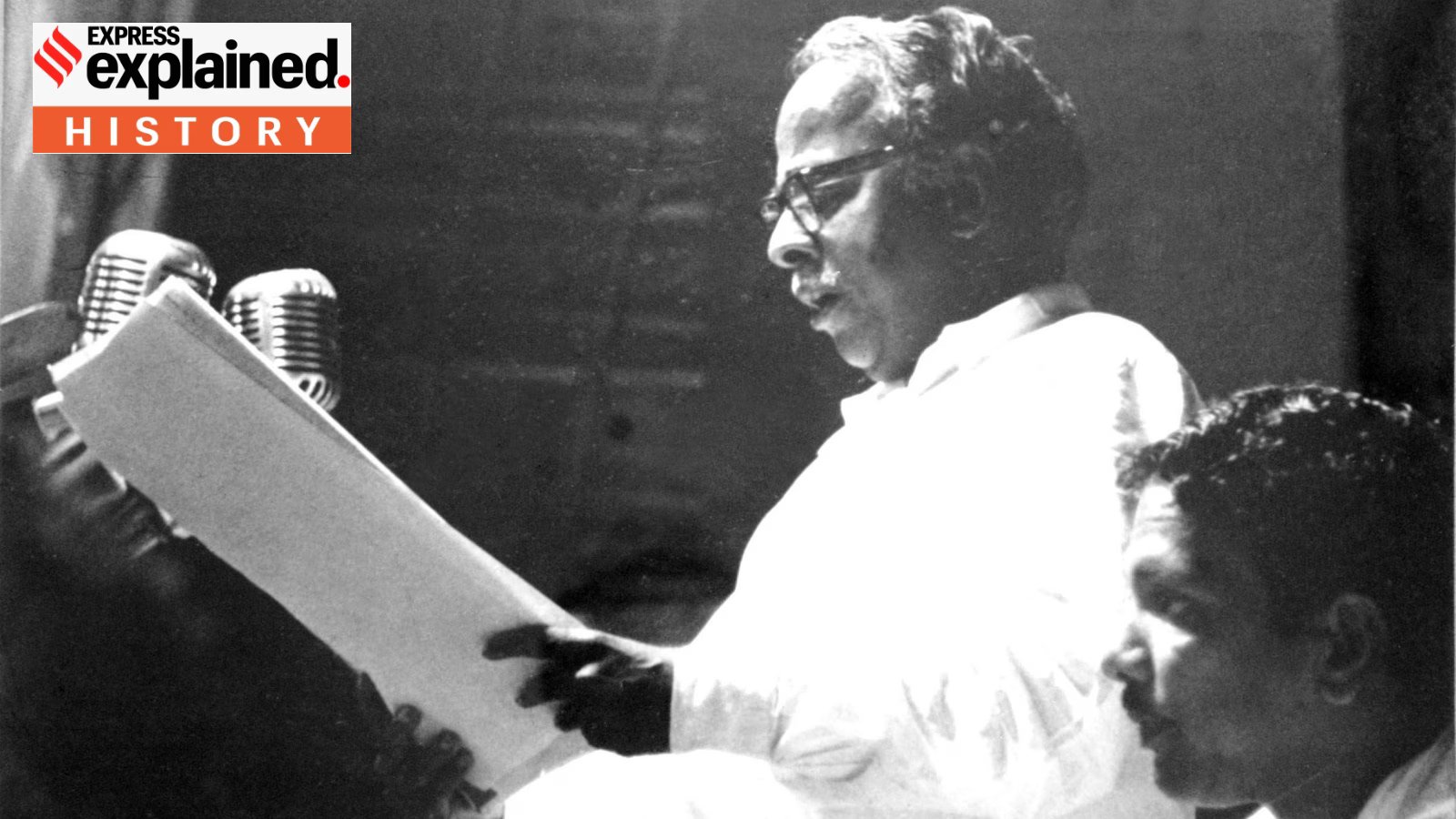
In a video released last week, Tamil Nadu Chief Minister M K Stalin addressed the Centre, saying, “Do not assume that, since this is an election period and attention is elsewhere, you can quietly carry out delimitation in Delhi. Do not even entertain that thought..”
He added, “You will witness a Tamil Nadu that you have not seen before. India will once again witness the spirit of the DMK of the 1950s and 1960s.”
What did that era represent for the Dravida Munnetra Kazhagam (DMK), and why is Stalin invoking it now in the context of the delimitation exercise? Here’s what to know.
Dravida Munnetra Kazhagam
Founded in 1949 by C N Annadurai, the DMK emerged from the broader Dravidian movement (Dravidar Kazhagam, or DK) led by E V Ramaswami Naicker. Popularly known as “Periyar” (great man), Ramaswami was a fierce critic of what he saw as the northern domination of Indian politics, culture, and religion. He advocated the creation of a separate nation in south India, to be called “Dravida Nadu”. The DMK itself was formed by a group of his former followers.
“It would be a truism to state that the history of Tamil Nadu politics cannot be written without the predominant role played by the DMK,” noted Vijaya Ramaswamy in Historical Dictionary of the Tamils (2017). Strongly influenced by the Justice Party (1925-44), which was the DK’s political wing and the ideological precursor for most present-day Dravidian parties, the DMK positioned itself against theistic practices and grounded its politics in social justice, caste equality, and anti-Brahminism.
In the 1957 elections, the DMK won 15 seats in the Tamil Nadu Assembly and two in the Central Parliament. In India after Gandhi (2007), Ramachandra Guha wrote, “Although they won but a handful of seats — these mostly in the assembly polls — their creeping successes were worrying, since the party stood not merely for a new province based on ethnicity or language, but for a separate nation-state altogether.”
The anti-Hindi plank
While the Sino-Indian War prompted it to drop its secessionist plank, the DMK continued to champion the protection of Tamil language and culture. Its political rise was closely tied to language politics. In 1949, the Constituent Assembly chose Hindi as the official language of the Union, with a 15-year “grace period” (until January 26, 1965) during which English would continue alongside it. As this period drew to a close, fears grew that Hindi would dominate official communication.
Story continues below this ad
In 1956, the Academy of Tamil Culture passed a resolution urging that “English should continue to be the official language of the Union and the language for communication between the Union and the State Governments and between one State Government and another”. The signatories included C N Annadurai, E V Ramaswami, and C Rajagopalachari. The DMK led the campaign, organising protests against Hindi imposition.
This anti-Hindi plank swept the party to power in 1967, first under Annadurai and then M Karunanidhi, both of whom leveraged Tamil cinema to build political influence.
Known as “Anna” (or elder brother), Annadurai argued that Hindi lacked special merit. Guha noted: “To the argument that more Indians spoke Hindi than any other language, Anna sarcastically answered: ‘If we had to accept the principle of numerical superiority while selecting our national bird, the choice would have fallen not on the peacock but on the common crow.’”
As the deadline approached, opposition intensified. Ten days before Republic Day, Annadurai wrote to then Prime Minister Lal Bahadur Shastri stating that his party would observe the day of the language changeover as a “day of mourning”.
Story continues below this ad
Shastri and his government stood by the decision to make Hindi official on January 26. In response, the DMK launched a statewide protest movement. Across villages, effigies of the Hindi demoness were burnt; Hindi books and relevant pages of the Constitution were set on fire. At railway stations and post offices, Hindi signboards were removed or blackened. Towns witnessed fierce — and sometimes deadly — clashes between the police and protesting students. The agitation took collective forms: strikes and processions; bandhs, hartals, and dharnas.
Guha recalled one particularly disturbing form of protest: “There was one form of protest that was individual, and disturbingly so: the taking of one’s life. On Republic Day itself, two men set themselves on fire in Madras. One left a letter saying he wanted to sacrifice himself at the altar of Tamil. Three days later a twenty-year-old man in Tiruchi poisoned himself with insecticide. He too left a note saying his suicide was in the cause of Tamil. These ‘martyrdoms’, in turn, sparked dozens more strikes and boycotts.”
Striking parallels
The intensity of these protests alarmed the Central government. On January 31, a group of senior Congress leaders met in Bangalore, warning that the hasty push for Hindi could imperil national unity. PM Shastri found himself under mounting pressure.
“His heart was with the Hindi zealots; his head, however, urged him to listen to other voices. On 11 February the resignation of two Union ministers from Madras forced his hand. The same evening the prime minister went on All- India Radio to convey his ‘deep sense of distress and shock’ at the ‘tragic events,’” noted Guha.
Story continues below this ad
Shastri affirmed that he would honour his predecessor Jawaharlal Nehru’s assurance that English would continue as long as people desired. He then outlined four guarantees: states could conduct their affairs in their language of choice; inter-state communication would be in English or accompanied by an English translation; non-Hindi states could correspond with the Centre in English without change to this arrangement; and English would continue for official business at the Union level. According to Guha, he later added a “crucial” fifth assurance: that the All-India Civil Services Examination would continue to be conducted in English rather than in Hindi alone.
As the proposed delimitation exercise evoked the prospect of a North vs South divide, the parallels with the language debates of the 1950s and 1960s are striking. Perhaps, Stalin was invoking this spirit of resistance. And as Guha pointed out in his book: “Then, too, a popular social movement led the prime minister of the day to reconsider both the stated official position and his own preferences.”