






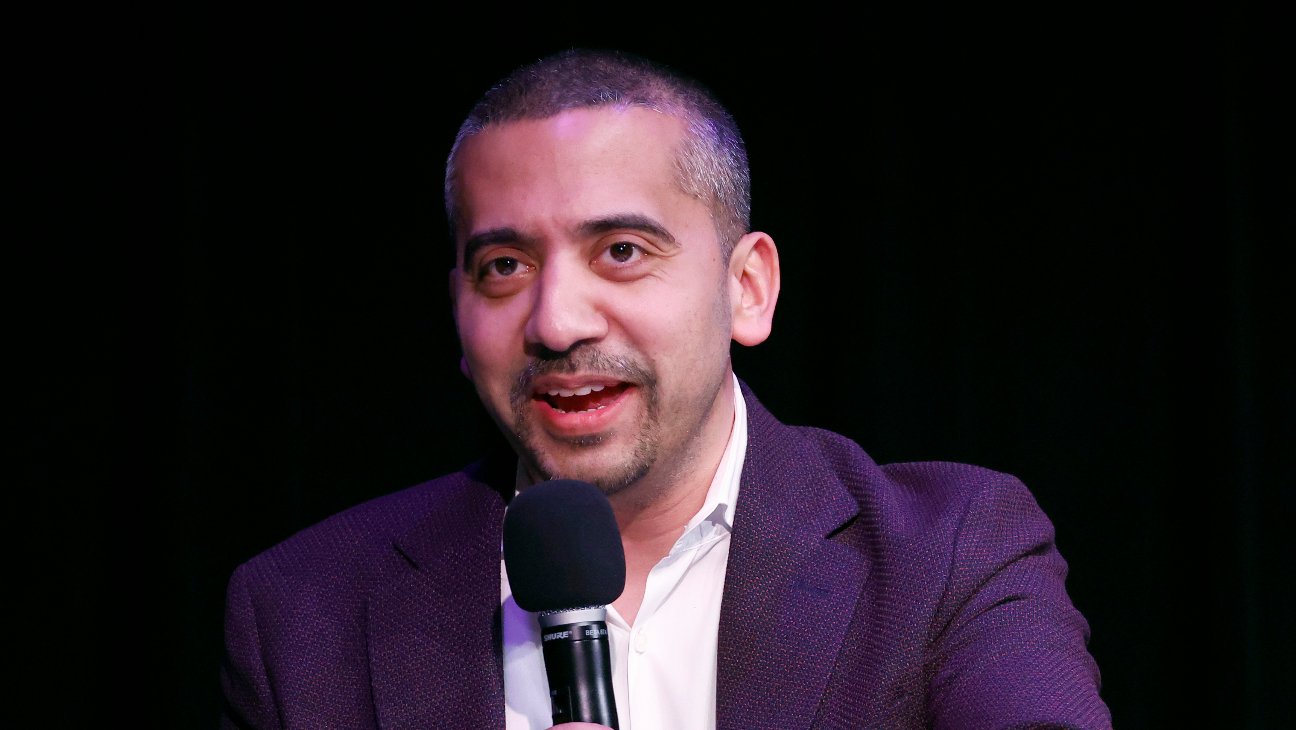
Mehdi Hasan realized that he survived the jump from linear to digital after an encounter in a men’s room. “Another man came out and started talking to me,” Hasan recalled. “He pointed at me and said, ‘You’re …’ — and I thought he was going to say, ‘You’re Mehdi Hasan from MSNBC, you’re the guy from Piers Morgan, you’re the guy from Jubilee or the Oxford Union’ — he said, ‘You’re that guy from Zeteo, right?’ And I said, ‘Yes, that is me. The Zeteo guy.’
“When the brand is being used to identify you in public restrooms, that is when you know you have made it,” Hasan quipped, speaking to a crowd of well-wishers that included comedian Hasan Minhaj, chef José Andrés and New York City Mayor Zohran Mamdani in a midtown Manhattan Lebanese restaurant in April.
Hasan is one of a small number of TV news veterans who have built a viable business after leaving behind the lucrative but slowly declining world of linear media. On-air talent across the spectrum is dealing with the drawn-out death of TV in different ways. Some are seeking better time slots paired with digital extensions that can net them bigger contracts from TV networks desperate to break free from diminishing pay TV revenue. Others are resigned to having paychecks slashed or remaining static, clinging to their lucrative deals for as long as they can. “Everyone is obsessed with their brand now,” is how one TV news veteran explains it.
TV news operations, well aware of the changing dynamics, are getting into the game as well. MS NOW inked a deal with Jon Favreau, Jon Lovett and Tommy Vietor’s Crooked Media to televise some of their video podcasts on TV, and they won’t be the last. Licensing video podcasts, it turns out, is a pretty cost-effective way to fill linear hours that need constant content.
One insider predicts that there will be a slew of “hybrid” deals over the course of the next few years, with TV talent keeping one foot in each bucket of the business. And the good news for TV vets is that the marketplace for news, talk and interview content seems to be expanding. Yes, YouTube has become the de facto home for it, but TV channels are now buyers, as are platforms like SiriusXM and, much to the amazement of some, Netflix too (hello, Brian Williams).
Agents, anchors and others in the ecosystem are looking outside of the TV glass, envious of TV alumni like Hasan or Megyn Kelly, who found success on the other side, cognizant of the way the wind is blowing. In one notable recent poll, online personalities and comedians were named as primary news sources for consumers.

Mehdi Hasan transitioned from MSNBC to launch Zeteo, which has 65,000 paid subscribers.
Paul Morigi/Getty Images for Crooked Media
But going indie is far from easy. A TV anchor not only gets a six-, seven- or eight-figure salary, and all the benefits and perquisites that come from corporate employment, but they also get an entire staff of producers and crewmembers who, to be blunt, often do most of the work. While there are plenty of workaholic news anchors (looking at you, Andrew Ross Sorkin), there are others who show up an hour before air, read the teleprompter and head home.
Breaking off on your own, by contrast, is not only risky but expensive. Sources say that the costs to hire a modest production team and build a video podcast setup that meets the current standard can run from mid-six figures to $1 million. “It’s scary,” says one journalist who spent years at a TV network before going digital. “You need to work harder than you ever have in your life.”
If they make it, it can be lucrative. Just ask Kelly, or Piers Morgan, who raised a reported $30 million for his Uncensored media company at a nine-figure valuation. Hasan says that Zeteo now has 65,000 paid subscribers, which some back-of-napkin math pencils out to mid-single-digit millions in revenue annually (they also have advertising and live events).
But before talent takes that leap, they need to ask themselves some difficult questions: Do they have the stomach to operate as a business owner and risk fading into irrelevance? And is there an audience for what they have to sell? “Is this person an artifact of their time period? Or do they have an actual fan base?” one veteran in the space says bluntly. “If you took the 4 o’clock host at NewsNation and just put them on YouTube, they’re going to make $4.75.”
Or, to frame it differently: The personalities who have found success in digital almost all have a strong point of view. An anchor who holds back may have a tougher time. “I think you should always have a different expectation for what a straight news creator economy show would do versus what a point of view or interview-type of creator economy show would do,” says Chris Balfe, CEO of Red Seat Ventures, which provides services to podcast hosts and creators.
Some TV talent, like Chris Hayes and Sean Hannity, are inking deals for podcasts that extend their brand to digital platforms in-house, while others are creating Substacks to build email lists alongside their day jobs. Anthony Mason, a veteran CBS News anchor and correspondent, is launching an interview show on YouTube called Alchemy that he owns, even as he stays at CBS.
Anthony Mason, pictured with Gayle King and Tony Dokoupil, launched his own interview show while staying at CBS.
Michele Crowe/CBS
The success of opinionated hosts on YouTube and in podcasts underlines the conundrum facing those working in TV, with the take-centric model that helped propel Fox News to the top of the ratings charts seeping into almost every corner of the business, from CNN’s NewsNight to CBS News under Bari Weiss. “It’s terrible for our political conversation because essentially more journalists are preaching to the choir,” says Mark Lukasiewicz, dean of the school of communication at Hofstra University and a former NBC News executive.
But even those not trying to build a business in digital are thinking about what one source calls the “magic fairy dust” of social video platforms. In recent years, “clipping” has become rampant, with expert clippers slicing and dicing cable news segments and podcasts and publishing them to platforms like TikTok and YouTube Shorts, where they can spread far and wide, context be damned.
“It’s a really critical question that we ask ourselves, even for the biggest shows: How much of the clipping is a net benefit because people are seeing it and you’re keeping in the conversation?” Balfe says. “It’s important to acknowledge that those clips aren’t going to make you any money. The core show, the YouTube and podcast business, needs to be solid, and then you can worry about the exposure side of it.”
But that isn’t stopping TV talent, who are acutely aware that what happens on CNN (or MS NOW, or a podcast appearance) is often spread via those clips. One dayside anchor says that they go into their show thinking about what segments will be the most clippable, and plan accordingly. Networks are encouraging talent to embrace the likes of TikTok and in some cases holding classes to teach anchors the nuances of talking to those audiences.
Netflix won’t be opening a newsroom anytime soon, but it is bullish on pods. “While still early, we’re seeing video podcasts over-index on daytime viewing and on mobile devices,” it told shareholders in its Q1 earnings letter, underscoring how viewers are trading in morning shows and daytime chat shows for video podcasts. “We want to win more moments of truth, and we’re doing that by broadening our service to include an even wider range of entertainment options, including video podcasts.”
That includes former NBC Nightly News and MSNBC anchor Brian Williams, who teamed up with his friend and producer Jonathan Wald on a series called We’re Back! But even among the anchors that aren’t contemplating leaving TV for YouTube, the attraction of digital media is too irresistible to ignore.
“It’s certainly been a phenomenon for a while that individual journalists have started paying even more attention to their personal brand, to use a marketing PR term, than to the newsroom for which they work,” says Lukasiewicz. “I’m old enough to remember an era that for most journalists, the important calling card was ABC News, New York Times, Washington Post, 60 Minutes. I think today that balance has shifted a little bit.”
Just look at the White House Correspondents’ Dinner. When Cole Tomas Allen attempted to breach the ballroom at the Washington Hilton, the 2,000 or so guests all dove under the tables, but as one attendee recalls, the phone cameras came out immediately. It was a moment that showed TV still has some muscle: The anchors were in the room where it was happening, not yapping in their home studio.
“When the Iran War starts, when there is a shooter at the White House Correspondents’ Dinner, yeah, people are scrolling TikTok looking for clips,” says Lukasiewicz. “But I’m certain that what people are really doing is turning on their television and finding a news channel to find out what’s actually going on.”
Who Makes What In TV News
Network morning show anchors $1M–$20M
Morning TV remains the last great cash machine in network news — and it shows. Franchise anchors on Today, Good Morning America and CBS Mornings (think: Gayle King) command eye-watering deals, while the ever- expanding supporting cast creates a steep drop-off below them. The upside: Visibility here still translates into upward mobility.
Cable news primetime stars $1M–$20M
The star system hasn’t disappeared — it’s just a lot thinner. Cable’s biggest names still command premium salaries, especially in primetime, but fewer hosts are landing those legacy-sized deals. At the top: Anderson Cooper and Rachel Maddow. Below them, a crowded field jockeys for position in a tighter market.
Evening news anchors $2.5M–$10M
Once the most powerful jobs in television, evening anchors like Tony Dokoupil now occupy a more symbolic perch. The audience — and the ad dollars — have shifted to mornings. Even so, these roles remain institutionally important, and compensation reflects that, albeit at a sharp discount from TV’s glory days.
High-profile correspondents/ Sunday show moderators $250K–$4M
This is where beat meets brand. A marquee assignment — the White House, Capitol Hill — plus regular anchor fill-ins or a Sunday platform (Like George Stephanopoulos‘ perch at ABC) can drive salaries up fast. Without that combination, pay drops precipitously.
Cable news utility players/ emerging stars $400K-$3M
The swing players of cable news — part anchor, part analyst, part fill-in — are paid on trajectory as much as output. Own a time slot or show with breakout potential, like Ali Velshi, and the numbers climb. Stay in rotation, and they plateau.
Cable news correspondents/ high-profile contributors $250K–$2M
In an era of personality- driven punditry, visibility is currency. Regular hits on top-rated shows and strong audience recognition can translate into meaningful paydays. And, increasingly, buzzy breakout nontraditional voices — like Scott Jennings — can be as valuable (and expensive) as seasoned reporters.