







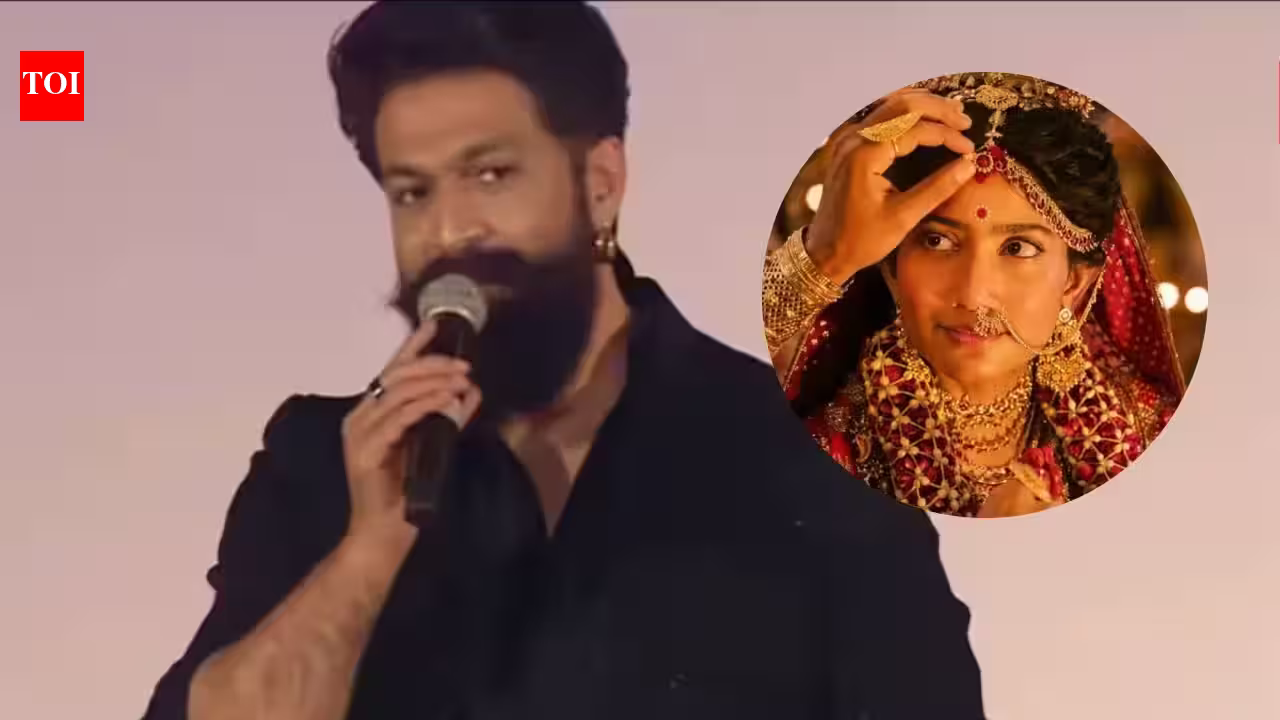
The air in Bengaluru was thick with anticipation this week as the star-studded cast of Nitesh Tiwari’s highly anticipated Ramayana made their presence felt. While the project—a massive, multi-part mythological undertaking—has been the subject of industry whispers for months, it was the unlikely public endorsement from one of Indian cinema’s biggest titans that truly turned heads. Yash, the man who redefined the Kannada film industry with KGF, took center stage to discuss his role as Ravana. Yet, it wasn’t his own dark, antagonistic character that he chose to champion; instead, he directed the spotlight toward his co-star, Sai Pallavi.
In a heartfelt moment during an international trailer launch event, the “Rocking Star” put aside the rugged, intense persona he is known for to offer a gentle, almost reverent request to the audience: shower Sai Pallavi with your blessings as she steps into the role of Goddess Sita.
A Higher Calling: Yash’s Heartfelt Endorsement
For an actor like Yash, known for his larger-than-life, high-octane performances, the transition into a mythological epic carries a different weight. When asked about his experience working alongside Sai Pallavi, who portrays the central figure of Sita opposite Ranbir Kapoor’s Lord Ram, Yash’s response was surprisingly intimate. He didn’t talk about her professional work ethic in the cold, transactional terms of a movie set; he spoke about her spirit.
“Sai Pallavi, she is a devotee,” Yash told the gathered crowd, his tone softening. “She is so devoted that she remembers Sita for five minutes whenever she gets a chance.”
The significance of this statement goes beyond mere professional courtesy. In the world of high-budget commercial cinema, where actors are often judged by their star power and marketability, Yash’s focus on Pallavi’s personal piety highlights the reverence with which this cast is approaching the source material. He noted that her internal connection to the divine is evident to everyone working on the production. “We have seen her work on set. Very devotional, God-loving, God-fearing. She talks about God. I am very happy that she is portraying Sita. She has that art. She has a good heart. Bless her. I request you all to give her love and bless her.”
Reimagining an Epic for a Global Audience
Nitesh Tiwari, the visionary behind Dangal and Chhichhore, has taken on the Herculean task of adapting the Ramayana for a new generation. This is not merely a film; it is a cinematic odyssey that aims to translate ancient epic storytelling into a language that resonates with modern, global audiences. With Ranbir Kapoor confirmed as Lord Ram and the powerhouse ensemble that includes Ravi Dubey as Lakshman and the formidable Sunny Deol as Lord Hanuman, the casting choices suggest a deliberate move toward grounded, intense performances rather than mere theatrical posturing.
The scale of this production is staggering, with reports circulating that the total budget for the two-part epic sits at an eye-watering Rs 4,000 crore. This is a level of investment rarely seen in Indian cinema, signalling that producers, led by Namit Malhotra, are aiming for a visual and narrative spectacle that rivals the biggest Hollywood franchises.
A Sonic and Visual Collaboration
The film’s technical arsenal is perhaps the most intriguing aspect of its development. Bringing together the musical prowess of A.R. Rahman—the pride of Indian cinema—and Hans Zimmer, the legendary architect of modern film scores, creates an auditory landscape that promises to be nothing short of transcendent. It is a collision of worlds: Rahman’s deep, cultural roots in melody paired with Zimmer’s sweeping, atmospheric soundscapes.
When you pair this global-scale production value with the grounded performances of actors like Sai Pallavi, who is known for her selective, character-driven projects, the result is a project that feels both authentic and colossal. Shridhar Raghavan, the man responsible for the screenplay, has the daunting task of bridging the gap between the sanctity of the epic and the requirements of a high-stakes, multi-part theatrical experience.
The Weight of Expectation
As the release date draws closer—currently pegged for November 5, 2026—the pressure on the cast is immense. Any attempt to adapt the Ramayana is met with intense scrutiny, as the narrative is woven into the cultural fabric of millions of lives. Yash’s call for “blessings” for his co-star is a tactical masterstroke in building a positive narrative around the film. By framing Sai Pallavi not just as an actress, but as a “devotee,” he is signaling to the audience that the project is being handled with the care and sincerity it deserves.
For many fans, the idea of the intense, anti-heroic Yash playing Ravana alongside a soulful, dedicated Sai Pallavi creates a compelling duality. The chemistry between a “God-fearing” Sita and a formidable, complex Ravana will undoubtedly be the pivot point upon which the drama turns.
Looking Toward the Future of Indian Cinema
The scheduling of this project—Part 1 in November 2026 and Part 2 in Diwali 2027—suggests a confidence in the audience’s willingness to engage with long-form storytelling. In an era where streaming platforms often favor bite-sized content, the Ramayana is doubling down on the “event cinema” model.
If the ambition behind the budget, the gravitas of the cast, and the soulfulness expressed by actors like Yash translate to the screen, this could be the definitive cinematic version of the Ramayana. For now, the takeaway from the Bengaluru event is clear: the cast is not looking at this as just another massive paycheck or a career milestone. They are approaching it with a humility that suggests they understand exactly how precious this story is to the audience. When one of the biggest stars in the country asks for blessings for his co-star, it’s a rare, genuine moment that suggests a project rooted in respect—and that might just be the secret ingredient to its success.
Disclaimer: This content is auto-generated for informational purposes only.
Source: Read Original News