







The Dawn of “Starwashing”: Unpacking the PR Tactics of the Trillion-Dollar Space Economy
As the space economy rockets towards a projected US$1.8 trillion by 2035, a new marketing phenomenon, dubbed “starwashing,” is emerging. This tactic sees space companies and their affiliates promoting narratives of space exploration and expansion for humankind, often while downplaying or outright omitting the potential negative repercussions for both Earth and the delicate space environment.
The term “starwashing” draws parallels with “greenwashing,” a well-established concept describing how companies deceptively portray their practices or products as environmentally friendly, or minimize the impact of their harmful activities. Examples of greenwashing include auto companies suggesting dumping cars in oceans benefits marine life, or plastics companies exaggerating the recyclability of their products. These practices capitalize on the growing public concern for environmental sustainability.
A social work researcher, observing the commercialization of space, has identified that space companies are employing similar strategies. However, instead of solely appealing to environmental responsibility, they leverage a sense of cosmic wonder and the innate human desire to explore beyond our planet. This is the essence of starwashing: positioning a space-related idea, activity, product, or policy as universally beneficial, even when it risks damaging Earth or the cosmic environment.
Beyond Earth: A Solution or a Distraction?
Leading space technology company, Blue Origin, exemplifies this approach. Its mission statement includes both colonizing space and “restore and sustain Earth.” Founder Jeff Bezos envisions building space habitats for billions as a solution to environmental catastrophes on Earth, and plans to move industries, starting with the Moon, off-world. While this might seem environmentally desirable, particularly given Amazon’s substantial carbon footprint (larger than many nations), the near-term efficacy of such a strategy for pressing environmental crises like wildfires or climate change is questionable.
Blue Origin’s claims about its rocket fuel also raise questions. The company states its New Shepard rocket is “for the benefit of Earth,” with minimal dry mass waste and only water vapor emissions. However, this omits that water vapor can amplify atmospheric warming caused by other greenhouse gases – a detail Blue Origin has not addressed.
The Race for Lunar Resources and a Crowded Orbit
The pursuit of lunar resources is another significant area of starwashing. Companies like Blue Origin aim to extract resources from the Moon, such as for lunar development and to reduce the frequency of Earth-to-Moon trips. Others, like Interlune, plan to harvest valuable materials like helium-3. These endeavors will necessitate more frequent rocket launches, increasing demand for coastal and potentially oceanic launch sites, impacting terrestrial environments.
The Moon’s environment itself is also at risk. Its surface area is limited, and desirable resources are concentrated in specific, finite locations. These prime landing sites are often invaluable scientific sites that human ventures could compromise. Discussions at events like Space Resources Week reveal attempts to “market” lunar mining to the public, shifting focus from potential off-Earth environmental damage to promises of pharmaceutical research and wireless connectivity.
The burgeoning field of Artificial Intelligence, deemed a “key” ingredient for space economy growth, further complicates matters. While orbital data centers are framed as environmentally beneficial due to reduced reliance on Earth-based water and electricity, these clusters of satellites would exacerbate an already-crowded low Earth orbit. Blue Origin and SpaceX have launched tens of thousands of satellites, with plans for millions more to power AI data centers. These constellations threaten Earth-based astronomy, contribute to orbital debris, and potentially damage the ozone layer upon re-entry.
Even as Elon Musk admits the unsustainable impact of terrestrial AI data centers, his company, SpaceX, continues to build them. The company’s brand, built on space exploration, paradoxically leases computing power to AI competitors, with its Memphis-based Colossus data complex facing allegations of violating the Clean Air Act.
Celebrity Endorsements and the “Benefit of All Humankind”
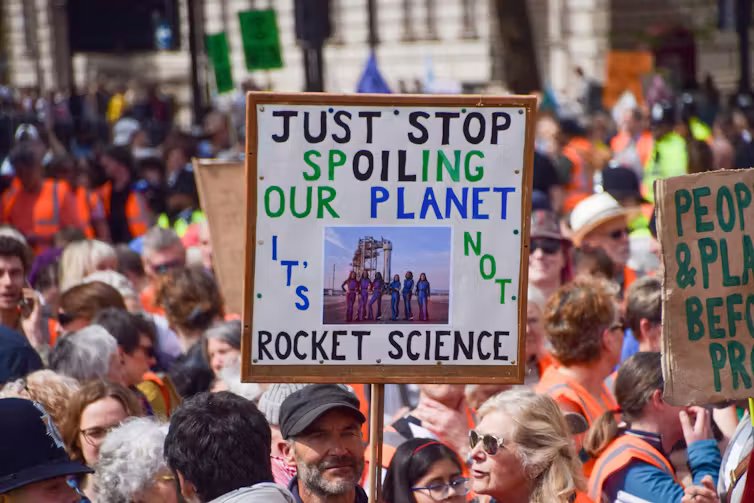
Starwashing often leverages the allure of celebrities. SpaceX partnered with then-businessman Jared Isaacman (now NASA administrator) for the Inspiration4 mission, advertising seats with a Super Bowl commercial featuring Celeste’s “Twinkle Twinkle Little Star.” Blue Origin has also transformed celebrities like Katy Perry into space tourists, aligning their launch capabilities with pop culture spectacles.
Vuk Valcic/SOPA Images/LightRocket via Getty Image
The Outer Space Treaty of 1967 mandates that space exploration be for the “province of all mankind.” SpaceX, for instance, claims to be saving humanity from future environmental catastrophes like asteroid impacts by colonizing the Moon and Mars. This philosophy, however, often sidesteps more probable and immediate threats to Earth’s habitability, such as climate change and biodiversity loss, in favor of less immediate, albeit dramatic, risks.
With U.S.-based space companies receiving billions in taxpayer-funded contracts, their environmental footprint, both on and beyond Earth, is set to grow. A critical question remains: will “all of humankind” truly reap the benefits of space, as the Outer Space Treaty demands?
From Earthrise to Earthset: A New Environmental Awakening?
The iconic “Earthrise” photograph captured by Apollo 8 in 1968 profoundly inspired the environmental movement. This past April, the Artemis II crew delivered its counterpart, “Earthset,” an image of our blue marble setting behind the Moon. While this captivating image has resonated globally, whether it will ignite an off-Earth environmental movement, one that holds space companies accountable for starwashing practices, remains an open and crucial question.