








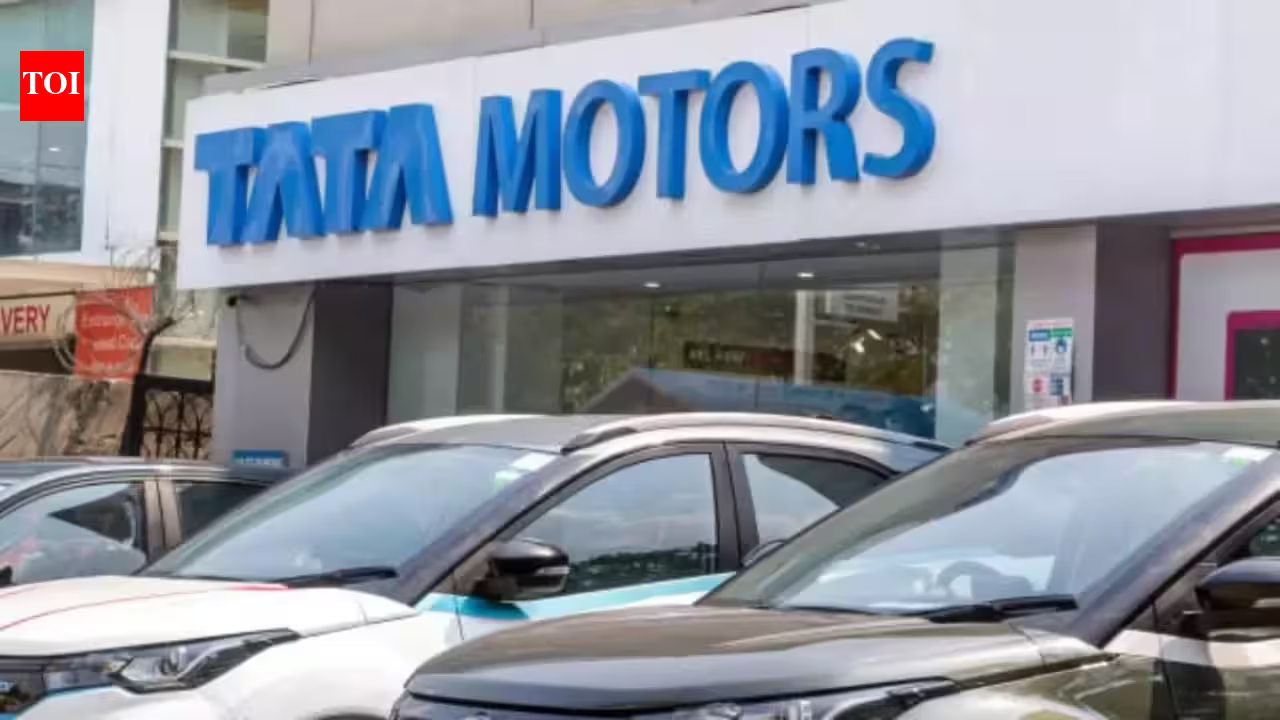
Tata Motors Passenger Vehicles (TMPV) experienced a significant downturn in its profitability during the June quarter, primarily attributed to a confluence of factors including headwinds faced by its luxury arm, Jaguar Land Rover (JLR), and escalating raw material expenses. This challenging financial performance occurred despite a notable expansion within its domestic market operations.
The consolidated net profit for the period plummeted by a substantial 80.3% year-on-year, settling at Rs 775 crore. This sharp decline transpired even as the company’s revenue from operations saw a modest increase of 9.3%, reaching Rs 95,799 crore. A crucial contributing factor to the reduced profitability was the disproportionate rise in total expenses, which surged by 12.1% to Rs 95,338 crore, outpacing revenue growth.
Jaguar Land Rover’s performance was particularly impactful, with its profit after tax falling by a considerable 73% to £66 million (approximately Rs 850 crore) from £248 million in the corresponding period of the previous year. Similarly, JLR’s profit before tax decreased by 68.9% to £109 million. The report indicates that increased incentives played a significant role in eroding profitability, evidenced by a rise in variable marketing expenses from 4.1% to 7.1%.
While JLR’s performance represented the most significant drag on the overall consolidated figures, Tata Motors is also bracing for further challenges. The company anticipates a continued surge in commodity costs in the September quarter, an escalation that could necessitate additional price adjustments. Shailesh Chandra, MD and CEO of Tata Motors PV, candidly stated, “Q2 is going to hit us badly. Not only us, the industry will get hit with additional increases.”
Chandra further elaborated on the impact of this inflationary pressure, revealing that commodity inflation alone accounted for an impact equivalent to nearly 4.5% of revenue on Tata’s domestic passenger vehicle business during the June quarter. In response to these rising costs, the company has already implemented price hikes of up to 1.5% across its internal combustion engine (ICE) and electric vehicle portfolios, effective from July 1.
Despite the immediate need to address these cost pressures, Tata Motors does not intend to fully pass on the entire cost increase to consumers instantaneously. Chandra indicated that any future price adjustments would be “more gradual, more calibrated,” suggesting a cautious approach to avoid alienating buyers. The pressure is particularly pronounced for electric vehicles, where battery cell costs have seen a sequential increase of approximately 10%. To mitigate this, Tata Motors is actively pursuing a more aggressive cost-reduction program specifically for its electric vehicle offerings.