








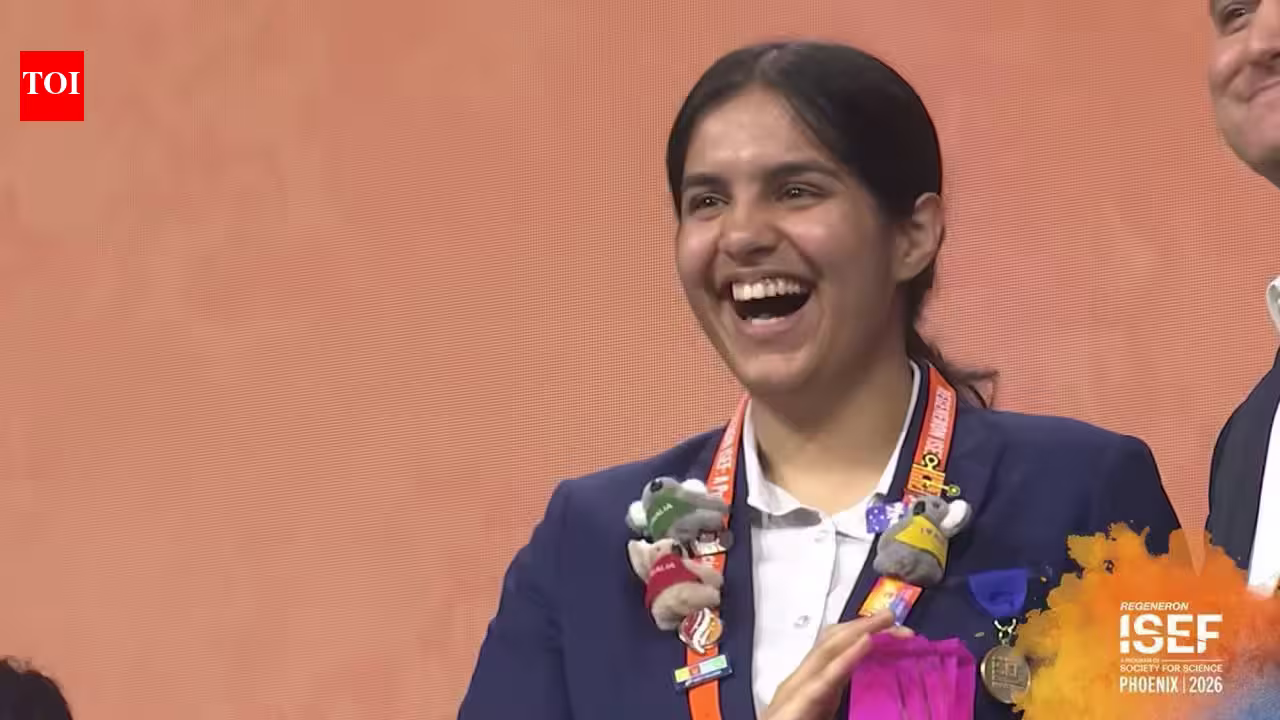
Anusha Arora, a gifted 15-year-old student from Bellevue, Washington, has garnered significant recognition and a substantial financial award for her innovative work in artificial intelligence and mental health. She was recently honored with the inaugural F. Thomson Leighton and Bonnie Berger Family Prize for STEM Excellence at Regeneron ISEF 2026, an esteemed international science and engineering fair. Arora’s groundbreaking achievement stems from her development of “Harmony,” an AI-powered music therapy platform specifically designed to enhance access to personalized mental health support.
The genesis of Harmony was deeply personal for Arora. She recounted how her mother’s positive response to music during a stressful period inspired her to delve into the potential of combining artificial intelligence and sensor technology to create a more customized and effective music therapy experience. This insightful observation served as the catalyst for her extensive research and development.
Harmony operates as a portable platform that uniquely adapts to a user’s real-time emotional state. It employs advanced finger sensors to meticulously collect physiological data. This data is then processed by a sophisticated system comprising 11 distinct AI programs. These programs collaboratively work to accurately detect the user’s emotional state, subsequently generating bespoke music and accompanying visuals that are intended to correspond harmoniously with their detected feelings. This real-time adaptation ensures that the therapeutic experience is dynamic and responsive, moving beyond static, pre-determined playlists.
Arora conducted rigorous experiments to evaluate the efficacy of Harmony. The findings were remarkably positive: participants utilizing the platform demonstrated noticeable reductions in stress and anxiety levels. Crucially, they also exhibited increased engagement during therapy sessions. This heightened engagement is a particularly significant outcome, as it plays a vital role in the overall effectiveness of therapeutic interventions. Arora’s project thus explored a novel approach to making music therapy more engaging and responsive through personalized music generation based on emotional data. It is important to note, however, that Harmony, while promising, remains a research project and is not intended to replace professional mental health care.
Arora’s focus on music therapy addresses a critical societal issue: the widespread lack of accessibility to mental health support. While music therapy is recognized for its benefits in promoting mental well-being, barriers such as high treatment costs, a scarcity of qualified providers, and inadequate insurance coverage often limit its reach. Harmony offers a potential solution by leveraging technology to create a portable, personalized music-based support system, making it more readily available to a broader population. Her innovation lies not just in generating music with AI, but in intricately linking that generation to physiological signals and emotional responses, thereby creating a truly adaptive therapeutic tool.
For her exceptional work, Arora received a $50,000 scholarship, which can be applied to the educational institution of her choice. The F. Thomson Leighton and Bonnie Berger Family Prize for STEM Excellence is a newly established Grand Award at Regeneron ISEF, specifically designed to recognize finalists who demonstrate exemplary application of advanced mathematics and technology in tackling significant global challenges. The judging criteria for this prestigious award encompass projects that integrate theoretical mathematics, algorithm design, practical computer science, distributed computing, computational biology, large-scale data analysis, cloud computing, cybersecurity, and content delivery. This award honors the innovative spirit and profound contributions of F. Thomson Leighton and Bonnie Berger to the fields of mathematics, computer science, and technology.
In a video message following her win, Arora expressed profound gratitude for the recognition of her work, emphasizing the tangible benefits of her research. She passionately encouraged her peers to “Keep researching. Keep pursuing science and technology.” Her powerful message underscores the core mission of the Regeneron International Science and Engineering Fair: to inspire and cultivate young researchers who can develop transformative ideas with real-world applications.
Regeneron ISEF stands as a premier global platform that unites high school students from across the world to showcase their original scientific research and engineering projects. The 2026 competition saw the participation of over 1,700 young scientists and engineers representing 64 countries, regions, and territories. Collectively, these finalists were awarded more than $7 million, with prizes ranging from $10,000 to $100,000, all aimed at supporting their educational pursuits and continued research endeavors. The awards ceremonies for 2026 were held at the Phoenix Convention Center in Phoenix, Arizona, with the Special Awards Ceremony on May 14th and the Grand Awards Ceremony on May 15th.
Maya Ajmera, President and CEO of Society for Science and Executive Publisher of Science News, extended her heartfelt congratulations to all the winners, highlighting the remarkable diversity of backgrounds and disciplines represented at ISEF. She expressed immense admiration for the students, stating that they “never fail to inspire me,” and commended their “rigor, imagination, and determination” in addressing urgent global challenges. Ajmera conveyed a strong sense of optimism for the future, viewing these young scientists as clear evidence of the extraordinary achievements possible when aspiring minds are given the opportunity to pursue ambitious research. George D. Yancopoulos, co-founder, co-chairman, president, and chief scientific officer of Regeneron, also shared his congratulations. Reflecting on his own scientific journey, which began in high school, he spoke of being driven by a “fearless youthful belief” and inspired by the “excitement and challenge of science competitions.” Yancopoulos firmly believes that “the best hope for overcoming the greatest threats facing humanity lies in inspiring brilliant young minds to take on these challenges.”