








Australia’s financial regulatory body, the Australian Securities and Investments Commission (Asic), has issued a stern warning regarding a dramatic surge in investment scams utilizing sophisticated deepfake technology. These fraudulent schemes employ fabricated video and audio of prominent public figures and celebrities to entice victims into bogus investment opportunities, leading to significant financial losses. Alarmingly, Australian Prime Minister Anthony Albanese has emerged as the most frequently impersonated individual in these deceptive campaigns.
One particularly egregious example circulating online features what appears to be genuine footage of Prime Minister Albanese, but with manipulated audio promising extraordinary returns. This deepfake Albanese falsely claims that by investing a mere $4,000, Australians can purportedly earn $40,000 each month. The fraudulent message goes further, explicitly stating that this is not “just another scam product,” but rather an “official platform” backed by a government guarantee – a declaration that is entirely false. Another deepfake video portrays the Prime Minister with an American accent, offering a fictitious tax dividend scheme, promising residents earnings of $35 an hour, totaling over $25,000 monthly. This disinformation, replete with incorrect mathematical claims, further highlights the elaborate nature of these scams.
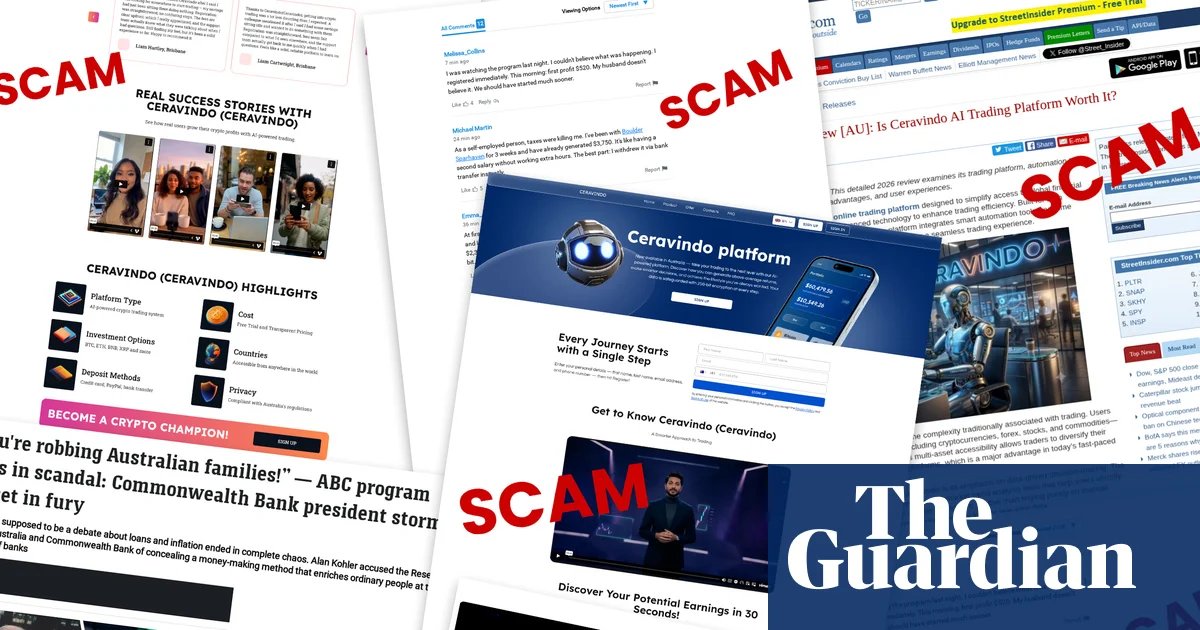
The sheer volume of these fraudulent activities is staggering. Asic reported addressing over 19,400 scams in the last financial year alone, a nearly threefold increase compared to the previous year. This alarming escalation is attributed to the growing accessibility and sophistication of artificial intelligence (AI), which makes the creation of convincing deepfakes increasingly effortless. Beyond individual celebrity impersonations, scammers are constructing intricate networks of fake brands, websites, fabricated reviews, deceptive news articles, and doctored videos. These interconnected components work in concert to build a façade of legitimacy, ultimately coercing victims into handing over their money, which often ends up in the hands of overseas criminals.
The financial repercussions for Australians have been substantial. According to reports submitted to the National Anti-Scam Centre’s Scamwatch, Australians collectively lost an estimated $7.4 million to scams involving the top 10 impersonated public figures, with Prime Minister Albanese leading this unfortunate list. Other prominent Australians frequently targeted for deepfake impersonation include economists Tom Piotrowski and Stephen Koukoulas, ABC financial journalist Alan Kohler, and politicians Jacqui Lambie and Angus Taylor. The list further extends to entrepreneur Dick Smith, billionaire Gina Rinehart, economist Alan Oster, Pauline Hanson, and the late radio legend John Laws. Asic emphasizes that scammers are highly adaptable, swiftly altering their choice of celebrity impersonation to capitalize on current events and topical issues.
In an effort to combat this growing threat, Asic actively removed 5,476 phishing scam hyperlinks last financial year, nearly four times the number from the year before. They also dismantled 7,051 fake investment platforms, a 2.5-fold increase, and identified 3,106 cryptocurrency scams, representing an almost 30% rise. Sarah Court, Asic chair, underscored the deceptive nature of these scams, stating that the presence of polished content, familiar branding, or seemingly credible testimonials does not guarantee the legitimacy of an investment opportunity. She highlighted that AI is rendering investment scams more convincing and significantly harder to detect, emphasizing that a simple online search is no longer sufficient to verify an opportunity’s authenticity. Consumers are urged to meticulously verify website addresses, confirm the legitimacy of individuals and companies, and exercise extreme caution when faced with urgent calls to act.
Scamwatch advises consumers to pause before sharing any money or personal information, to independently verify all details, and to protect themselves and others by reporting any scams to their organization, their bank, or cyber.gov.au. Asic further recommends that consumers verify the existence of a certified Australian financial services license, while also remaining aware that scammers frequently misuse legitimate licenses. Therefore, cross-referencing with Asic’s official professional registers is crucial. Commonwealth Bank research from earlier this year revealed a concerning disconnect: approximately nine out of ten Australians expressed confidence in their ability to identify an AI scam, yet in reality, they were successful less than half the time. The increasing use of deepfakes extends beyond financial scams, impacting the political landscape as well. Independent MP Zali Steggall has proposed legislation aimed at curbing deceptive political advertising, which would mandate clear identification of all AI-generated content capable of misleading voters.