







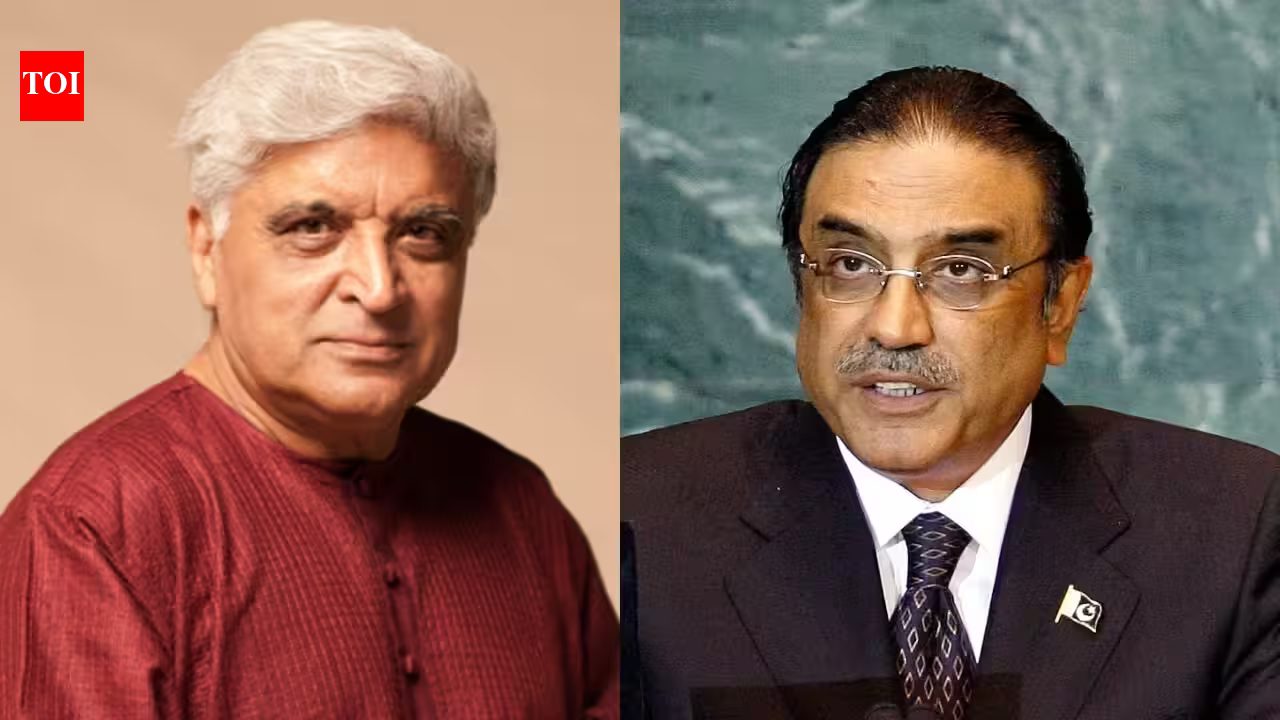
Veteran Indian screenwriter and lyricist Javed Akhtar, known for his outspoken nature and willingness to voice his opinions, has sharply criticized Pakistan President Asif Ali Zardari. Akhtar’s strong reaction stems from Zardari’s recent remarks concerning the Hindu minority residing in Pakistan, which Akhtar perceives as consistently insensitive. This condemnation by Akhtar underscores his consistent stance on various social and political issues, including his fervent patriotism and his readiness to challenge what he believes is unjust.
Akhtar’s pointed comments were made in response to a speech delivered by Zardari during Pakistan’s Independence Day celebrations. In this address, the Pakistani president touched upon the situation of Hindus within Pakistan, drawing a comparison with their counterparts in India. Zardari stated, as reported by CNN-News18, that “The Indians have a different point of view. They have their own agenda in mind. They believe in Akhand Bharat. But there is a lot in between which they have forgotten. We are Muslims. They are not. But we are Muslims of the mindset that we tolerate 3-4 per cent Hindu population in Pakistan. They are as free, as good as anywhere else they were. They would rather be with us than be with them.”
The use of the word “tolerate” in reference to the Hindu population particularly incensed Akhtar. He took to social media platform X (formerly Twitter) to express his outrage, directly addressing Zardari. Akhtar’s post read, “Mr Zardari of Pakistan, who had come into the limelight after Benazir Bhutto had married him, says that they tolerate the 3-4 per cent Hindu population in their country. I understand, Mr Zardari, you have always been insensitive to all under the sun, which is less than 10 per cent.”
Akhtar also made a clear and deliberate reference to Zardari’s infamous sobriquet, “Mr Ten Per Cent.” This nickname has shadowed Asif Ali Zardari, the widower of former Pakistani Prime Minister Benazir Bhutto, since the late 1980s and early 1990s. It originated from widespread allegations that he demanded a 10 percent commission on various government projects and business transactions during his wife’s tenure as Prime Minister. Despite Zardari consistently denying these accusations, the moniker became deeply entrenched in public discourse. Its prominence was further amplified following the dismissal of Bhutto’s government by then-President Ghulam Ishaq Khan in 1990. At that time, caretaker Prime Minister Ghulam Mustafa Jatoi explicitly leveled serious charges against Zardari, telling TIME magazine in 1990, “A 10 per cent commission had to be paid to get permission for setting up any project. Commissions had to be paid to get bank loans… Zardari is a party to all that happened. He is the kingpin.” Akhtar’s revival of this historical nickname serves to underscore his critique of Zardari’s perceived ethical shortcomings and insensitivity, suggesting a pattern of behavior that extends beyond just his recent comments on the Hindu minority.