








Astronomers Discover ‘Mega-Earth’ That Challenges Planetary Formation Rules
When researchers peer into the cosmos to observe planets orbiting distant stars, they typically rely on a well-established set of planetary "rules." Generally, rocky worlds remain small and compact, while massive entities like Jupiter or Neptune accrete enormous gaseous envelopes, ballooning into gas giants. However, a newly discovered exoplanet located 87 light-years from Earth is defying these expectations, forcing astronomers to rethink how planets grow.
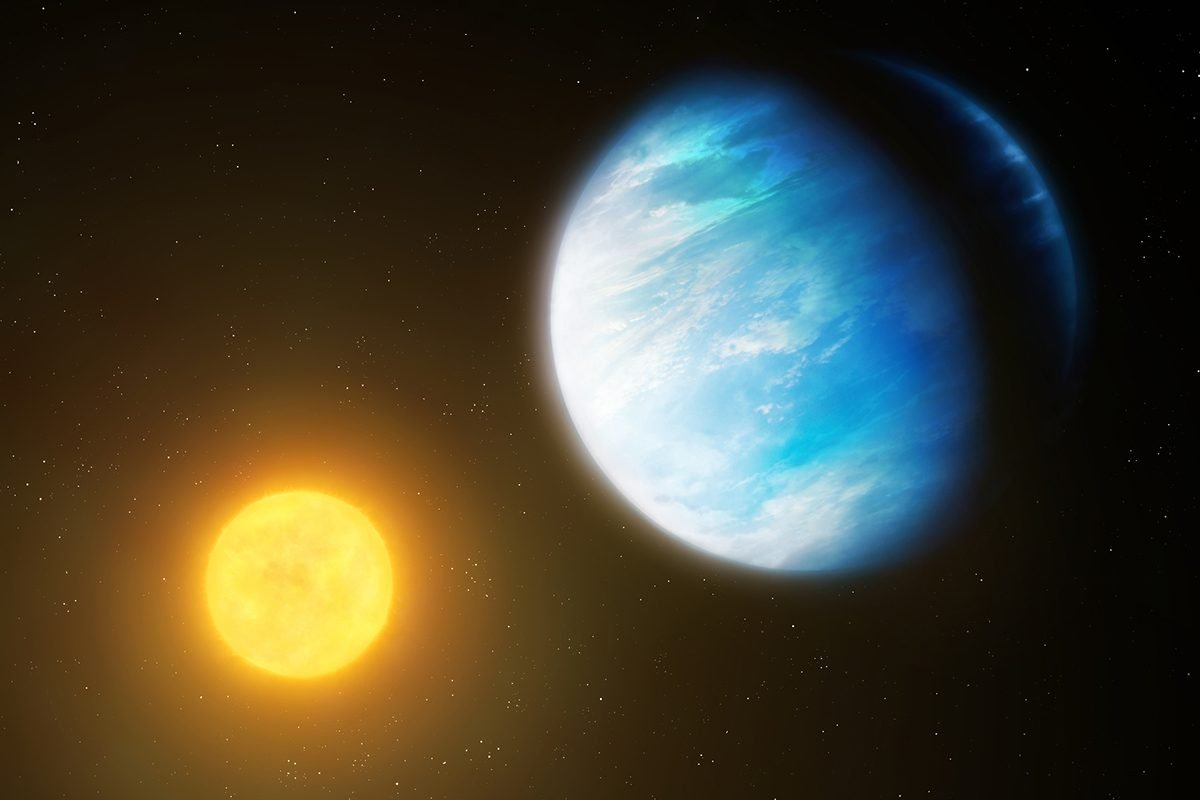
The discovery of GJ 523b—the first exoplanet cataloged by the University of Wisconsin–Madison’s Wisconsin Center for Origins Research (WiCOR) project—has left scientists baffled by its impossible composition.
A Planetary Anomaly
To understand why GJ 523b is so unusual, one must consider its extreme density: it packs the mass of approximately 23.5 Earths into a body only 2.5 times the radius of our home planet.
In standard astrophysical models, a planet of this size would fall into the "sub-Neptune" category. Such worlds are typically cloaked in thick, bloated atmospheres of hydrogen and helium. However, GJ 523b appears to be almost entirely solid rock and metal, earning it the classification of a "mega-Earth"—a class of ultra-dense, massive rocky planets that shouldn’t, theoretically, exist at this scale.
"This isn’t what we expected at all," said Max Kroft, a researcher at the University of Wisconsin–Madison who led the study. "Dense planets like this aren’t uncommon, but they’re usually small rocky planets similar to Earth or Mercury. This planet is two and a half times bigger than the Earth."
The "Gas Giant" Paradox
The mystery lies in the growth process of young planets. According to prevailing theories, once a rocky core reaches about 10 to 20 times the mass of Earth, its gravitational pull becomes a "cosmic vacuum cleaner." It should begin rapidly pulling in gas from the surrounding protoplanetary disk, inevitably transforming into a gas giant.
GJ 523b has clearly crossed that critical mass threshold, yet it has somehow managed to remain a bare, rocky sphere. Because the planet is only 170 million years old—an infant compared to our 4.5-billion-year-old Solar System—it is too young to have shed a massive atmosphere through gradual evaporation.
Solving the Mystery
Astronomers are now investigating several theories to explain the existence of this dense titan:
- Violent Collisions: The planet may have been formed by the cataclysmic merger of two massive protoplanets. Such a collision could have fused their heavy iron-and-rock cores while simultaneously stripping away any pre-existing gas layers.
- Stellar Stripping: The planet may have originally possessed a thick gaseous shroud, but the intense, erratic radiation and powerful flares from its young host star may have violently stripped that atmosphere away.
- Formation Environment: The planet may have originated in a "dry" region of its protoplanetary disk that was rich in rocky material but starved of the light gases required to build a giant atmosphere.
The team, which utilized data from NASA’s Transiting Exoplanet Survey Satellite (TESS) and the ground-based WIYN Observatory in Arizona, hopes to utilize the James Webb Space Telescope for follow-up observations. By examining the planet’s extreme gravitational signature and searching for even minor traces of an atmosphere, researchers hope to solve the riddle of how this "mega-Earth" defied the conventional laws of planetary evolution.