









Engineering the Impossible: How Custom ExpressLRS Receivers Defy Radio Limits
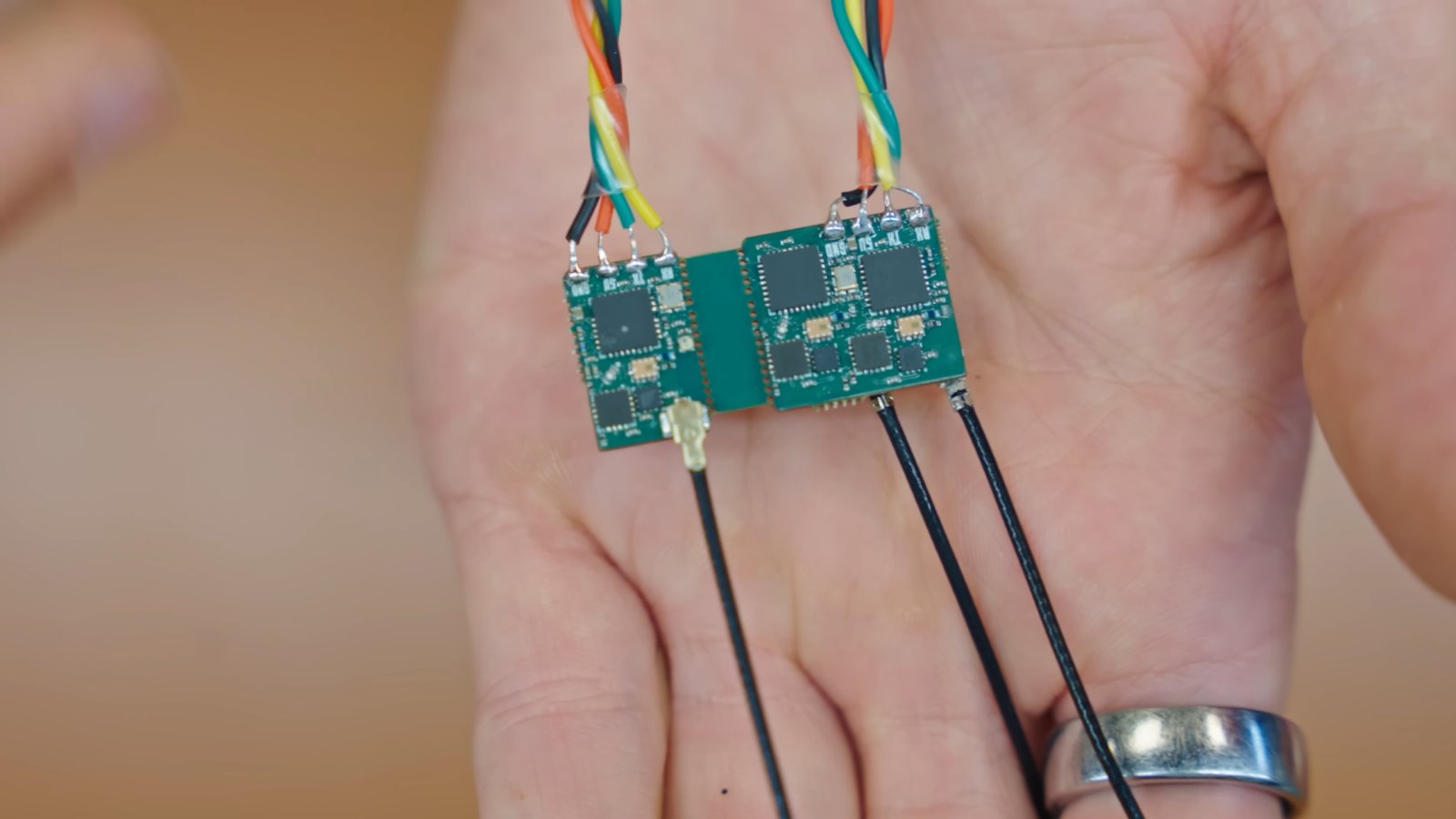
In the world of radio communication, the performance of modern drone control links feels nothing short of miraculous. With a transmitter output capped at a mere one watt, advanced protocols can maintain a stable command link over distances exceeding 100 kilometers. Recently, hardware enthusiast Stan took a deep dive into the mechanics of this long-range capability, documenting the creation of four custom drone receivers to explain the principles behind their staggering reach.
The Secret Sauce: Chirp Spread Spectrum
While intuition might suggest that range is primarily a function of lowering radio frequency—a valid tactic that allows signals to penetrate obstacles more effectively—the true secret to this performance lies in modulation.
Unlike traditional control protocols that rely on standard frequency modulation, or Wi-Fi systems burdened by complex phase and amplitude modulation, ExpressLRS (ELRS) leverages ExpressLRS technology. At its core, ELRS utilizes Chirp Spread Spectrum (CSS) modulation. In this scheme, every bit is transmitted as a "chirp"—a tone that rises linearly in frequency.
By encoding data into the starting frequency of these chirps, the system achieves incredible reliability at a lower data rate. Decoding the signal involves multiplying the incoming tone by an inverse chirp and performing a Fast Fourier Transform (FFT). This process provides an equivalent gain of 24 dB, allowing the receiver to pull a signal out of the air even when it is buried deep below the ambient noise floor.
Hardware Simplicity and Robust Design
To test these theoretical advantages, Stan designed four custom receivers utilizing a minimalist hardware stack: an ESP32 microcontroller paired with an SX1281 radio chip. While all four designs operated in the 2.4 GHz band, two were equipped with supplementary 900 MHz antennas to provide versatility.
The project also challenged common assumptions in radio frequency (RF) engineering. For instance, one receiver design utilized a via for an antenna connection—a technique typically avoided due to fears of impedance mismatch. However, Stan discovered that by placing sufficient ground-plane vias in close proximity, the current return path remained stable, resulting in virtually no degradation in performance.
The real-world validation was striking: during field testing, all four receivers maintained a solid connection through a dense forest at a distance of five kilometers, proving that robust protocol design can compensate for less-than-ideal physical layouts.
A Legacy of Range
The success of this hardware highlights the maturation of the ExpressLRS ecosystem. By building on the foundation of LoRa (Long Range) technology—which has recently been used to set record-breaking communication distances, including transmission attempts spanning hundreds of miles and even lunar distances—ELRS has cemented itself as the gold standard for long-range drone piloting.
For those interested in the technical minutiae or the PCB designs themselves, Stan has made his OpenRX hardware available via GitHub, providing a blueprint for the next generation of long-range aerial experimentation.