







Caught in the Crossfire: Can Venezuela Secure India’s Energy Future Amid Rising Global Sanctions?
The global crude oil market is currently traversing a period of extreme volatility, exacerbated by escalating geopolitical tensions and aggressive new trade policies from Washington. As the United States intensifies its “economic warfare” against Iran and moves toward potentially punitive tariffs on Russian energy imports, India—the world’s third-largest oil consumer—finds itself at a critical crossroads.
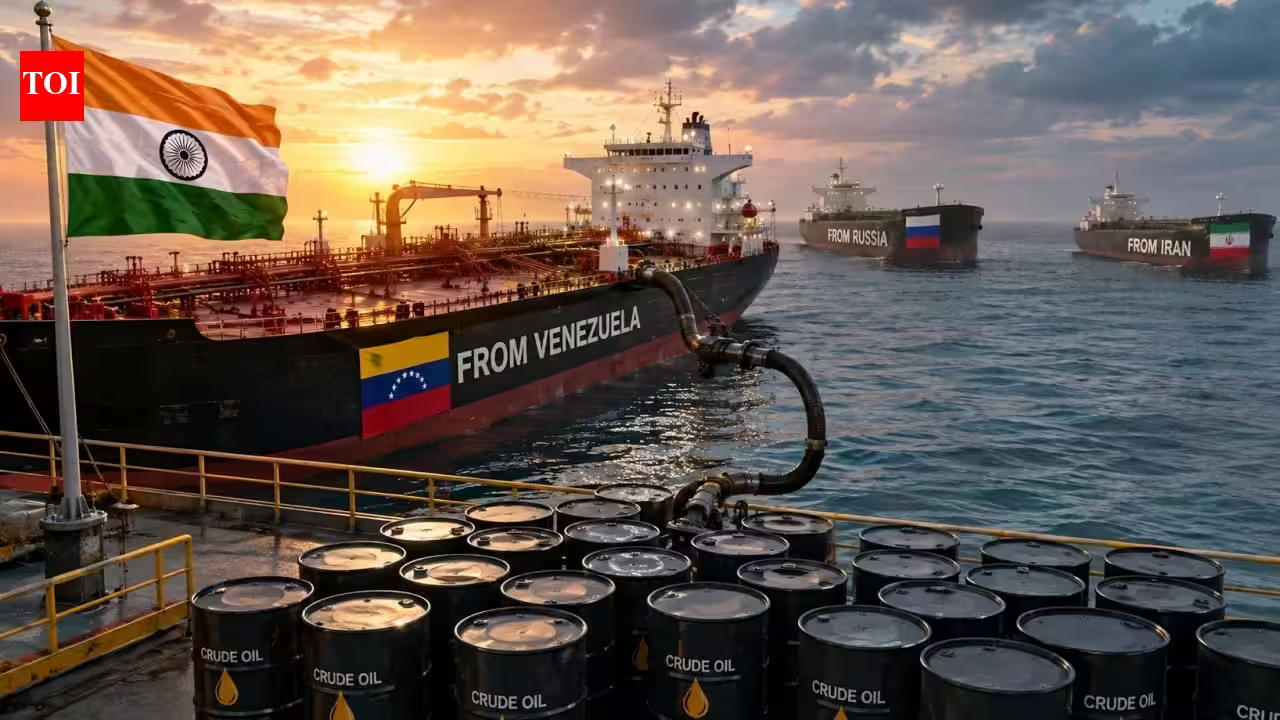
With Russia currently accounting for over 50% of India’s crude import basket, the looming threat of the “Lindsey O. Graham Sanctioning Russia Act”—which could empower the US President to impose 100% tariffs on countries purchasing Russian energy—has forced New Delhi to scramble for alternatives. In this high-stakes search for energy security, Venezuela has emerged as a potential, albeit limited, savior.
The Geopolitical Squeeze
The Trump administration has launched what it terms “Operation Economic Outcast” against Iran, targeting key financial and industrial sectors to further isolate the regime. While the US has tempered its most aggressive secondary sanctions to avoid immediate global market chaos, the threat to global supply chains remains palpable.
Simultaneously, the proposed legislation targeting Russian oil threatens to dismantle the current status quo. If these sanctions manifest, the impact on India would be two-fold: a direct threat to the price and availability of its primary supply of Russian Urals, and indirect inflation caused by reduced global supply as other nations exit the Iranian and Russian markets.
The Venezuelan Pivot
Since the onset of disruptions in the Strait of Hormuz, India has aggressively diversified its supply chain. Venezuela, once a dormant partner, has made a dramatic comeback, now ranking as a top-five supplier for India. Data from Kpler indicates that Venezuelan imports have scaled to roughly 220,000–380,000 barrels per day, accounting for about 8% of India’s total intake.
These barrels are primarily processed by India’s sophisticated coastal refineries—such as those in Jamnagar, Paradip, and Mundra—which are uniquely equipped to handle the heavy, sour, and high-acid nature of Venezuelan crude.
Why Venezuela Cannot Fully Replace Russia
Despite its strategic importance, energy analysts caution against viewing Venezuela as a total replacement for Russian supply.
“Venezuelan barrels cannot fully replace Russian supplies in either quantity or quality,” explains Pankaj Srivastava, Senior Vice President at Rystad Energy. The constraints are structural:
- Production Caps: Venezuela’s production is currently stagnating around 1.3 million barrels per day, with the US retaining priority access to a significant portion of those exports.
- Refinery Limitations: The “heavy-sour” profile of Venezuelan crude is not a one-for-one swap for Russian Urals, limiting its versatility across India’s broader refining network.
- Infrastructure Deficits: Ongoing structural issues in Venezuela’s upstream and export infrastructure mean that any significant ramp-up in production will be a slow, long-term process.
Naveen Das, a senior crude oil analyst at Kpler, notes that while Venezuela provides a “useful extra leg” for energy security, it is not a “pillar.” He estimates that at an absolute stretch, Venezuela could supply India with 400,000 to 600,000 barrels per day—a fraction of the 2 million-plus barrels India currently sources from Russia.
The Path Forward: A Portfolio Strategy
If a supply shock occurs, experts suggest that India will likely revert to a “portfolio approach.” This strategy would involve renewed engagement with Middle Eastern suppliers—who have been partially absent due to regional conflicts—alongside increased imports from the US, Brazil, and West Africa.
Ultimately, the goal for New Delhi is to maintain energy security while navigating the crude oil market’s volatile new reality. While Venezuela offers a crucial cushion, it remains a secondary component in a much larger, more complex puzzle that prioritizes national economic stability above all else. For now, India continues to walk a fine line, balancing its sovereign energy needs against the tightening grip of international sanctions.