








From Pest to Plate: New England’s Battle Against the Invasive Green Crab
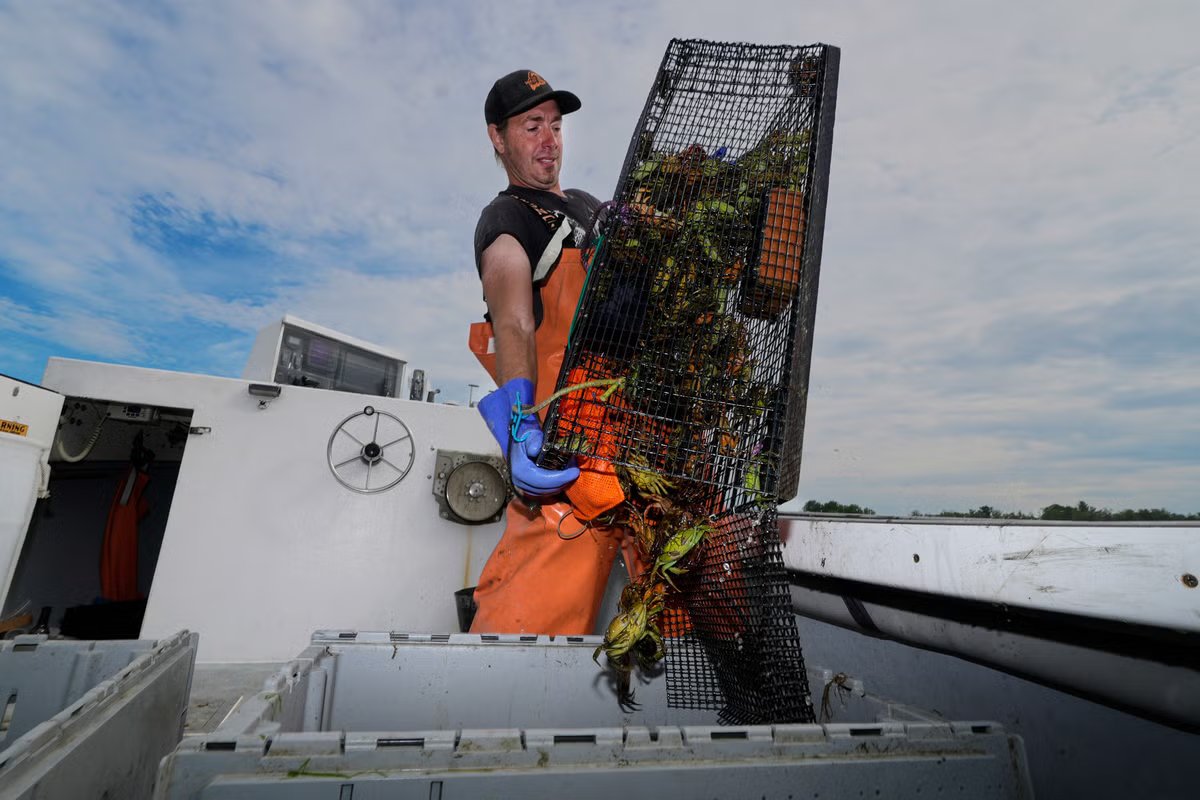
YORK, Maine — As the morning fog lifts over Maine’s York River, the rhythmic sound of sorting gear marks the start of a unique, high-stakes mission. Mike Masi, a former marine science teacher turned entrepreneur, works alongside his interns to sift through a haul of the region’s most reviled creature: the European green crab.
The goal is to find those few specimens currently molting—shedding their hard, calcified shells for a soft, pliable exterior. In this fleeting phase, the crabs become a sought-after delicacy, commanding as much as $3 each at market, compared to the meager 8 cents a hard-shell crab might fetch.
“Just about everyone hates them, and we’re trying to turn them into a premium seafood product,” says Masi, who operates shell+claw, currently the region’s only commercial cultivator of the invasive species.
A Destructive Invader
The Carcinus maenas, or European green crab, was transported to North American waters in ship ballast centuries ago. Today, their population numbers in the tens of millions along the East Coast. Recognized by their brownish-green shells and five distinct spines along each eye, these crustaceans have become an ecological nightmare.
They regularly outcompete native Atlantic rock crabs and juvenile lobsters, destroy vital eelgrass beds, and degrade the banks of salt marshes. By feeding voraciously on oysters, mussels, and soft-shell clams, they have dealt a crippling blow to the regional shellfish industry. In Maine alone, soft-shell clam landings have cratered from 7.8 million meat pounds in 1978 to just 1.3 million in 2025.
“They’re really pretty resilient little guys,” notes Carolyn Tepolt, an evolutionary biologist at the Woods Hole Oceanographic Institution. Their ability to thrive in warming waters—fueled by climate change—combined with their rapid reproduction rate (a single female can release up to 185,000 eggs twice a year) has cemented their status as one of the world’s most successful invasive species.
The Challenge of Scale
Despite growing grassroots interest in turning the pest into a profitable commodity, the broader fight against the invasion remains stalled. While innovative ventures are popping up—producing everything from green crab-infused fish sauce and pet snacks to distilled green crab whiskey—the supply chain remains underdeveloped.
“Harvesters can catch as many green crabs as you could ever possibly want,” says Marissa McMahan, vice president of fisheries at Manomet Conservation Sciences. “But they can’t get them on a truck and get them to where they need to be. That is a huge impediment.”
State-level efforts are inconsistent. While Massachusetts offers a financial incentive of 40 cents per pound to fishermen, other states have yet to provide similar support. In contrast, Washington state, fearing the spread of the crab into the Pacific Northwest, has authorized over $38 million in funding through 2027 to aggressively suppress their population.
A Culinary Solution?
Back in the kitchen, chefs are beginning to champion the ingredient. The number of restaurants featuring green crab on their menus has increased tenfold since 2021. At PAGU, a Spanish-Japanese tapas restaurant in Cambridge, Massachusetts, chef-owner Tracy Chang highlights the crab’s unique profile, which she describes as “rich, deep, and luscious.”
Whether in a Malaysian-style laksa or served tempura-style inside a steamed bao, diners are discovering that the invasive green crab offers a flavor profile distinct from the standard king or Jonah crab.
For pioneers like Masi, the road to a sustainable business model is paved with trial and error. His operation, which generates up to $20,000 annually, relies on labor-intensive hand-sorting. Yet, he remains undeterred, looking to Mediterranean models—such as the fried moeche of Venice—as proof of concept.
“I am cautiously optimistic,” Masi says. “We are one breakthrough from making this a profitable business.”