







Nepal-Tibet Flood Crisis: International Rescue Efforts Race Against Time as Thousands Remain Missing
Five days after a catastrophic glacial collapse triggered massive flash floods across the Himalayan border, Nepal is grappling with its most significant humanitarian crisis in years. Search teams are working around the clock, battling treacherous terrain and volatile weather, as they attempt to locate thousands of people still missing under layers of mud and debris.
The disaster, which began on August 26, was set in motion when a section of a glacier near the 5,200-meter-high Langtang Lirung peak detached, plunging 1,200 meters into the Lende River. The resulting torrent of ice, rock, and water surged southward, ravaging districts in Nepal, including Rasuwa, Nuwakot, and Dhading.
A Focus on Trapped Workers
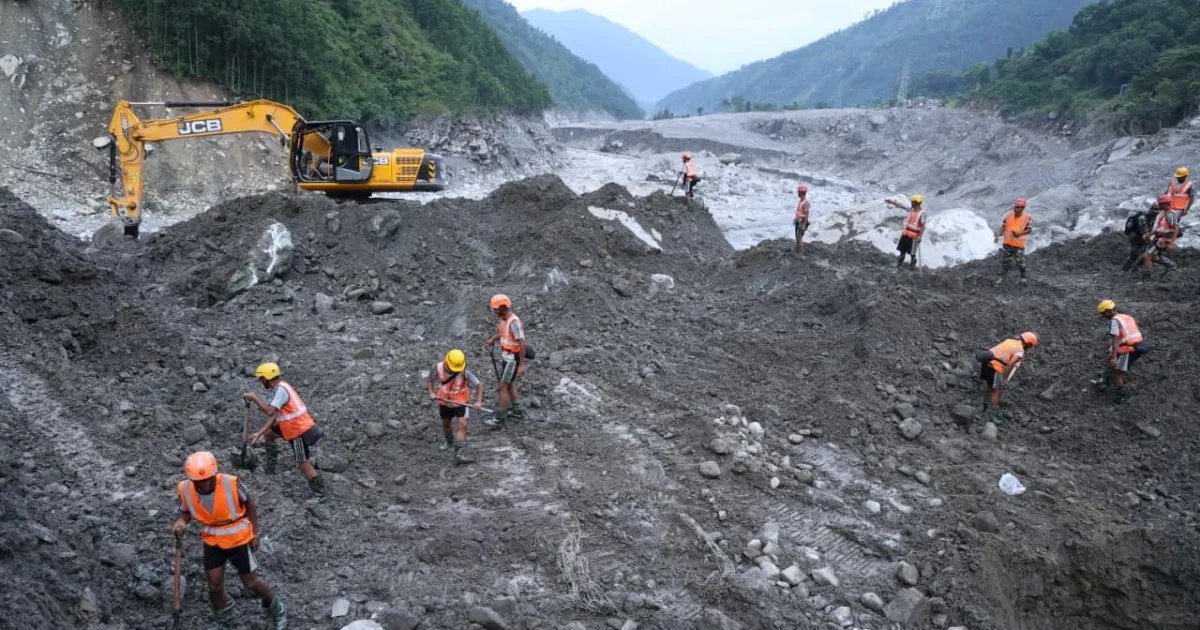
A primary point of desperation for rescue teams is the series of hydropower tunnels lining the region’s riverbanks. According to the National Disaster Risk Reduction and Management Authority, nearly 1,000 workers were stationed at these sites when the flood struck. Many are believed to be trapped in subterranean tunnels now choked with sediment.
Raja Ram Basnet, spokesperson for the Nepal Army, acknowledged the immense logistical hurdles. “A large amount of debris has been deposited, and that is posing us a big challenge to open the tunnels,” Basnet told the media.
While authorities have managed to rescue nearly 300 individuals, including several Indian nationals, from sites like the Trishuli 3A and 3B projects, the operation remains agonizingly slow. Rescue teams are using drills, thermal imaging, and endoscopes to probe the mud-filled passages, though recent efforts have yet to yield further survivors.
Global Response Bolsters Local Operations
Facing a disaster of such scale, the Nepali government has pivoted from its initial stance to accept international assistance. Nearly 21,000 security personnel are currently mobilized on the ground, now supported by specialized teams from China and India.
- China’s Involvement: Beijing has deployed over 2,100 rescue workers and committed roughly $33 million in relief funds. Chinese forces are utilizing advanced life-detection equipment to survey the disaster zones, while President Xi Jinping has emphasized the priority of relocating survivors and providing medical care to the injured.
- India’s Support: India has contributed 18 army officers specialized in tunnel extraction, along with forensic experts to assist in DNA-based identification of victims. Additionally, New Delhi has provided critical infrastructure support, including portable power generators and prefabricated Bailey bridges to reconnect communities isolated by destroyed transit routes.
The Growing Threat of Secondary Disasters
The recovery mission is hampered not only by geography but by the looming threat of secondary flooding. The deluge created large “barrier lakes” in the mountains, one of which began overflowing late last week. Physical geographer Nitesh Khadka warned that these unstable water bodies pose a constant threat to rescue workers, as a sudden breach could send new surges downstream, potentially retrapping those attempting to clear the hydropower tunnels.
The Human Toll
As of Monday, the official death toll stands at 903 in Nepal, with 4,247 people still missing. On the Chinese side of the border, authorities in Gyirong County have confirmed 16 deaths and 546 missing, a figure that includes hundreds of foreign nationals from 23 different countries.
Prime Minister Balendra Shah described the event as an “unprecedented and devastating natural disaster.” As international aid from the UN, Red Cross, and various nations continues to pour in, the primary challenge remains shifting from the recovery of the deceased to finding those who may still be waiting in the dark, hope fading as the Nepal tunnel traps continue to hinder rescue operations.