






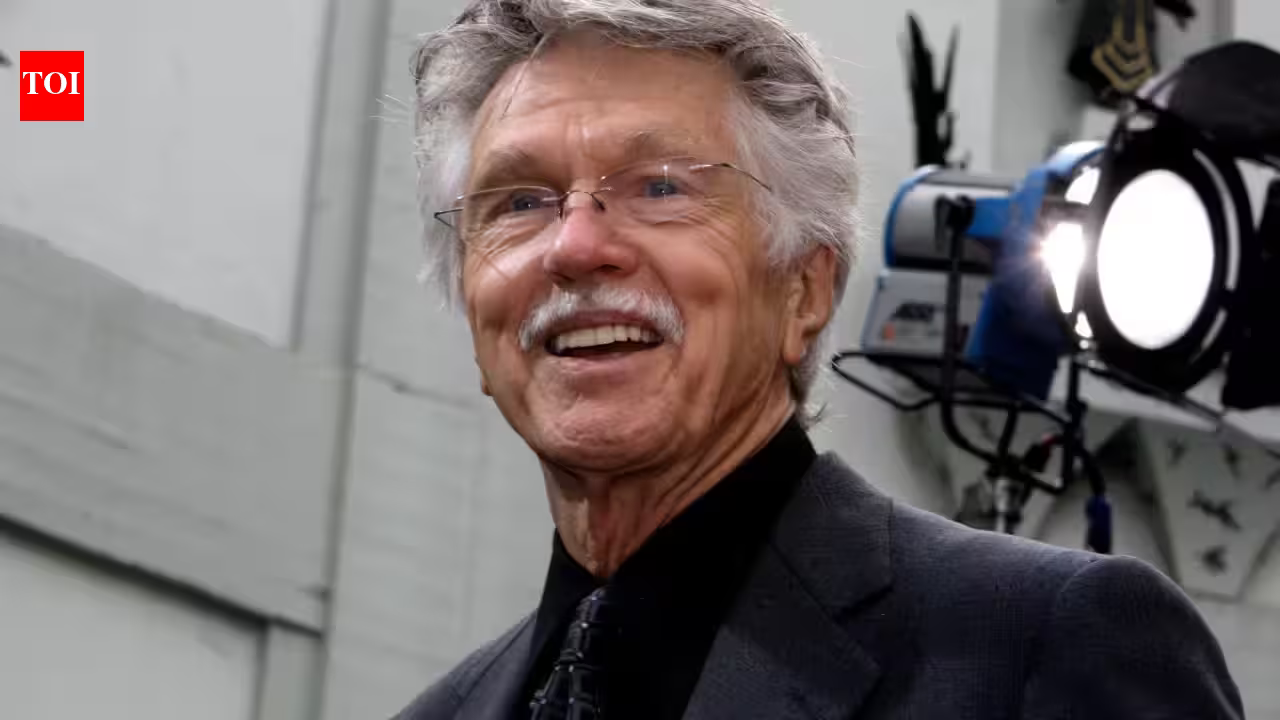
The landscape of American cinema has lost one of its most reliable, grounded, and essential anchors. Tom Skerritt, the Emmy-winning veteran whose career spanned more than six decades and touched almost every facet of the industry, passed away this Wednesday at the age of 93. While his family confirmed the news was due to natural causes, the announcement has triggered a wave of reflection across Hollywood, reminding us that some actors don’t just play roles—they define the structural integrity of the films they inhabit.
Skerritt was rarely the man shouting from the rooftops or demanding the spotlight. Instead, he was the steady heartbeat of a scene. Whether he was guiding fighter pilots through the clouds in Top Gun, patrolling the quirky, complex streets of Rome, Wisconsin, in Picket Fences, or navigating the suffocating corridors of a haunted spaceship in Alien, Skerritt possessed a “wry authority.” He had the rare ability to make you believe he was the smartest, most capable man in the room, even when he was clearly out of his depth.
A Legacy Written in Honesty
In a poignant statement released following his passing, the Skerritt family captured the essence of the man behind the accolades. “While the world knew Tom through his remarkable acting career, we knew him for his humour, curiosity, wisdom, generosity and the love he brought into our lives,” they shared. It is a sentiment that resonates with those who saw him as an institution—not just an actor, but a man who cared deeply about the preservation of storytelling and the nurturing of voices that might otherwise go unheard.
For a man who occupied such a significant space in popular culture, Skerritt was remarkably self-aware. He once told the Seattle Post-Intelligencer in 1997, “A writer once described me as a character actor locked in a leading man’s body, and I have always loved that.” That duality was his secret weapon. He was handsome enough to lead, but he had the grit and unpredictability of the best character actors. This allowed him to bridge the gap between blockbuster features and character-driven television dramas with an effortless fluidity that few of his peers could replicate.
The Breakthrough: Finding the Rhythm in MAS*H
Skerritt’s path to fame didn’t happen overnight, but it was forged in the fires of 1970’s MASH*. Directed by Robert Altman, the film was a cynical, black-comedic masterpiece that perfectly tapped into the nation’s burgeoning disillusionment with the Vietnam War. As Duke Forrest, the roguish Army surgeon, Skerritt was part of a formidable ensemble.
Playing a Southerner in the Mobile Army Surgical Hospital, he helped establish a tone of dark, absurdist humor that turned the traditional war movie on its head. The film’s massive success—culminating in five Academy Award nominations—catapulted Skerritt into the cultural conversation. He proved he could hold his own against industry titans like Donald Sutherland and Elliott Gould, establishing a reputation for being the “glue” that held complex, ensemble-heavy projects together.
Into the Void: The Enduring Impact of Alien
While his resume is packed with prestige drama, Skerritt’s role in Ridley Scott’s 1979 sci-fi landmark Alien remains perhaps his most iconic genre contribution. As Captain Dallas, Skerritt was the quintessential professional, maintaining a semblance of order as his crew was picked off by a terrifying, parasitic extraterrestrial.
He understood that for a horror film to work, the stakes had to feel real. He provided the necessary grounded energy that allowed the audience to suspend their disbelief during the film’s legendary “chestburster” sequence. In a 2019 interview, Skerritt reflected on the project’s unique energy, citing “spontaneity and impulse” as the driving forces behind the cast’s rapport. It is a testament to his professionalism that he consistently championed the work of his co-stars, particularly Sigourney Weaver, at a time when the “strong female lead” in a sci-fi blockbuster was a radical, pioneering concept.
The Sage of Picket Fences
For many television viewers, Skerritt will forever be Sheriff Jimmy Brock from David E. Kelley’s Picket Fences. It was the role that brought him the industry’s highest honors, including his Emmy win for outstanding lead actor in 1993. The show was a bizarre, brilliant mix of small-town charm and high-concept social commentary, and Skerritt was the calm eye of that storm.
He played Brock not as a lawman defined by his badge, but as a man constantly trying to manage the chaotic, often surreal morality of his community. His performance was a masterclass in subtlety; he could convey profound empathy with a mere look, or exasperated authority with a slight adjustment of his stance. It was a role that felt tailor-made for his particular brand of wisdom and lived-in experience.
A Life Beyond the Screen
Beyond the glitz of award shows and the intensity of film sets, Skerritt led a life defined by varied interests. Born in Detroit in 1933, his early years were marked by service in the U.S. Air Force, an experience that likely informed the stoic, disciplined characters he became famous for playing. His film debut came in 1962, but he never let the art form consume his entire identity.
He was a man of the theater, stepping onto the Broadway stage in 2013 for A Time to Kill, and a man of the community in Seattle, where he lent his time to various creative and veteran-focused endeavors. He leaves behind five children and a legacy that spans three marriages and countless collaborations.
Tom Skerritt belonged to a generation of actors who prioritized craft over notoriety. He never seemed to be chasing the next big hit for the sake of fame; he was chasing the next good story. As he once remarked, he loved that he was able to “walk the line between television and features,” but he walked it with such grace and consistency that he became a fixture in the American consciousness. We lose a piece of our cinematic history with his passing, but for those who grew up watching him navigate the complexities of life on screen, his voice—that calm, steady, reliable voice—remains a permanent fixture. He wasn’t just a captain of a spaceship or a sheriff of a town; he was, in every sense of the word, a working master.
Disclaimer: This content is auto-generated for informational purposes only.
Source: Read Original News