





EU Climate Chief Sounds Alarm Over China’s Dominance in Green Technology
The European Union is facing a critical strategic challenge as it attempts to accelerate its transition to net-zero, with top officials openly acknowledging a growing dependency on Beijing’s industrial capacity.
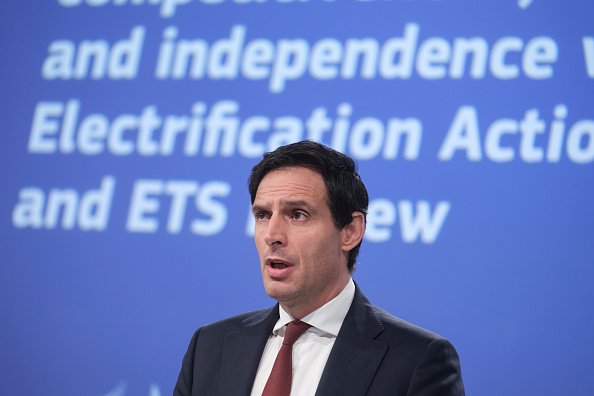
Wopke Hoekstra, the European Commissioner for Climate Action, has issued a stark assessment of the current geopolitical landscape, characterizing the bloc’s relationship with China as a significant “problem.” As the EU doubles down on its European Green Deal, Hoekstra argues that Beijing has engaged in aggressive industrial practices that threaten to stifle European competitiveness and jeopardize the bloc’s energy security.
A “Ruthlessly Weaponised” Supply Chain
During recent high-level policy discussions, Commissioner Hoekstra leveled pointed criticism at Beijing, suggesting that the Chinese government has systematically distorted global markets to cement its control over essential green technologies. According to the Commissioner, Beijing has ruthlessly weaponised its dominance in the manufacturing of solar panels, wind turbines, and critical battery components.
By leveraging massive state subsidies and maintaining tight control over upstream mineral supply chains, China has positioned itself as the primary supplier for the global energy transition. For Brussels, this creates a precarious vulnerability: the very technologies required to break free from fossil fuel dependency are now tethered to a single, increasingly assertive geopolitical rival.
The Brussels Response: De-risking vs. Decoupling
The European Commission has been grappling with how to reconcile its ambitious climate goals with the stark economic reality of its dependence on Chinese imports. While the EU maintains that it is not seeking a complete “decoupling” from the Chinese economy, there is a clear shift toward a strategy of “de-risking.”
This approach involves:
- Strengthening Domestic Manufacturing: Incentivizing the production of clean technologies within EU borders to reduce reliance on foreign supply chains.
- Strategic Diversification: Expanding trade partnerships with emerging economies in Africa, Latin America, and Southeast Asia to secure alternative sources for raw materials like lithium and rare earth elements.
- Trade Defense Instruments: Utilizing anti-subsidy investigations to ensure that Chinese products entering the Single Market adhere to fair competition standards.
Balancing Climate Goals and Industrial Sovereignty
The challenge for Hoekstra and his colleagues is one of timing. The EU is under intense pressure to meet its 2030 climate targets, which require a rapid, massive-scale deployment of renewable energy infrastructure. Importing affordable Chinese equipment is the quickest path to achieving these targets, yet doing so risks hollowing out the European industrial base and creating long-term strategic dependencies.
“We cannot trade our reliance on Russian fossil fuels for a new, deeper reliance on Chinese clean-tech,” one EU official remarked on the condition of anonymity.
As the geopolitical climate grows increasingly tense, the European Union’s next steps will be decisive. Whether Brussels can successfully foster a sovereign, resilient green industry while simultaneously meeting its climate obligations remains the defining political test of the current Commission’s mandate.