








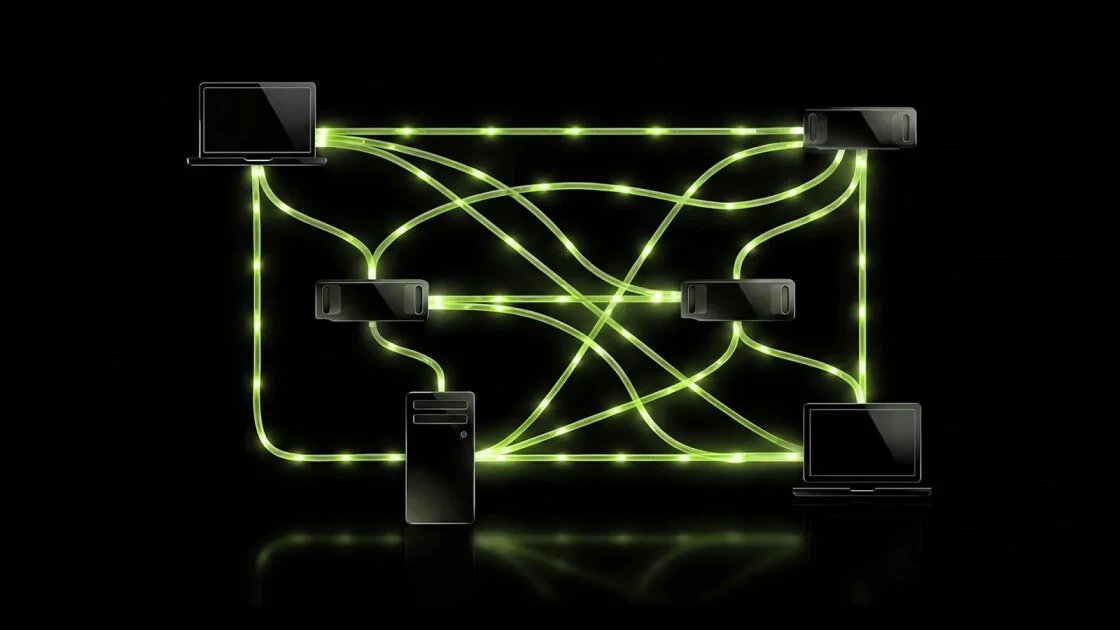
Nvidia has introduced a significant shift in how personal computing hardware handles artificial intelligence with the release of PAIR, or Personal AI Router. Rather than focusing on a new high-end graphics card or a monolithic AI model, this free, open-source software project enables users to connect multiple computers within a home network to form a localized, distributed computing grid. By transforming idle laptops, workstations, and desktops into a unified resource, Nvidia aims to address the growing compute requirements of modern AI agents without forcing users to rely on cloud-based processing.
Solving the Compute Bottleneck for Local AI
As AI agents move from experimental software to household utility, the demand for sustained processing power is rising. Traditionally, running complex AI tasks locally has been limited by the capabilities of a single machine. If a task is too large for the onboard hardware, users have historically faced the choice of either accepting slow performance or offloading the work to remote servers. The latter introduces significant concerns regarding the privacy of sensitive household data, personal files, and private correspondence.
PAIR provides a third path by creating a plug-and-play cluster from existing home hardware. By managing the distribution of workloads across multiple devices, the software allows users to run heavy-duty AI agents—such as those tasked with file organization, software development, or home management—entirely within their private network. This localized approach ensures that data never leaves the home environment, providing a robust solution for those seeking to combine the convenience of automated agents with the security of edge computing.
The Mechanics of Intelligent Routing
The core function of PAIR is that of an intelligent traffic controller. When a user initiates an AI task, PAIR acts as an orchestration layer that breaks down the project into smaller, manageable sub-tasks. It then assigns these individual workloads to different computers on the local network that have the necessary capacity to execute them. This parallel processing capability is a substantial upgrade over standard sequential execution, where one machine processes each step of a task one after another.
It is important to clarify how PAIR differentiates itself from traditional cluster computing. It does not attempt to pool VRAM across different machines or split a single large model into segments across various systems. Instead, it utilizes individual machines to handle discrete sub-tasks in their entirety. By routing specific jobs to the hardware best equipped to handle them at a given moment, PAIR maximizes the efficiency of the entire home network. The system manages the coordination entirely in the background, requiring minimal user intervention.
Hardware Requirements and Platform Flexibility
One of the most notable features of PAIR is its broad hardware compatibility, which extends beyond Nvidia’s specialized AI infrastructure. While the software is designed to leverage the power of Nvidia GeForce RTX 20 Series GPUs and newer, as well as professional RTX workstation hardware and DGX Spark units, it also supports modern Apple hardware. Specifically, systems utilizing Apple M4 silicon or newer can participate in the local network, enabling a heterogeneous mix of Windows, macOS, and Linux-based machines to work in concert.
To ensure stability, participant machines require a minimum of 8GB of RAM and at least 20GB of disk space. Because the software is designed for home networks, it does not require complex networking configuration or proprietary cabling. The system features dynamic discovery, meaning that as machines join or leave the network, the router automatically adjusts the distribution of tasks accordingly. Once the necessary AI models are downloaded to the machines, the system can function in an entirely offline state, reinforcing the privacy-centric design of the project.
Empowering the Private AI Ecosystem
Nvidia’s move toward local, distributed AI is a strategic effort to cement its presence in the emerging field of agentic computing. As the industry transitions from simple app-based interactions to autonomous agents that perform multi-step tasks, the need for high-performance computing at the edge becomes a defining factor in user experience. By lowering the barrier to entry for building a home-based AI cluster, Nvidia is offering a clear alternative to the subscription-based, cloud-centric model that currently dominates the AI landscape.
For the user, this development marks a transition where the hardware already sitting on desks or in home offices becomes the infrastructure for an autonomous personal assistant. Whether it is managing complex datasets, analyzing home security logs, or automating creative workflows, PAIR creates a framework where users retain ownership of their data and their compute power. In an era increasingly defined by concerns over data harvesting and the reliance on external server availability, Nvidia’s open-source router presents a practical approach to building a private, secure, and highly efficient AI ecosystem within the modern home.
Disclaimer: This content is auto-generated for informational purposes only.
Source: Read Original News