








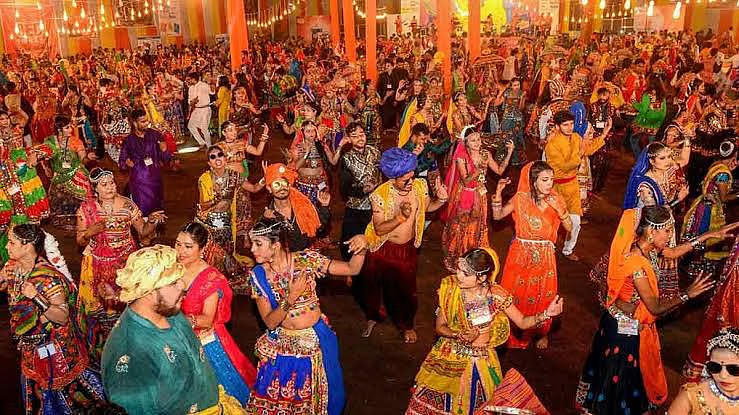
MUMBAI — In a move set to reshape the landscape of the upcoming Navratri celebrations in Maharashtra, the Vishva Hindu Parishad (VHP) has issued a directive barring members of the Muslim community from participating in Garba and Dandiya events. The festival, which is scheduled to commence on October 11, 2026, will now be subject to strict identity verification protocols enforced by the organization.
VHP spokesperson and joint secretary Shriraj Nair announced the decision this week, framing it as a measure to protect the sanctity of the festival. According to the organization, the primary objective is to preserve the cultural and religious character of Navratri, which is dedicated to the worship of the Goddess. Nair questioned the logic of individuals from communities that do not practice idol worship taking part in traditional celebrations centered around it.
“This is a festival deeply rooted in our traditions and the worship of the Goddess,” Nair stated. “We believe it is important to ensure that the sanctity of these rituals is maintained by those who share the same beliefs.”
To enforce this ban, the VHP has issued a specific set of guidelines for all Garba and Dandiya event organizers across the state. The directives mandate that organizers conduct rigorous checks of government-issued identification. Attendees will be required to present their Aadhaar cards at venue entry points to verify their Hindu identity. Furthermore, as a secondary measure of verification and cultural adherence, the VHP has instructed that a tilak—a traditional mark applied to the forehead—be placed on every attendee before they are permitted to enter the dance grounds.
While the VHP has maintained that these steps are “precautionary” and intended to safeguard the cultural integrity of Hindu festivals, the announcement has sparked immediate discourse regarding religious inclusivity in public spaces. The organization explicitly denied that the move is an act of hostility against any particular community, insisting instead that the policy is designed to prevent “outsiders” from entering spaces meant exclusively for the observation of specific religious rites.
The announcement places significant pressure on event organizers, who must now navigate the logistical challenges of identity verification at large-scale public gatherings. As the October 11 start date approaches, questions remain regarding how law enforcement and local authorities will monitor these private events and whether such exclusionary policies might lead to friction during what is traditionally a period of communal festivity.
For now, the VHP remains firm in its stance, calling on all organizers to strictly adhere to these new protocols to ensure that the forthcoming Navratri celebrations remain, in their view, strictly aligned with Hindu traditions.
Disclaimer: This content is auto-generated for informational purposes only. It has been rewritten and paraphrased from the original source.
Source: Read Original News