








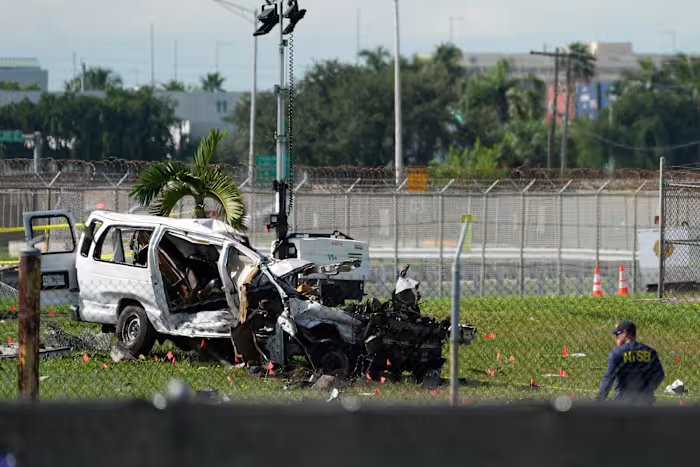
MIAMI – Authorities have confirmed that all five people killed in the tragic Amazon cargo jet crash at Miami International Airport on Sunday were employees of a cleaning service, traveling in a van that was struck as the plane careened off the runway.
The Boeing 767, operated by North Carolina-based carrier 21 Air, overshot the landing strip, smashing through an airport fence and colliding with the cleaning crew’s van on airport property before striking an SUV on a nearby city street. The victims have been identified as Rolando Aleman Leon, 55; Yoel Rodriguez Naranjo, 53; Julio C. Pineda, 75; Carlos Acosta Fajardo, 53; and Javierkys Reyes Quevedo, 47. All were employees of Professional Ocean Service Corp.
“Our employees are far more than the people who work beside us each day; they are family,” the company said in a statement Tuesday.
Five others sustained injuries in the incident. While the pilot and co-pilot have since been released from the hospital, Miami-Dade County Sheriff Rosie Cordero-Stutz reported that two individuals remain in critical condition, while a third is in stable condition.
The National Transportation Safety Board (NTSB) has launched a full investigation, recovering the jet’s flight data recorder to determine why the 32-year-old aircraft continued to hover over the runway rather than flaring for a standard landing. Experts reviewing footage of the arrival suggest that a strong tailwind may have pushed the plane deep into the runway, yet it remains unclear why the flight crew did not initiate a go-around.
A central point of the federal inquiry will be the airport’s infrastructure. Miami International does not utilize the Engineered Material Arresting System (EMAS)—a series of crushable, lightweight concrete blocks designed to stop runaway jets. While the airport remains compliant with federal regulations by maintaining a 1,000-foot safety buffer, NTSB Chairwoman Jennifer Homendy emphasized that such safety systems are vital.
“Our recommendations must be implemented or we’re going to be here again,” Homendy said during a Monday news conference, describing the crash site as “utter devastation.” She noted that the agency has long advocated for the installation of stop-systems at major airports to prevent exactly these types of runway excursions.
The crash has caused significant logistical disruption, forcing the closure of two of the airport’s four runways and resulting in hundreds of cancellations and delays. Amazon, which utilizes the cargo jet for operations, stated it is cooperating fully with investigators and offered its deepest sympathies to the families of those lost.
As investigators continue to document the wreckage—where jet fuel remained a concern 24 hours after the impact—the focus remains on reviewing communication with air traffic controllers and the mechanical history of the converted freighter. The airport has yet to announce when the affected runways will return to service.
Disclaimer: This content is auto-generated for informational purposes only.
Source: Read Original News