







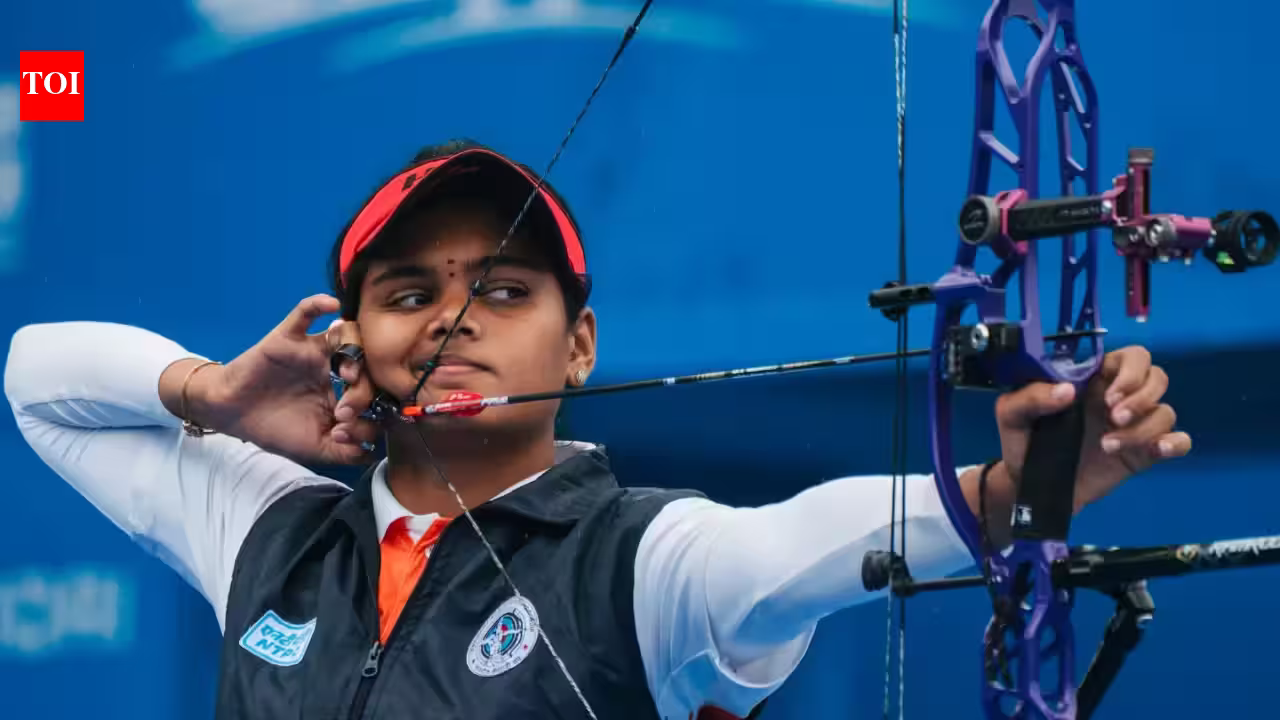
PRECISION IS the language of Jyothi Surekha Vennam. As she prepares to embark on her fourth Asian Games campaign, the ace compound archer is tuning out the noise, the historical weight of her past successes, and the external pressures of expectation. Instead, she is narrowing her world down to the few seconds of focus it takes to release an arrow.
“Right now, I am just focused on myself and on shooting my best,” Jyothi told reporters ahead of her departure for Aichi-Nagoya. “I’m not chasing results or scores. I know that if I execute my shot really well, the arrow will for sure be a 10.”
This mantra—a blend of stoic detachment and technical obsession—has become the hallmark of a career that has seen the 30-year-old become the bedrock of Indian archery. Following her historic golden sweep at the 2023 Hangzhou Games, where she secured top honors in the individual, women’s team, and mixed team events, Jyothi enters this iteration of the Games not just as a participant, but as the gold standard for Indian excellence on the continental stage.
Leading the Charge: A New Trio
The Indian archery contingent faces a transitional period, but Jyothi remains the constant. For the upcoming Games, she will spearhead a fresh-faced trio alongside Chikitha Taniparthi and Prithika Pradeep. While the composition of the team has evolved, the chemistry has been forged in the crucible of international competition, with the group having already tested their mettle during this year’s World Cup circuit.
“We are working together as a team to give great performances at the Games,” Jyothi noted. “I’m confident about the way things are going right now.”
By balancing her individual ambitions with her responsibilities as a mentor and teammate, Jyothi is looking to replicate the synergy that defined India’s compound dominance in Hangzhou. She is set to feature across all three major categories—individual, women’s team, and mixed team—meaning her output will effectively dictate the ceiling of the Indian medal haul.
The Architecture of a Champion
Preparation for the Aichi-Nagoya Games has been nothing short of military in its precision. The squad has been entrenched at the SAI Sonipat center for the second phase of their national camp, where the routine is grueling: two daily practice sessions supplemented by rigorous physical conditioning, physiotherapy, and dedicated psychological training.
Unlike many athletes who tinker with their gear under the pressure of a major event, Jyothi has opted for stability. “I haven’t made any changes to my equipment or myself,” she confirmed. Instead, her work has been internal. Supported by the Inspire Institute of Sport (IIS), Jyothi has leaned heavily into mental conditioning—utilizing visualization, meditation, and structured reading to maintain a steady heart rate under high-stakes conditions.
Her philosophy on handling the inevitable “off-days” is similarly pragmatic: check the equipment, audit the execution, acknowledge the error, and reset. It is a level of emotional intelligence that separates a contender from a champion. The team is scheduled to depart for Japan on Friday, with a ten-day training block in Kurobe City providing a crucial acclimatization period before the pressures of the Games village take hold.
The Continental Landscape
While the rivalry with South Korea—a perennial powerhouse in the sport—dominates the headlines, Jyothi remains wary of the changing landscape of Asian archery. The parity in the sport has grown, with several nations closing the gap on the traditional elite.
“The South Koreans are tough competitors, but you can’t underestimate any other Asian country,” she warned. “Everyone is doing a really great job, working hard. You have to be prepared for surprises because everyone understands the stakes.”
Those stakes are particularly high this year. With Olympic qualification implications on the line—including a vital quota linked to the mixed team compound event—the results in Aichi-Nagoya will have long-term consequences for the road to the Los Angeles Games.
Resilience Beyond the Bow
Despite her undisputed status as one of India’s most decorated athletes, Jyothi’s journey has not been without personal frustrations. She addressed the recent Khel Ratna snub with characteristic grace, admitting that while it is natural for an athlete to feel disappointment, such setbacks have no place in her professional mandate.
“I can’t let things that are personal affect the team as a whole,” she said, effectively closing the door on the narrative.
For Jyothi Surekha Vennam, the only thing that matters is the target. As she stands on the line in Japan, the noise of the outside world will fall away. There will be no focus on past medals, no fixation on administrative recognition, and no anxiety regarding the scoreboard. There will only be the draw, the aim, and the unwavering belief that if the process is perfect, the result will inevitably follow. In her world, the arrow belongs in the center—and she intends to put it there.
Disclaimer: This content is auto-generated for informational purposes only.
Source: Read Original News