








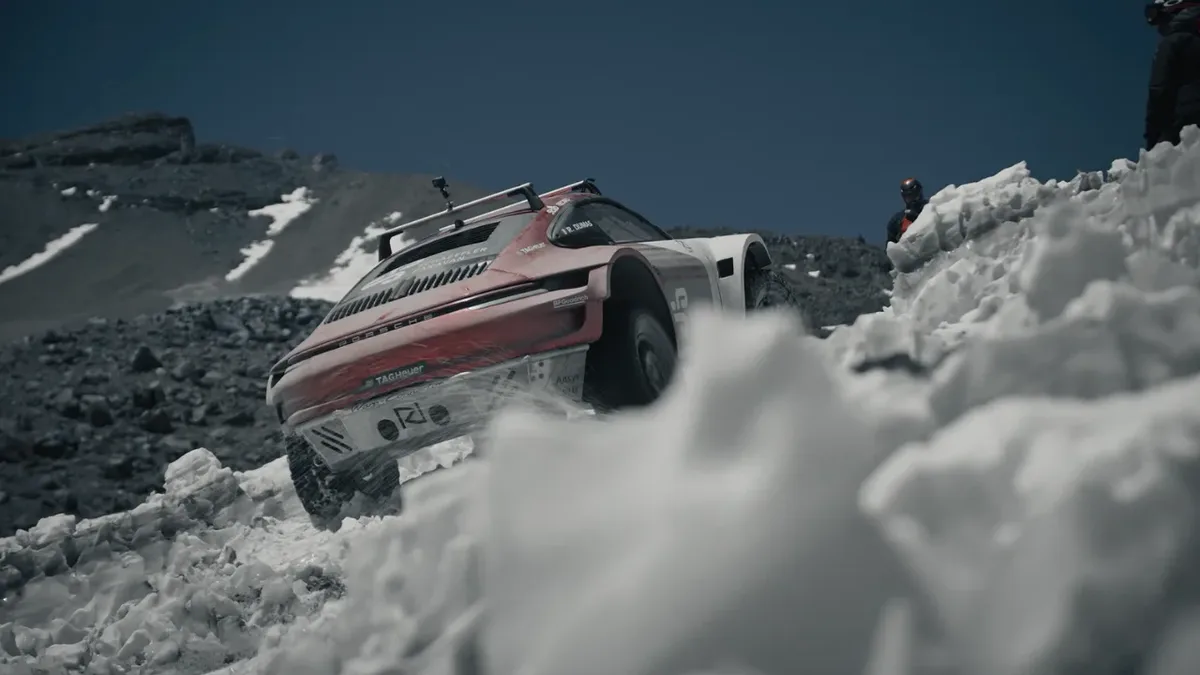
The automotive world has long associated the Porsche 911 with precision track performance and high-speed highway handling. However, a recent engineering endeavor has pushed the boundaries of this iconic platform to a literal record-breaking peak. By navigating the unforgiving terrain of Ojos del Salado in the Chilean Andes, a modified 911 reached an altitude of 22,093 feet, establishing a new world record for the highest altitude achieved by a motor vehicle. This feat, documented in the film Edith: Porsche’s Volcano Ascent, highlights the intersection of luxury sports car engineering and extreme-environment survival.
Engineering a High-Altitude Challenger
The project centered on two specialized vehicles, nicknamed Edith and Doris. Based on the Porsche 911 Carrera 4S, the core of the vehicle remained surprisingly familiar. Engineers retained the 3.0-liter twin-turbocharged flat-six engine, which produces 450 horsepower in standard trim. Keeping the engine architecture largely intact served a dual purpose: it demonstrated the inherent reliability of the flat-six platform while proving that stock-derived power units could function in environments where the air density is roughly 50 percent of that found at sea level.
To handle the extreme demands of the volcano, the vehicles underwent significant modifications. The most critical upgrade was the implementation of a portal axle system, which provided the necessary ground clearance to traverse large boulders and treacherous volcanic debris. The team also equipped the cars with massive off-road tires and a revised cooling system capable of operating under the extreme load of crawling up steep, high-altitude slopes. Despite these heavy-duty additions, the team focused on weight reduction to ensure the car did not sink into soft scree or snow, maintaining a nimble power-to-weight ratio suitable for delicate mountain climbing.
The Environmental Challenges of Ojos del Salado
Ojos del Salado is not merely a mountain; it is the highest volcano on Earth and a site of extreme physiological and mechanical stress. Operating at elevations exceeding 20,000 feet presents significant hurdles for internal combustion engines, which require consistent oxygen intake to maintain combustion. As the altitude increases, the lower oxygen content threatens to choke the engine, leading to power loss.
Beyond the engine requirements, the terrain itself is hostile to traditional machinery. The team faced constant exposure to sub-zero temperatures, which can jeopardize battery life, fluid viscosity, and mechanical flexibility. The combination of loose, shifting volcanic rock and ice-covered ridges created a surface where traction was never guaranteed. Furthermore, the driver, Romain Dumas—a seasoned Le Mans winner—had to contend with the physical effects of hypoxia, as even the slightest physical exertion at such heights is vastly more taxing than at sea level.
Strategic Evolution from 2022 to 2023
The record-setting ascent was not a singular event but the culmination of years of iterative testing. During the initial 2022 expedition, the team reached 19,708 feet before encountering impenetrable snow and ice. This initial failure was instrumental, providing the engineers with crucial data on how the vehicle performed in real-world high-altitude conditions.
Returning in 2023, the team brought refined equipment and a more tactical approach to the climb. The final push, occurring in the early morning hours of December 2, required precision driving to navigate narrow ridges. Dumas had to manage torque delivery carefully; applying too much power on loose surfaces would cause wheel spin, while too little would leave the car stranded on the steep 45-degree slopes. By successfully reaching 22,093 feet, the team surpassed the previous record of 6,694 meters, validating their mechanical modifications and confirming the structural integrity of the 911 chassis under immense vertical stress.
Impact on Automotive Technology and Design
The ascent of Ojos del Salado serves as more than just a marketing stunt. It functions as a rigorous testbed for systems that can be integrated into future automotive development. By forcing a high-performance engine to operate in oxygen-depleted, freezing, and high-load environments, Porsche gathered data on thermal management, sensor calibration, and drivetrain durability.
The use of a manual transmission in the record-breaking vehicle also speaks to the importance of driver control in off-road environments. In scenarios where computer-assisted gear shifts might misinterpret the terrain or altitude, the ability for a professional driver to select specific gears allowed for the precise throttle control needed to maintain momentum on volcanic scree. This project proves that the fundamental architecture of the 911—rear-engine weight distribution and balanced handling—can be adapted into a legitimate cross-country explorer.
Reflections on the Expedition Documentary
The resulting documentary, Edith: Porsche’s Volcano Ascent, serves as a comprehensive archive of the technical and physical challenges of the mission. Winning the Best Documentary Feature at the 2024 International Motor Film Awards, the production captures the reality of an engineering team trying to break physics-based limits. It showcases the collaborative effort between the drivers, mechanics, and logistics experts required to move a 911 from the factory floor to the summit of the world’s highest volcano.
Ultimately, this project stands as a testament to the adaptability of modern vehicle platforms. While the 911 is fundamentally a creature of the asphalt, the ability of the Edith team to repurpose its core components highlights the endurance and versatility baked into the design. Whether it is tearing around a racetrack or traversing a frozen volcanic ridge, the spirit of this machine remains rooted in its ability to handle immense pressure while maintaining technical precision.
Disclaimer: This content is auto-generated for informational purposes only.
Source: Read Original News