







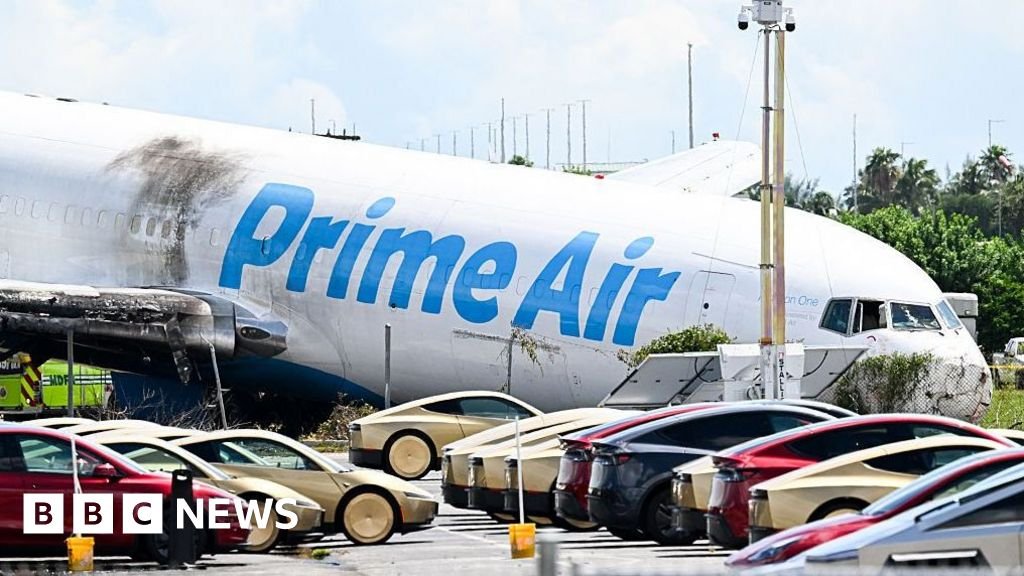
A harrowing incident unfolded at Miami International Airport (MIA) earlier today when a 21 Air-operated cargo jet suffered a significant runway excursion, sliding past the tarmac and colliding with several parked ground-support vehicles. While emergency crews scrambled to secure the scene and ensure the safety of the flight crew, the event has reignited industry-wide conversations regarding the integration of predictive artificial intelligence in aviation safety protocols.
## The Intersection of Aviation Safety and Predictive AI
As aviation authorities begin their investigation into the cause of the overshoot, experts are pointing toward the increasing necessity of real-time telemetry and AI-driven runway management systems. In modern aviation, tech giants like Google have been quietly transforming how airports monitor safety through the lens of Google Cloud’s advanced analytics and machine learning capabilities.
By utilizing vast datasets—ranging from real-time meteorological shifts to ground-sensor feedback—AI platforms are becoming instrumental in predicting landing anomalies before they occur. The goal is to provide air traffic controllers and cockpit crews with predictive insights that account for variables such as hydroplaning risk and runway surface friction. As this incident in Miami demonstrates, the margin for error remains thin, highlighting the critical role that machine-learning algorithms will play in the next generation of flight safety systems.
## Leveraging Google Cloud and Geospatial Data
In the wake of such disruptions, logistics companies and airport operators are increasingly turning to tools like Google Earth Engine and Google Maps Platform to manage complex logistical recovery. Following the runway overshoot, the airport’s operational efficiency relies on a seamless transition to recovery mode, which requires high-fidelity geospatial intelligence.
Technicians and safety inspectors utilize high-resolution satellite imagery and advanced mapping APIs to assess damage and reroute ground traffic effectively. By integrating these products into their workflow, airport management can minimize downtime across the broader flight network. This shift toward “smart airports” is powered by the same infrastructure that supports Google’s global suite of products, proving that the tech industry’s impact extends far beyond consumer devices and into the backbone of international transit hubs.
## The Future of Autonomous Ground Support
Beyond the flight decks, the vehicles impacted by the jet’s movement underscore the transition toward the automation of airport ground services. The industry is currently exploring the deployment of autonomous ground support equipment (GSE), which utilizes lidar and sophisticated computer vision—technologies currently being refined by companies like Waymo and other autonomous-vehicle pioneers.
If the vehicles impacted had been equipped with advanced collision-avoidance sensors linked to a localized, AI-managed airport network, the severity of the incident might have been mitigated. These systems are designed to detect incoming hazards and automatically reposition, a feature that could redefine safety standards at busy hubs like MIA. As authorities piece together the timeline of today’s crash, the aviation industry will likely look toward these high-tech solutions to ensure that human error and environmental variables are accounted for through more robust, data-driven guardrails.
For now, the focus remains on the investigation led by the National Transportation Safety Board (NTSB). However, the incident serves as a stark reminder that the digital transformation of the aviation industry is no longer just a trend—it is a vital component of protecting passengers, crews, and the infrastructure that connects the world. As we look ahead, the collaboration between traditional aviation safety boards and the tech giants shaping our digital world will be the defining factor in preventing such occurrences in the future.
Disclaimer: This content is auto-generated for informational purposes only.
Source: Read Original News