



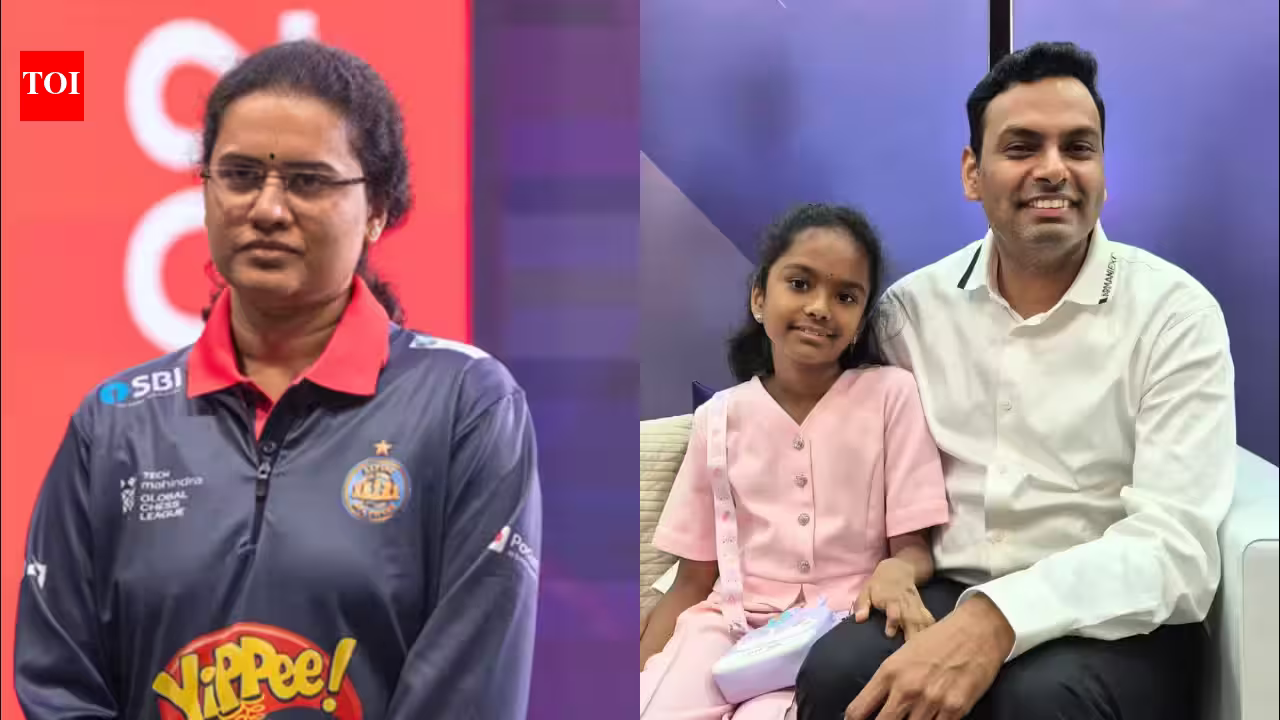
BENGALURU: While the high-stakes tension of the Global Chess League (GCL) final reached its zenith at the Lalit Ashok on Sunday, the most poignant narrative unfolding in the arena had little to do with the complex tactical maneuvers occurring on the board. For Koneru Humpy, the legendary Indian grandmaster, the day was defined by the relentless pressure of professional competition. But for her nine-year-old daughter, Ahana, it was a landmark occasion—a day when the abstract concept of “Mom’s work” finally transformed into a tangible, awe-inspiring reality.
As the APL Pipers prepared to lock horns with the Ganges Grandmasters for the prestigious GCL title, Ahana stood in the VIP lounge, visibly restless. Surrounded by the quiet hum of professional analysis, she wasn’t interested in the tournament standings or the tactical nuances. She was nudging her father, Dasari Anvesh, for something far more simple: she wanted to be closer to the stage to see her mother play a competitive game of chess in person for the first time.
### A First for the Daughter, A Routine for the Master
For Anvesh, who has navigated the complexities of being married to one of the world’s most decorated chess players for over a decade, this was a rare “first.” While he has accompanied Humpy to international events, including tournaments as far away as Russia, the sheer logistics of top-level chess often necessitate a physical distance between the player and the family.
“This is our first edition of the GCL,” Anvesh said, observing the electric atmosphere of the final. “It’s very exciting times. We’re visiting physically, and the good thing is Humpy’s team is in the final.”
When asked if the nine-year-old had a pre-match message for her mother, the immense gravity of the moment seemed to settle in. Ahana was shy—perhaps grappling with the realization that the woman on the stage, deep in intense concentration, was the same person who guided her through her daily life at home. It is a distinction that has defined the Humpy-Anvesh household since their marriage in 2014, and especially since Ahana’s birth in 2017.
### Navigating the Delicate Balance of Elite Sport
The career of a world-class athlete is rarely a straight line, and Humpy’s journey has been marked by difficult, values-based decisions. Earlier this year, the chess world took note when Humpy withdrew from the Women’s Candidates in Cyprus. At the time, the tournament served as the ultimate hurdle for a shot at the World Championship. Citing safety concerns amidst escalating tensions in the Middle East, Humpy chose to prioritize her well-being and her family.
“It was a collective family decision,” Anvesh revealed. “The time was not right. Whenever she wants to play any game, we always support her wherever she wants to go. But at that time, we all felt safety comes first, and we took that decision collectively, even though it was very challenging.”
This prioritization of family, according to Anvesh, is the secret to Humpy’s longevity in a sport that demands total mental consumption. He notes that while Humpy possesses an unparalleled, singular focus when a tournament is underway, she achieves a “clean break” the moment she steps away from the board.
“She is able to balance both sport and family,” he noted. “As a mother, as a wife, she’s giving her hundred percent. Family comes first, and then sport. Her passion for chess always drives her, and it’s nice to see her balancing it so well.”
Anvesh was characteristically humble regarding his own role in her success, deflecting any technical credit. “I’m not a chess player. My father-in-law is the main coach who has trained Humpy; all credit goes to him. I was the only one staying calm and offering emotional support.”
### The Duality of the Podium
The final itself proved to be a bittersweet affair for the Pipers. In a decisive match that tilted the scales in favor of the Ganges Grandmasters, Stavroula Tsolakidou, playing with the black pieces, managed to outmaneuver Humpy, securing the title and leaving the Pipers with silver.
At the medal ceremony, the contrast between mother and daughter could not have been more stark. For Humpy, an athlete with nearly three decades of high-level competition under her belt, a second-place finish registers as a disappointment—another “near-miss” in a career defined by the pursuit of perfection. Her expression reflected the cold, hard reality of professional defeat.
Yet, from the front row, Ahana’s perspective was untainted by the outcome. As her mother stood on the podium to receive the silver medal, the nine-year-old didn’t see a loss. She saw her mother being celebrated on a grand stage. As the medal was placed around Humpy’s neck, Ahana clapped with such unbridled, infectious joy that she nearly lost her balance.
For the young girl, the medal wasn’t silver—it was a symbol of her mother’s hard work, a tangible prize from a world she had finally been granted a glimpse into. As they exited the venue, Humpy remained deep in thought, processing the result of the match. Ahana, however, walked out with a beaming smile, clutching her father’s hand—a reminder that in the eyes of a child, the real victory is simply having a front-row seat to their hero’s efforts.
Disclaimer: This content is auto-generated for informational purposes only.
Source: Read Original News