





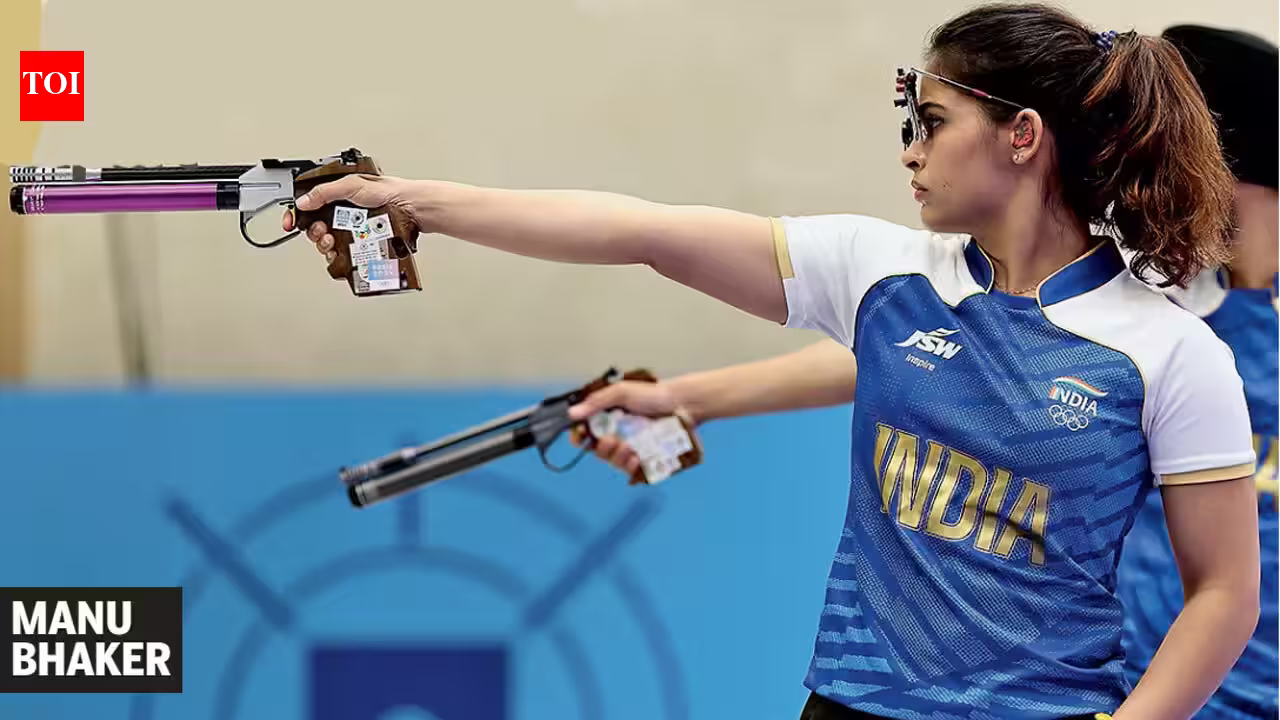
PUNE: There is an intangible quality that defines Manu Bhaker. Beyond the accolades of being a double Olympic medallist, a former world No. 1, and a fixture on World Championship podiums, the 24-year-old possesses a relentless, iron-willed competitive fire that burns brightest when the pressure is at its peak. While she has undoubtedly silenced the doubters who questioned her trajectory early in her career, the Haryana-born sharpshooter is currently zeroed in on the one missing piece of her storied puzzle: an individual medal at the Asian Games.
The Missing Jewel in the Crown
For a shooter of Bhaker’s caliber, the Asian Games remain an anomaly. Despite her dominance on the global stage, her appearances at the 2018 Jakarta Games and the 2023 Hangzhou edition ended in fifth and sixth-place finishes, respectively. In Hangzhou, her focus was narrowed exclusively to the 25m pistol, but as she sets her sights on Aichi-Nagoya, the landscape of her ambition has shifted.
Bhaker is returning to a dual-event focus, competing in both the 10m air pistol and the 25m pistol. Over the years, observers have struggled to pin down her true specialty—a testament to an evolution that has seen her reach elite status in both disciplines. Whether it is the precision of the 10m range or the rapid-fire intensity of the 25m circuit, Bhaker approaches both with a singular, terrifying focus.
The Philosophy of Longevity
Behind the scenes, her Serbian coach, Jelena Arunovic, offers a perspective that transcends simple medal tallies. Having guided her own sister, Zorana, to gold at the Paris 2024 Olympics, Arunovic is well-versed in what makes a champion. Her assessment of Bhaker is rooted in the concept of sustainability.
“I think an athlete is defined not just by achievements, but also by longevity,” Arunovic told reporters. “If someone has been competing at the highest level for almost 10 years, regularly reaching finals and standing on international podiums, I don’t think there is a better résumé than that.”
After spending six months embedded with the Indian squad, observing the daily rigors of the range, Arunovic has gained a profound understanding of the “Manu psyche.” Despite enduring immense personal turbulence recently—including the sudden passing of her mentor Jaspal Rana in June and the loss of her grandmother just last week—Bhaker has remained a model of composure. According to her coach, this stems from a rare breed of mental fortitude.
“Technically, she has a very strong foundation,” Arunovic noted. “Mentally and temperament-wise, she is a fighter. She wants to improve, she asks questions, she thinks about what she is doing, and she is willing to work even when something is difficult or uncomfortable.”
The Culture of Work: India vs. The World
Perhaps the most striking revelation from the Serbian coach is the high regard in which Indian shooting is held on the global circuit. While the sporting world often highlights the training volume of Chinese athletes, Arunovic suggests that the Indian contingent has surpassed them in sheer grit.
“There is a common belief in shooting that Chinese and Indian athletes train more than anyone else,” Arunovic observed. “I have now worked in both countries, and I can say that, in my experience, Indians work more than the Chinese. Manu is definitely part of that culture of hard work.”
She added that international rivals are acutely aware of the threat Bhaker poses. “I think people in India may sometimes underestimate how much respect Indian shooters have abroad. At international competitions, everyone knows who they are and what they are capable of.”
The Drive Within
Arunovic attributes much of Bhaker’s sustained success to her “internal motivation.” While external rewards—applause, fame, or sponsorship—can fluctuate, Bhaker is driven by a desire for self-improvement that exists independent of public perception.
“When external motivation disappears, everything can stop, but an athlete who genuinely wants to be the best does not adjust according to whether people applaud, support, or doubt them,” the coach explained. “Athletes with strong internal motivation are their own biggest critics. They constantly look for what can be better. Manu is a perfect example of that.”
As the Aichi-Nagoya Asian Games approach, the pressure will be immense. Bhaker will not only be shouldering her own individual aspirations but will also anchor the Indian squad in team events. She is set to pair with Suruchi Phogat and Esha Singh for the 10m air pistol, and with veterans Rahi Sarnobat and Esha for the 25m pistol.
With her eyes fixed on the target and a proven track record of overcoming both personal grief and technical hurdles, Manu Bhaker enters the arena not just as a competitor, but as a titan of the sport, seeking to close the final chapter of her Asian Games narrative. If history is any indication, she won’t leave the range until she has given everything she has—and perhaps, finally, that missing gold.
Disclaimer: This content is auto-generated for informational purposes only.
Source: Read Original News