

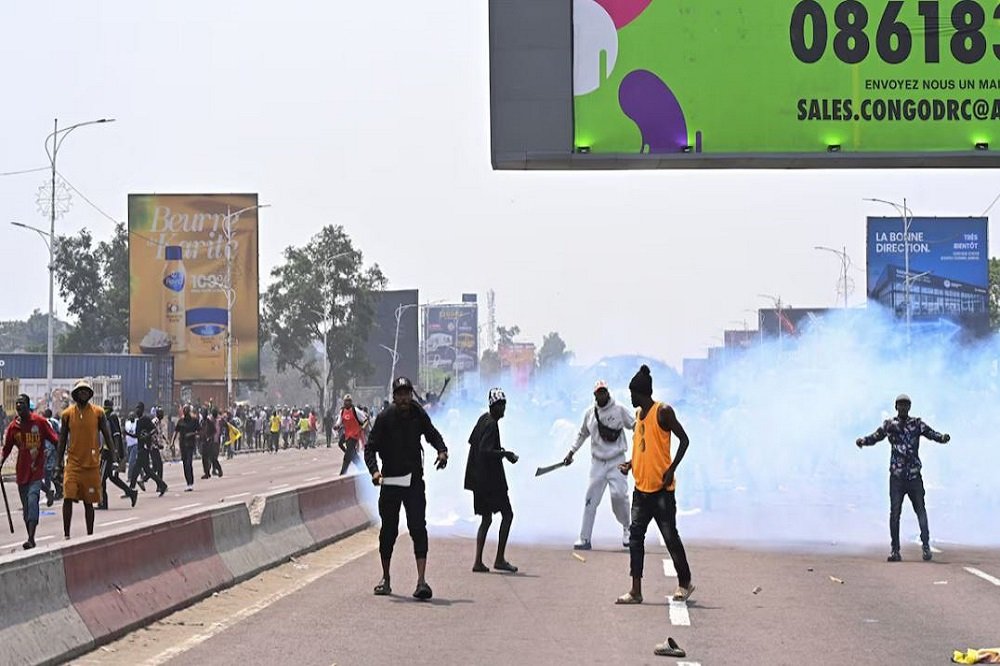
KINSHASA — Security forces in the Democratic Republic of Congo (DRC) launched a forceful crackdown on Tuesday, deploying tear gas and firing warning shots to disperse nationwide protests against proposed constitutional changes. The demonstrations, organized by the opposition C64 coalition, were fueled by fears that President Felix Tshisekedi intends to alter the country’s legal framework to seek a controversial third term in office.
In the capital, Kinshasa, where the protest had received official authorization, scenes of relative calm quickly devolved into chaos. Witnesses reported that clashes erupted between opposition demonstrators and pro-government supporters, with both sides trading stone-throwing attacks and brandishing machetes. Police intervened shortly after the violence broke out, utilizing tear gas to scatter the crowds.
The unrest extended far beyond the capital. In the cities of Lubumbashi and Uvira, local authorities had banned the protests entirely. Despite these prohibitions, opposition supporters took to the streets in defiance, only to be swiftly dispersed by security personnel.
The C64 coalition, which includes prominent political figures such as Martin Fayulu, Moise Katumbi, and Delly Sesanga, has become the primary vehicle for resistance against the current administration’s agenda. Tuesday’s events mirror a similar crackdown in June, when another C64-organized rally in Kinshasa was met with heavy-handed police tactics.
At the heart of the tension is the DRC’s constitution, which strictly limits presidents to two five-year terms. However, momentum has been building within President Tshisekedi’s ruling coalition to amend these rules. In June, Parliament took a significant step by passing a bill that clears the path for constitutional changes to be submitted to a national referendum. Supporters of the President argue that reform is necessary, but critics view it as a thinly veiled attempt to entrench Tshisekedi’s power indefinitely.
The protests arrive at a volatile moment, just three weeks after the President announced a plan for a “national dialogue.” Tshisekedi has pitched this initiative as a necessary forum to unite opposition parties, religious leaders, and civil society to address the country’s deepening political and security challenges. Notably, the proposed dialogue excludes the various rebel groups currently controlling vast swathes of the eastern DRC, further complicating the country’s stability.
The initiative has faced immediate blowback. Powerful institutions, including the Catholic Church—a significant moral force in Congolese politics—have joined opposition leaders in condemning the proposed constitutional shifts.
As the government pushes ahead with its legislative agenda, the recurring scenes of violence in major cities suggest a deepening divide. With the specter of a constitutional referendum looming, the streets of Kinshasa, Lubumbashi, and Uvira remain a barometer for the growing political volatility gripping the nation, as the opposition vows to continue its fight against what they characterize as an erosion of democratic term limits.
Disclaimer: This content is auto-generated for informational purposes only.
Source: Read Original News