







The Evolution of Capcom’s RE ENGINE on Portable Hardware
The gaming industry is witnessing a significant technical milestone as Capcom brings its acclaimed Resident Evil remakes to the upcoming Nintendo Switch 2. Following the official announcement during the recent Nintendo Direct, footage has emerged showcasing Resident Evil 2, 3, and 4 running directly on the new hardware. This transition is powered by the RE ENGINE, Capcom’s proprietary development environment designed to provide high-fidelity visuals and fluid performance across a wide spectrum of devices.
The RE ENGINE has long been lauded for its ability to handle complex lighting models, high-resolution textures, and intricate character animations. Bringing these remakes to a portable platform represents a leap in mobile hardware capabilities. By leveraging the updated processing power and efficient architecture of the Switch 2, these titles maintain their distinct visual identity—characterized by atmospheric horror and claustrophobic environments—without compromising the pacing or technical depth of the original console versions.
Technical Performance and Handheld Fidelity
Early impressions derived from 30 minutes of handheld gameplay reveal a stable and visually impressive experience. The footage demonstrates that the Switch 2 is capable of rendering the dense, particle-filled environments of Raccoon City and the sprawling, varied landscapes of the rural village in Resident Evil 4 with commendable consistency. While the current demonstrations focus exclusively on the handheld experience, the scalability of the RE ENGINE suggests that the system will likely utilize dynamic resolution scaling and optimized draw distances to maintain frame rate stability during high-intensity sequences.
The use of modern lighting techniques, such as volumetric fog and real-time shadow casting, remains a core component of the horror experience. In the provided gameplay, the player’s flashlight serves as a critical tool, cutting through darkness to reveal detailed character models and environmental decay. The ability for portable hardware to handle these lighting effects in real-time without significant artifacts is a testament to the hardware’s enhanced GPU capabilities and the efficiency of the software port.
Strategic Importance of the Resident Evil Catalog
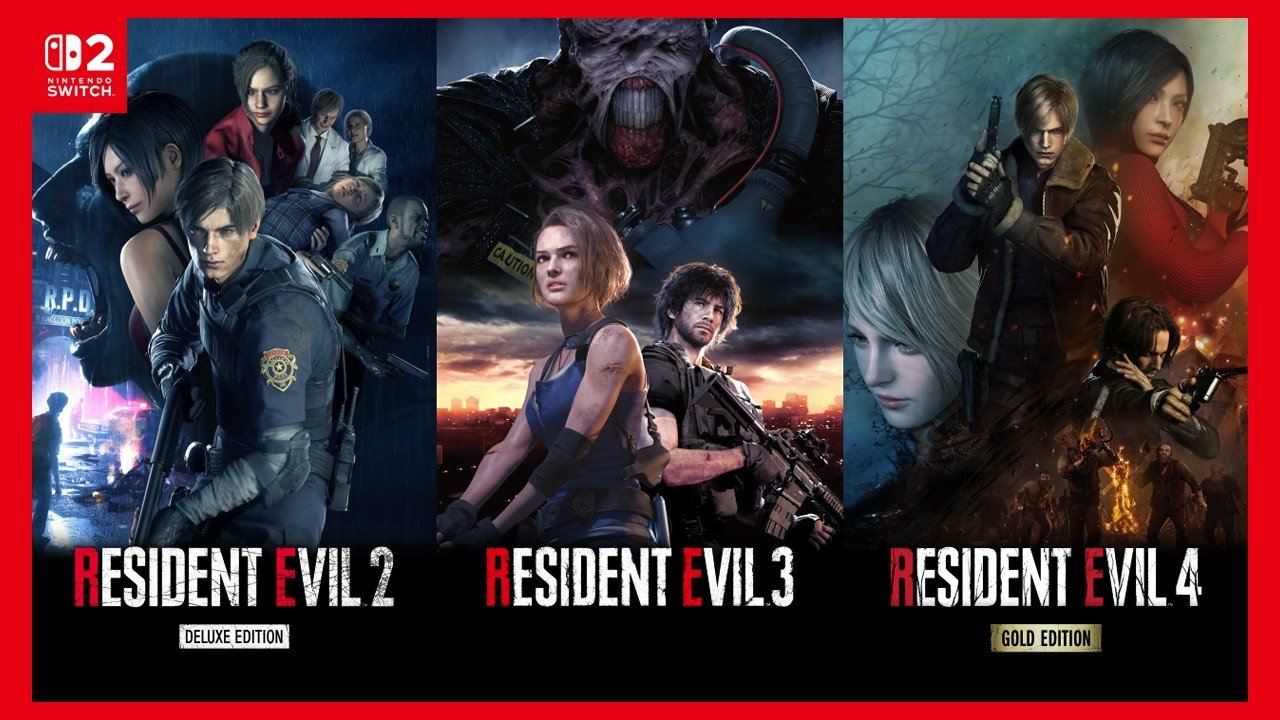
The addition of Resident Evil 2, 3, and 4 to the Nintendo Switch 2 library is a strategic move that completes the mainline presence of the franchise on the platform. With the inclusion of these titles, alongside Resident Evil Requiem and the upcoming Resident Evil Veronica, the Nintendo ecosystem now hosts the entirety of the modern Resident Evil timeline. This consolidation provides a comprehensive entry point for new users while allowing long-term fans to experience the evolution of the series in a portable format.
Resident Evil 2 Deluxe Edition and Resident Evil 4 Gold Edition arrive with all associated supplemental content. This includes expanded character scenarios, additional difficulty modes, and various costume sets that were previously reserved for higher-end consoles or PC setups. By ensuring that the Switch 2 versions contain the full suite of released material, Capcom avoids the “watered-down” perception often associated with historical mobile ports, instead offering a definitive edition that mirrors the content availability found elsewhere.
Modernizing Survival Horror Mechanics
Each title represents a distinct approach to the survival horror genre, now unified under the modernized gameplay framework of the RE ENGINE. Resident Evil 2 focuses on resource management and navigating the intricate layout of the Raccoon City Police Department, utilizing a third-person over-the-shoulder perspective that heightens tension. Resident Evil 3 leans into a more kinetic, action-oriented narrative, following Jill Valentine as she escapes the relentless pursuit of the Nemesis, requiring quick reflexes and tactical spatial awareness.
Resident Evil 4, a seminal work in the action-horror subgenre, balances high-stakes combat with a sophisticated inventory management system. The portability of the Switch 2 serves these mechanics well, allowing players to perform inventory organization—a frequent task in the series—on the go. The control schemes have been adapted to accommodate the hardware’s input architecture, ensuring that the precision aiming and melee interactions required for these titles remain responsive and intuitive during mobile play.
The Impact of Enhanced Hardware on Portability
The jump from the original Nintendo Switch hardware to the Switch 2 architecture changes the landscape for cross-platform development. Historically, technical limitations required developers to significantly reduce graphical fidelity or implement cloud-streaming to bring modern AAA games to portable consoles. The footage of these Resident Evil titles indicates that native execution is now the standard for high-end experiences on the system.
By relying on native hardware acceleration rather than streaming, players benefit from reduced input latency and the ability to play without a persistent, high-speed internet connection. This is essential for the horror genre, where timing and environmental feedback are integral to player immersion. The successful porting of these three remakes highlights the flexibility of the Switch 2, positioning it as a viable machine for both indie projects and resource-heavy, high-definition blockbusters. As the October 16, 2026, release date approaches, the industry will be watching to see how the docked performance further elevates the visual fidelity of these iconic horror adventures.
Disclaimer: This content is auto-generated for informational purposes only.
Source: Read Original News